

After I retired, I spent 2022 studying the big trends that will define the 2030s and 2040s. Three of them, AI, tokenisation and geopolitical change, have shaped where I have spent my time ever since, and have been the subject of many of my previous frameworks and writing.
But the number one trend I identified back then was none of those. It was the impact of climate on the world: the potential for harm to humanity on a massive scale, and what it will take to prevent, mitigate and manage it.
So when I created Asgard News in 2026, and got access to practically every news article from every source globally, I wanted to take stock of where we actually are on that journey, working from worldwide news and data rather than rhetoric.
This piece is the result: a detailed summary of what is happening, and how I now think about it. As Europe burns and the heatwaves keep coming, it has never been more important to understand what is really going on and what we can do about it, cutting through the propaganda on both sides and making up our own minds. This article is a companion piece to the Bright Side Podcast on Asgard News. A copy of the audio from the podcast is here:
This summer, wildfires forced mass evacuations across Europe and America. They tore through the south of France, Spain, Belgium, Canada and Greece. Around 40,000 people were cleared from the Arcachon and Cap-Ferret coast near Bordeaux in a single day, some taken off the peninsula by boat, and the wider fires across southwest France displaced more than 200,000 residents and holidaymakers over the summer. (Al Jazeera) And it kept happening: in mid-August, fires hit tourist regions again across France, Spain, Greece, Croatia and beyond. (Reuters)
A few years ago, if you said “wildfire,” you pictured California or Australia. That was where it happened. This summer, wildfires burned across the south of France, across Spain, Greece, Germany, and even here in Britain.
France recorded its hottest day ever, about 46 degrees. Spain came close to 47. Britain hit 38.1 degrees, the hottest August day since 2003 and one of the five hottest days ever recorded here, in the fifth heatwave of the season. (PBS News) July 2026 tied for the hottest month ever recorded on Earth, and about 900 million people just lived through their hottest July on record. (Yale Climate Connections, NOAA NCEI, World Weather Attribution)
That is the frightening first half of this story - but there is a hopeful second half that is badly under-reported and under-understood.
The main thing that needed to change has already changed: clean power got cheaper than fossil power. And we now have positive commercial incentives that drive behaviour that can help us save the planet.
Humanity is starting to address the problem, with a huge amount of work, technology and money now going into it, and real signs of solutions at scale. The job now is speed and scale.
This article aims to go back to first principles to examine the problem and the solutions.
The real killer is the heat
The fires make the news, but the heat behind them is what kills, and it does so out of sight. When a frail person dies in a heatwave, the death certificate usually records heart failure or a lung problem, not “heat.” So the real toll is not counted at the time; it is worked out months later, by comparing how many people died with how many normally would have.
By that measure the late-June heatwave alone killed more than 10,000 people across Europe in a single week, most of them over 65. (CBC) By early August, Europe’s heat toll for the summer had passed 25,000. (Bloomberg) Germany alone was near 12,000 by mid-summer, already more than any full year since its records began. (Clean Energy Wire) Britain’s May and June heatwaves are linked to around 2,700 deaths. (resilience.org) For scale, the summer of 2022 killed more than 60,000 people across Europe on the same excess-death measure. (NBC News)
This is not only a European problem, and it is not only a poor-country problem. In the United States, officially recorded heat deaths more than doubled between 1999 and 2023, from about 1,070 to about 2,325 a year, and since 2016 the death rate has climbed roughly 17% a year. The researchers warned that even these figures undercount the real toll, for the same reason: heat gets recorded as the heart attack or kidney failure it triggers. (JAMA, Annals of Internal Medicine)
Heat is already a major cause of death, this summer and in large numbers, not just a risk for the future.
Why one degree is a catastrophe
The planet has warmed by a bit more than one degree since we started burning coal and oil. One degree sounds like nothing. If your room warmed by a single degree you would not even take your jumper off.
The catch is that this is an average, across the whole planet, the entire ocean and all the air, all year round. It takes a staggering amount of extra energy to warm something that vast by a whole degree, and that energy is now in the system. It does not spread out gently. It piles up. You get patches of ocean running three, four, five degrees hotter than normal for a whole summer.
A patch of hot ocean drives the wild weather in two ways. Warm water shifts the ocean currents, which act like the planet’s central heating, moving heat around the globe. And warm water evaporates faster, loading the air above it with moisture.
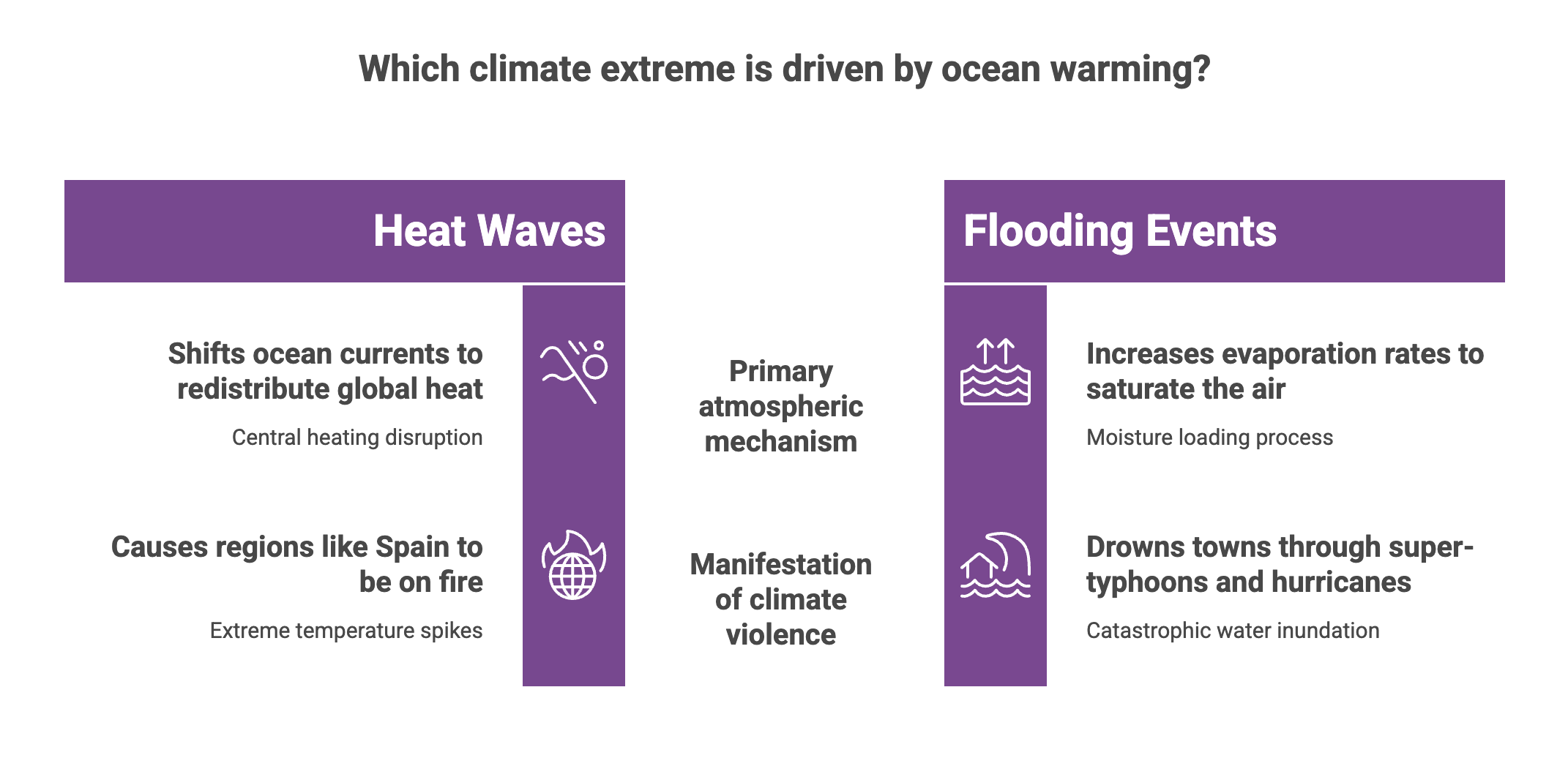
That warm, wet air is the fuel for the giant storms, the super-typhoons and hurricanes that now come off the coasts of the US and East Asia almost on a schedule. So the same one degree that has Spain on fire is also what drowns towns in floods on the other side of the world. Heat and flood are the same story. The whole system gets more violent, in both directions. (IPCC AR6 WG1)
The change in climate will impact you
It is easy to think this is other people’s weather. It is not. About 4 in 10 people on Earth live within 100 kilometres of a coast, and more than a billion live within 10 kilometres of the sea. (The Conversation) Most of the big cities that run the world economy are port cities, built right at the water, because that is where the trade was.
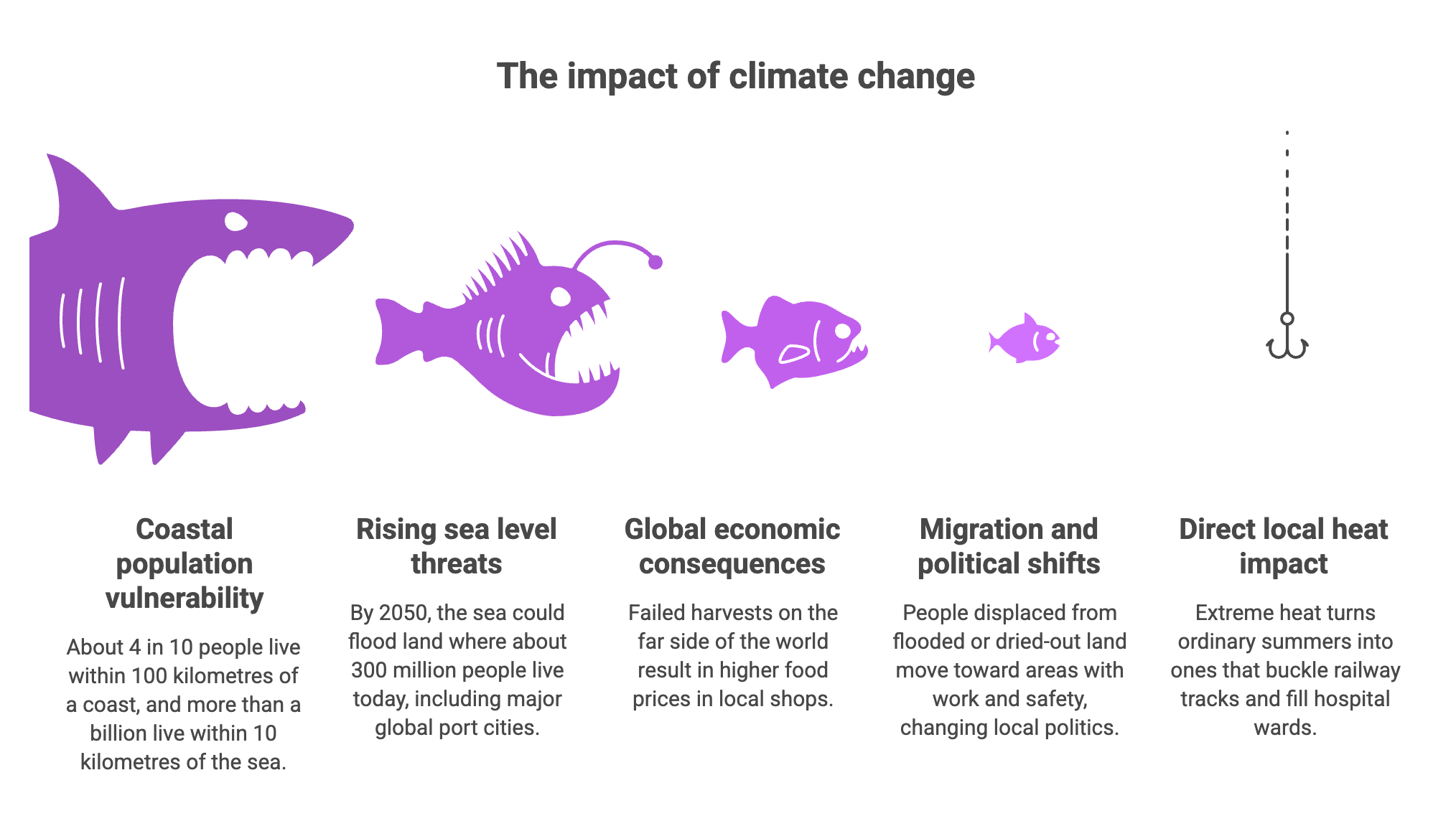
Climate Central mapped what rising seas do to that. On current trends, by 2050 the sea could flood land where about 300 million people live today. Two-thirds of them are in China, Bangladesh, India, Vietnam, Indonesia and Thailand. Shanghai, Mumbai, Dhaka, Bangkok, Ho Chi Minh City and Osaka are all on the list. (Climate Central) The rich world is on the same map. About 25% of the Netherlands already sits below sea level, dry only thanks to pumps and walls. (CNN) London stays dry behind the Thames Barrier, built for a world meant to last until about 2030. (Carbon Brief)
You do not need to live by the sea for it to reach you. A failed harvest on the far side of the world shows up as a higher price in your shop, because food is traded globally. People pushed off flooded or dried-out land do not vanish. They move, first to the nearest city, then towards wherever there is work and safety, and that changes the politics of the places they land in. And the heat reaches everyone, turning ordinary summers into ones that buckle railway tracks and fill hospital wards.
So the answer to “what does climate change mean for me” has changed. It used to mean polar bears and some far-off year like 2100. Now it means the price of food, the summer your town runs out of shade, and which climate migrant your government lets across the border.
The four-year clock
Here is the maths. We can still put about 170 billion more tonnes of carbon into the air and keep a 50/50 chance of staying under 1.5 degrees of warming. We add about 40 billion tonnes a year. So that budget runs out in roughly four years, and emissions are still rising. (Global Carbon Project) Four years is this decade, not a problem for the grandchildren.
Some scientists think we have already used this headroom up. 2024 was the first full year the planet ran hotter than 1.5 degrees, and the three years to 2025 were the hottest ever measured. (WMO, Copernicus) 1.5 degrees is the level the world signed up to in the Paris agreement in 2015. It is not a hard line with safety on one side and doom on the other, but below it the damage is bad and survivable, while above it more things unravel in ways we cannot predict fully or undo. (UNFCCC)
We tend to picture the climate like a heater. Turn it up, and if the room gets too hot you turn it back down and it cools. Most of the climate works like that.
But a few parts work like a switch, not a dial. Push them past a point and they carry on changing by themselves, even after we stop, and you cannot switch them back. Much of this is a one-way door to disaster. (Science)
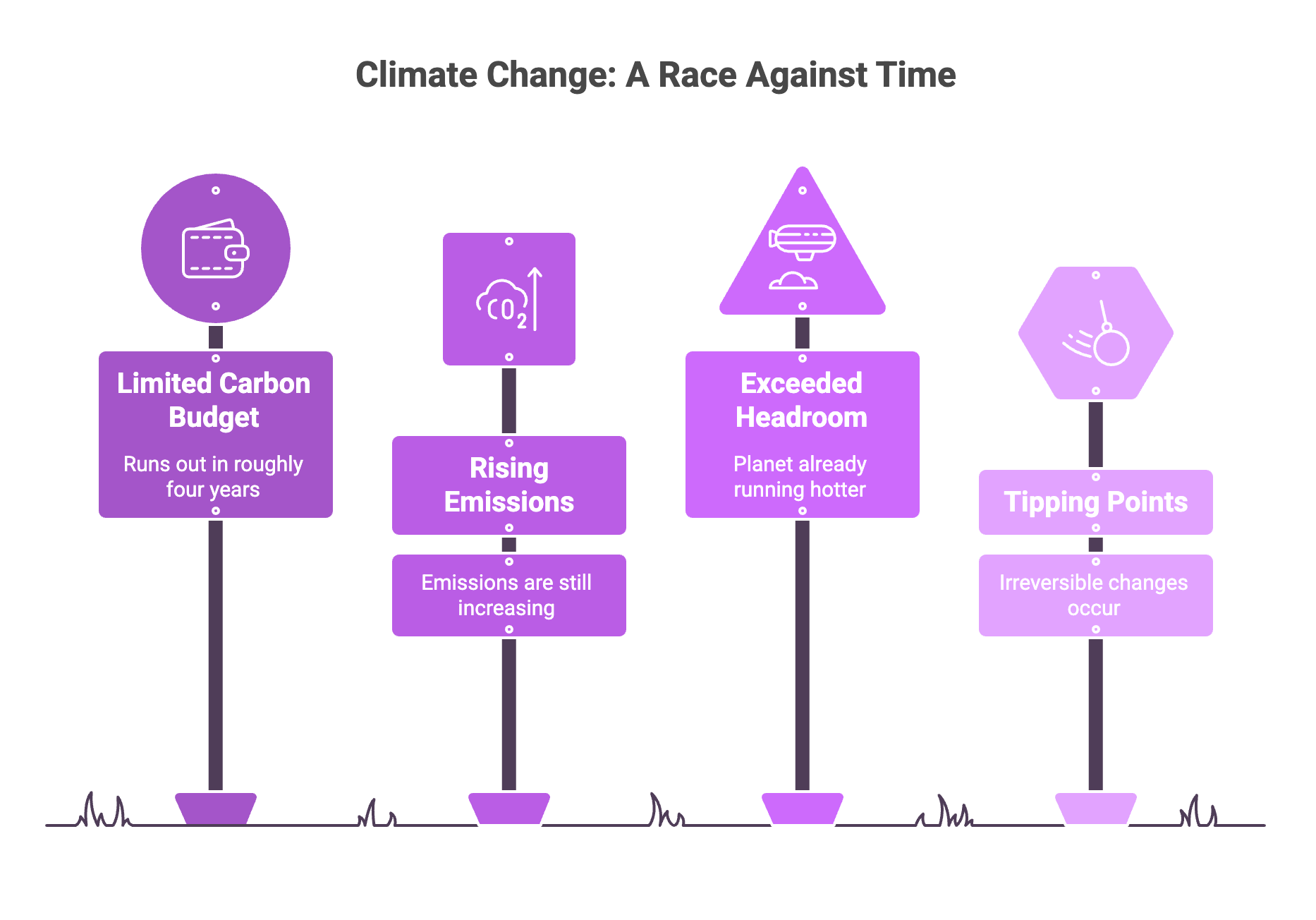
The clearest one is permafrost. Up in the far north, ground has stayed frozen for tens of thousands of years, and locked inside it is a colossal amount of dead plant matter that never rotted because it was too cold. There is roughly twice as much carbon frozen in that ground as in the entire atmosphere today. As the planet warms, the ground thaws, the plants finally rot, and they release their carbon, some as CO2 but a lot as methane, a gas that traps about 80 times more heat over the short term. That extra warming thaws more ground, which releases more methane. The switch feeds itself. (Carbon Brief, IEA) The far north is already warming almost four times faster than the rest of the world, and one Siberian town has hit 38 degrees. (WMO) There is even grass now spreading over parts of Antarctica that used to be permanent snow, and thawing ground has begun to expose old bacteria and viruses our bodies have never met.
This is why the next three to five years matter more than any that come after, not because year five is a cliff edge, but because the warmer we let it get now, the more switches we risk tripping, and no amount of good behaviour later trips them back. It is also why the usual figure you hear, that we are heading for about 2.8 degrees, is probably too low: it counts the heat we cause, but not the extra heat the planet then adds by itself. (UNEP)
So who caused this?
Everyone blames everyone else, and they talk straight past each other, because there are three different ways to measure it, and each gives a different answer.
Who emits the most right now? The top three are China, about 30% of the world’s total, then the United States at about 13%, then India at about 8%. (EDGAR) But wait. China has 1.4 billion people, and it makes an enormous share of the things the rest of us buy. So of course its total is big. Divide by population, and the picture turns over: one average American is responsible for about as much as two average Chinese, or six average Indians, because a richer life of bigger houses, more cars, more flights and more things bought and binned burns far more energy per head. (WRI)
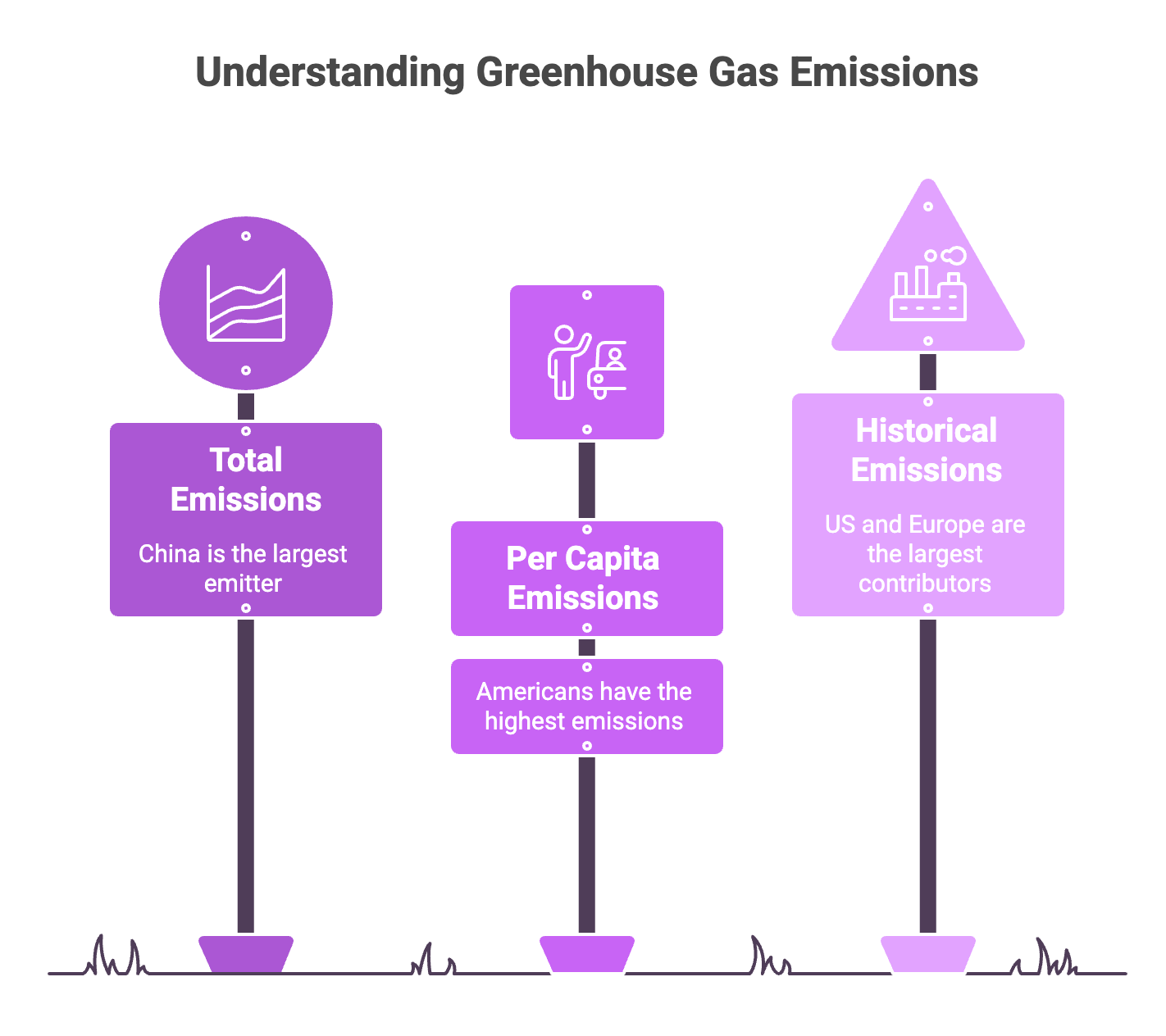
The third way matters most for the warming we actually have. CO2 does not disappear when you emit it; it stays in the air for centuries. So today’s temperature is the result of everything emitted across all of history. On that measure the biggest contributors by a distance are the United States, responsible for about 20% of all the CO2 ever emitted, and Europe including Britain for close to another 20%, because they industrialised first and burned coal for two hundred years to get rich. (Carbon Brief) So the countries doing most of the lecturing are, on the whole, the ones that filled the atmosphere in the first place.
All three measures still miss the same thing: they count emissions where goods are made, not where they are used. Take Britain. It will proudly tell you it has cut its emissions, and on paper it has, reporting about 405 million tonnes made at home in 2022. But count the carbon baked into everything it imports and the real footprint is about 740 million tonnes, roughly 60% of it now happening abroad. (DEFRA) Britain turned down its own North Sea gas and now buys gas from Norway across the same sea. It closed factories and buys the steel, cement and goods from China. It builds few data centres and rents its AI computing from the United States, so that pollution lands on America’s books. The scoreboard looks clean, but the consumption behind it has barely changed. (Our World in Data, SEI)
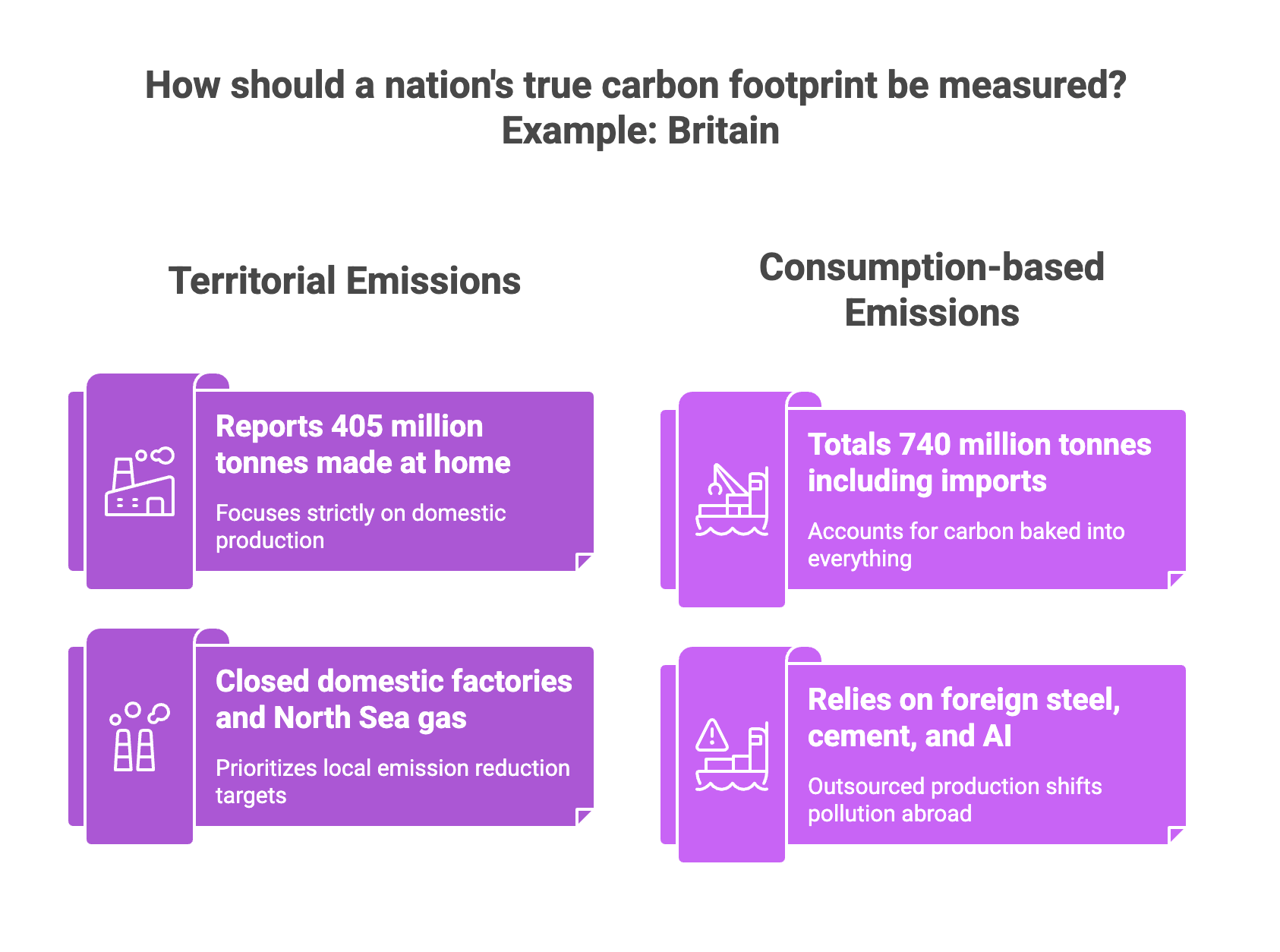
The facts are that the rich world caused most of the problem, still uses the most per person, and has shifted a chunk of its own pollution onto everyone else’s books.
Who is hit hardest
The people who did the least to cause this crisis get hit first, and hardest: poorer countries, nearer the equator, with the least money to protect themselves. The World Bank estimates that on current trends, climate pressure could push about 216 million people to move inside their own countries by 2050, with South Asia accounting for about 40 million of them and sub-Saharan Africa for 86 million. The same study finds that cutting emissions and planning for it could shrink the problem by up to 80%. (World Bank)
There is a fairness problem woven through this. In 2021 the rich nations promised to roughly double the money they give poorer countries to adapt, to about 40 billion dollars a year by 2025. The latest figures put it under 35 billion, and several European governments, Britain among them, cut their share instead of raising it. (UN News, Climate Change News) If the rich world caused most of this, does it owe the money to help everyone else cope? That argument runs through every climate summit, and it is nowhere near settled.
A stark example is the low-lying island nations. They put almost no carbon into the air, but the rising sea takes their homes first. Tuvalu, a Pacific nation of about 11,000 people, is slowly going under. In 2023 it signed a treaty with Australia for what is, in effect, a climate visa, a legal, planned way for its people to move and build a life there before their home disappears. When the first ballot opened in 2025, more than a third of the country applied within days. (Carnegie Endowment, The Conversation) It works because Tuvalu is small enough for one country to absorb. The Maldives, with half a million people, is not. No single neighbour can take that many, so it is spending enormous sums raising its own land, pumping sand from the seabed to build the islands higher out of the water. (NASA)
India and Bangladesh: where it becomes a civilisation problem
The islands may face the most imminent challenge, but the biggest human stakes are the giant, crowded countries, above all India and Bangladesh, with more than a billion and a half people between them. Several dangers land on them at once.
Start with heat, because there is a kind of heat far more dangerous than just the number on the thermometer. Your body cools itself by sweating, and sweat only works if it can evaporate. When the air is both very hot and very humid, your sweat cannot evaporate and you cannot cool down, no matter how much water you drink or shade you find. Past a certain combination of heat and humidity, a few hours outside can kill a fit, healthy person, and South Asia is exactly where that combination is turning up more often. (IPCC AR6 WG2)
And few of them can easily retreat into air conditioning. Hundreds of millions work outdoors or in workshops with no cooling, farming, building and driving, and they cannot step into an air-conditioned office. The dying has already started: one 2026 study estimated that a single day of extreme heat across India causes about 3,400 more deaths than normal, and five days in a row pushes that toward 30,000, most never counted as heat deaths because the certificate records a heart attack or kidney failure. (Frontiers in Environmental Health) On top of the deaths, the World Bank reckons lost work from heat could put the equivalent of as much as 4.5% of India’s whole economy at risk by 2030. (World Bank)
It is not only heat. India feeds more than a billion people on two harvests a year, and about 40% of what it grows depends on rain, not irrigation. The monsoon is getting more erratic, with longer dry spells and then a whole season’s rain dumped in a few violent days, which is terrible for growing food. High temperatures above roughly 34 degrees at the wrong moment sharply cut wheat yields. (World Bank) And India grows a big share of the world’s wheat and rice, so a bad heat year in India does not stay in India; it shows up as higher food prices everywhere, especially when governments restrict exports to protect their own supply.
Bangladesh has the same heat problem, plus a brutal geography. It is a country of about 175 million people in an area roughly twice the size of Ireland, much of it a low, flat river delta only a metre or two above the sea. So it gets the sea rising from one side, storm surges from cyclones on top of that, and the floodwater of three enormous rivers coming down off the Himalayas from the other. Even where the land does not go under, the salt does: seawater creeps into the soil and the wells and slowly ruins the farming and the drinking water. (World Bank Bangladesh profile) Extreme storm tides could become substantially higher and more frequent this century, and extreme rainfall is projected to rise across the country. (storm-tide study, rainfall study) One World Bank assessment estimated that heat cost Bangladesh about 250 million working days in 2024, worth as much as 1.78 billion dollars. (World Bank)
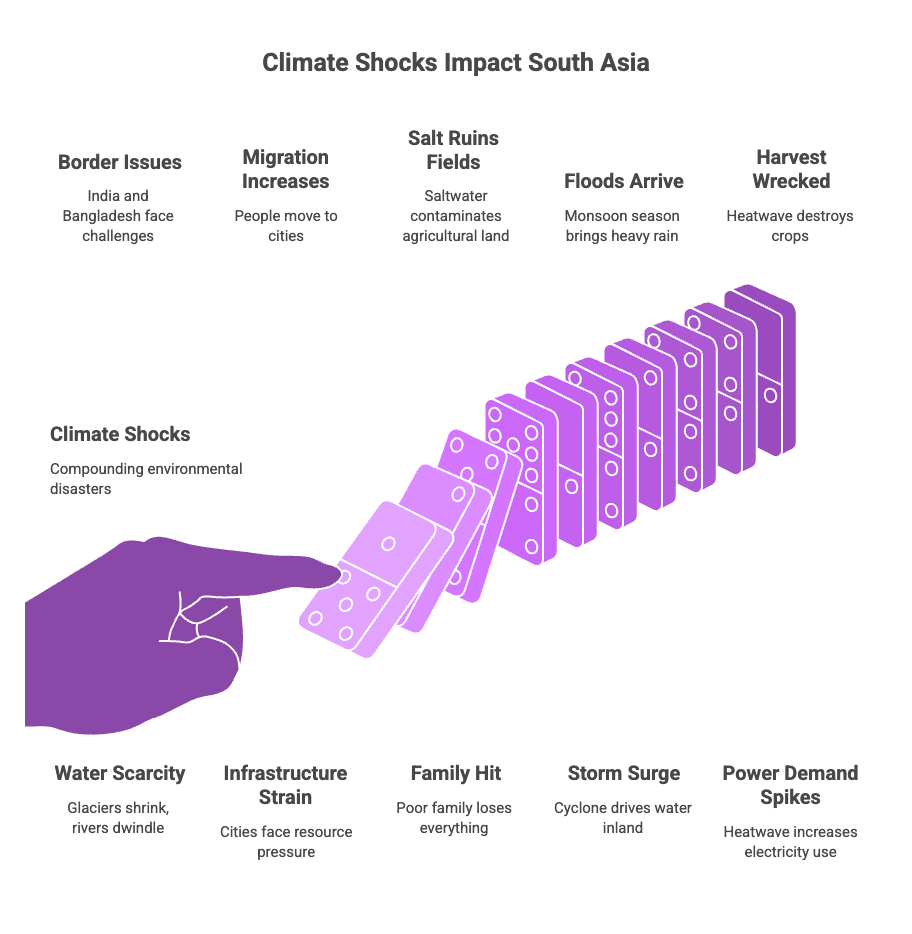
The real danger is the way these shocks compound, not any single record-breaking event. A heatwave wrecks the harvest and spikes power demand; then the monsoon floods arrive; then a cyclone drives a storm surge inland over an unusually high sea; salt ruins the fields; and a poor family gets hit three times in a year with nothing left to fall back on. People move inland into cities that are already bursting, Dhaka, Kolkata, Delhi, which piles pressure on housing, water and jobs. Indian cities alone may need more than 2.4 trillion dollars of climate-resilient infrastructure by 2050. (Reuters) Push displacement far enough and it stops being only a Bangladeshi problem, because India almost completely surrounds Bangladesh, so a large enough movement of people becomes a border and a politics between the two. (World Bank, South Asia migration) Further out, the Himalayan glaciers that feed Asia’s great rivers are shrinking, which first raises flood risk and later reduces the natural water store for hundreds of millions downstream. (IPCC AR6 WG2)
There is hope, though. Bangladesh has already shown that vulnerability is not fate. It used to lose hundreds of thousands of people to a single cyclone; now, through forecasts, warnings, concrete shelters and practised evacuations, it loses a tiny fraction of that from the same storms. Adaptation works, and getting richer helps too, because a richer country can afford cooling, sea walls and stronger buildings. The catch is that every extra degree of warming makes all of it harder and more expensive. So the heat we prevent, and the world we build for the heat we do not, both matter enormously to a billion and a half people.
Clean power now wins on price
Now the hopeful part of my story. It comes down to a price.
For almost all of history, one stubborn fact sat under the whole climate problem: the clean ways of making energy, sun and wind, were more expensive than burning coal and gas. So the world, quite rationally, burned coal and gas. Nobody was a cartoon villain; fossil fuels were cheaper, and cheaper wins. That is the real reason we are in this mess. Then, around 2023, that changed.
Strip the subsidies away, work out what each kind of power station really costs to build and run, and new wind and solar now come in cheaper than the cheapest new gas, while coal and nuclear cost two to four times more. (Lazard) This happened because solar got about 90% cheaper in fifteen years, and wind and batteries came down enormously too. (IRENA) The mechanism is scale: every time the world doubled the total amount of solar ever built, the price dropped again, and we badly underestimate how much that compounds over decades.
The cost that counts is the cost of each unit of electricity a plant produces over its life. On that measure, a unit from a new solar or wind farm is now cheaper than a unit from a new coal or gas plant. By 2024, IRENA calculated that 91% of newly commissioned utility-scale renewable projects generated electricity more cheaply than the cheapest new fossil alternative. (IRENA)
You will still hear that renewables only look cheap because of subsidies. But fossil fuels get far more. Governments worldwide put somewhere between 700 and 900 billion dollars a year into fossil fuels, mostly holding down the price of petrol, gas and electricity so voters do not feel the full cost. (IMF, OECD) There is no equally comprehensive global figure for renewable subsidies, but it is a good deal smaller: the most complete estimate put renewable support at about 166 billion dollars, and while clean-energy spending has grown a lot since, the IEA’s roughly 1.6 trillion dollars of clean-energy support disbursed between 2020 and 2025 averages around 270 billion a year and covers far more than renewables alone, including grids, EVs, heat pumps and hydrogen. (IRENA, IEA) So on a comparable basis, fossil fuels still take roughly two to four times the direct support that clean energy does. Strip the subsidies from both sides and, in most places, wind and solar still come out cheaper. There is a bigger number you may have seen, about 7.4 trillion dollars a year, but that one adds in the costs fossil fuels never pay for, the illness from air pollution and the damage from the warming; it is a bill society picks up later, not a cheque governments write. (IMF 2025 update)
Once the clean option is also the cheapest, there are automatic incentives to choose it. A company or a country builds solar because it is cheaper and it makes money, and the lower emissions come along for free.
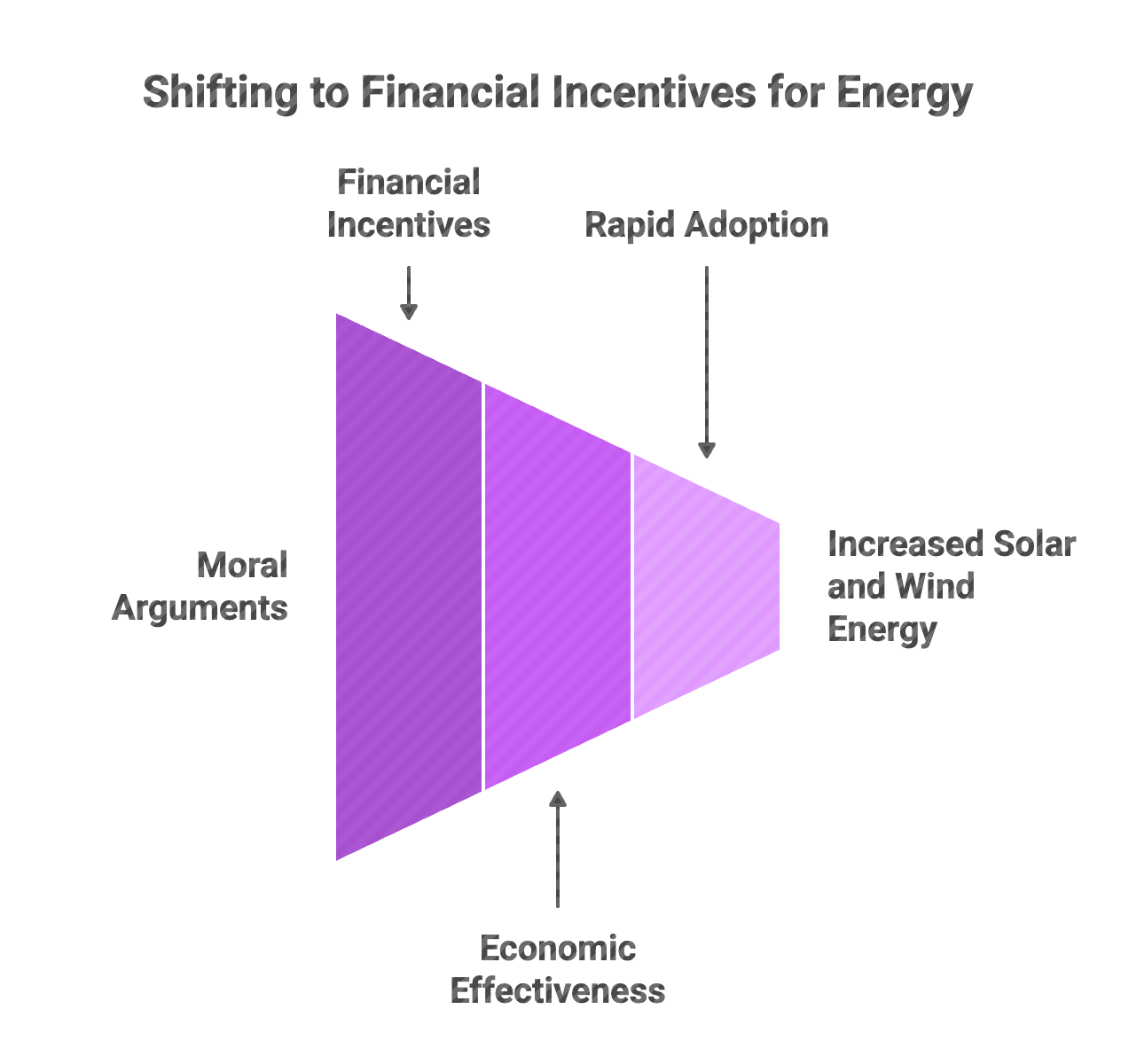
That swaps a moral argument, which humans are bad at acting on, for a money argument, which we are very good at. And it is happening now, not in some spreadsheet for 2050: last year, solar on its own supplied about three-quarters of the growth in the world’s electricity demand, and solar and wind together supplied nearly all of it. (Ember)
So why is my electricity bill still enormous?
If clean power is so cheap, why has your bill not fallen? Because the price you pay often does not come from the average of all that cheap power. It comes from the most expensive plant that has to run to keep the lights on.
At any moment the grid must match supply to demand exactly, so it turns on generators cheapest first. Wind and solar go first, because once they are built their fuel is free. Then nuclear. Then, when demand is still higher, you fire up a gas plant to fill the gap. And in places like the UK, just one plant sets the price for everyone: whichever is the last one you have to switch on to meet demand. If that is a gas plant, the gas price sets the price paid to the wind farm too. Britain’s problem is worse because it imports most of its gas and competes for it with the whole of Europe and Asia, which is why, after the invasion of Ukraine, British bills exploded even though Britain bought little Russian gas.
The way out is not to abolish that pricing system but to push gas off the end of the queue. Build enough wind, solar, nuclear and storage that you can meet demand for hours at a stretch without ever needing that last gas plant, and gas stops setting the price during all those hours. That is why the hundredth wind farm is worth far more than the electricity it makes: it can knock the expensive plant out of the picture and lower the price on a huge block of everyone else’s power. Britain’s own system operator thinks gas could be down to about 5% of generation by the end of the decade, and once you get there, bills finally follow the cheap power down. (National Energy System Operator)
There is one more reason governments drag their feet, and it is money. Governments make an enormous amount from us burning fossil fuels. In Britain, out of roughly 65 billion pounds a year that people spend on fuel, something like 35 billion is tax, fuel duty and VAT, and nobody has worked out yet what replaces that revenue when we all stop buying petrol and gas. (OBR)
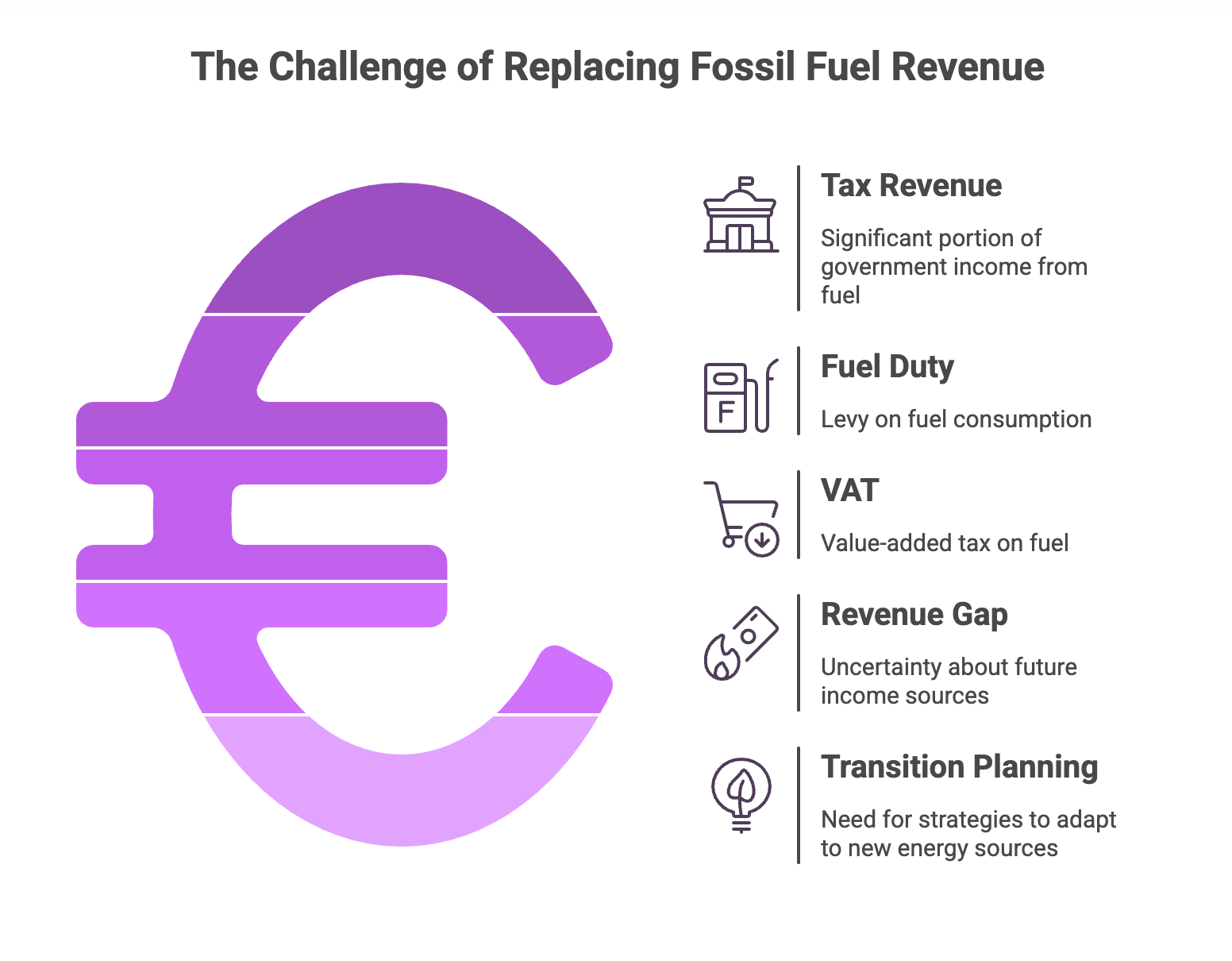
So a government can know perfectly well that clean is cheaper and still hesitate, because the cheap, clean future blows a hole in its budget.
Cheap power is the foundation, not the entire solution
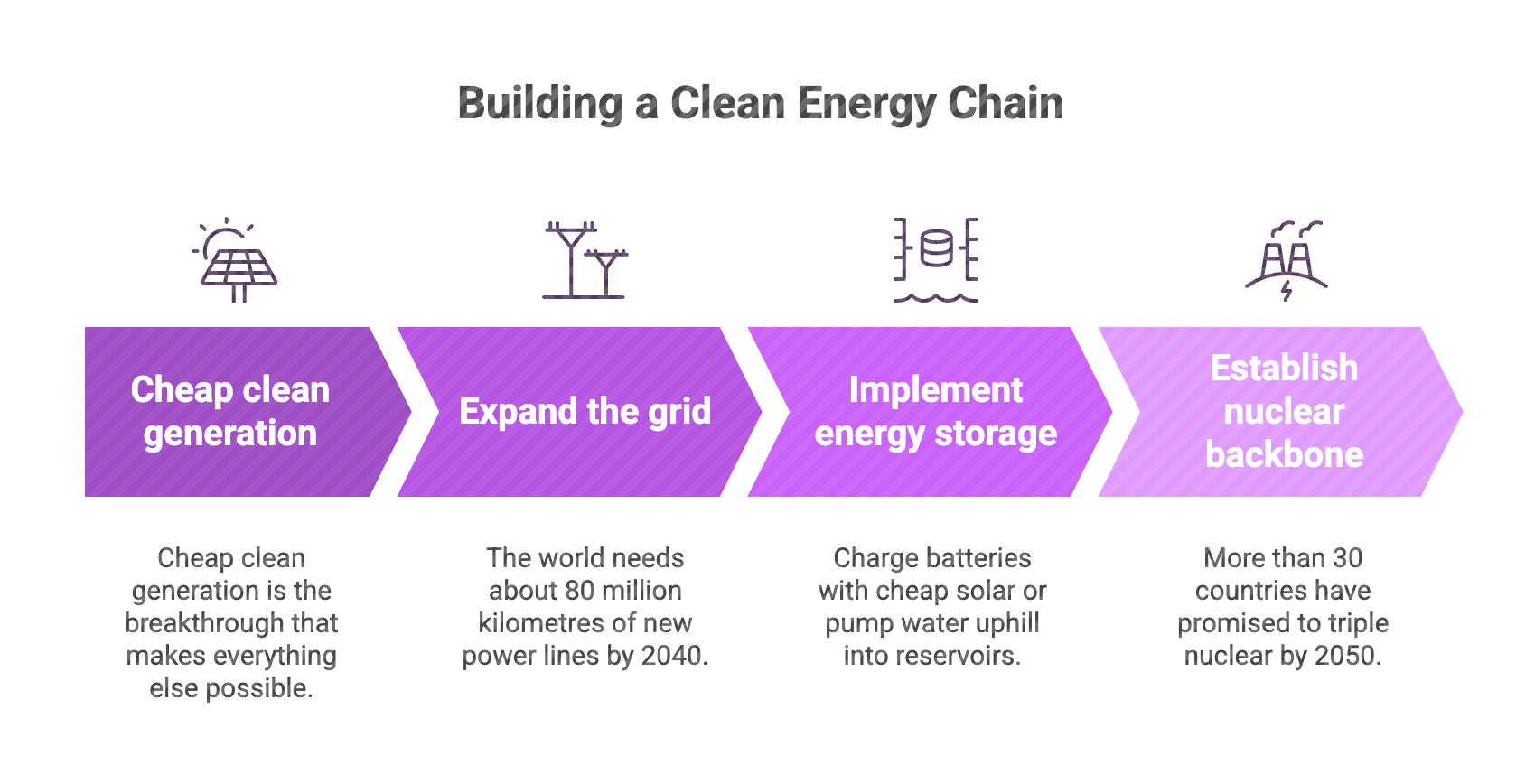
Cheap clean generation is the breakthrough that makes everything else possible, but it is only the first link in a chain, and every link has to hold.
The second link is the grid: the network of big power lines that moves electricity from where it is made to where it is used. A solar farm in a sunny desert is no use if the power cannot reach the city, and right now the grid is the real constraint, more than the panels. The world needs about 80 million kilometres of new power lines by 2040, roughly rebuilding every power line on Earth from scratch. (IEA) Britain has world-class wind in the north it sometimes cannot use, because it cannot move the power south, so it pays wind farms to switch off. (Asgard News)
The third link is storage, because the sun sets and the wind drops. In the day you can charge batteries with cheap solar and use it in the evening, and batteries have got cheap for the same scale reason. But there is not nearly enough battery in the world to soak up everything a country like China makes from renewables on a sunny, windy day, so it also uses spare power to pump water uphill into reservoirs, then lets it fall back through turbines when power is needed: water as a battery. You also need something for the steady demand that never goes away, the power a city draws even at three in the morning in midwinter. The cleanest way to cover that around the clock is nuclear, which runs day and night on a tiny patch of land; its problem is that it is slow and expensive to build. So the sensible mix is cheap solar and wind doing most of the work, with a steady nuclear backbone underneath. More than 30 countries have promised to triple nuclear by 2050 (S&P Global), and a newer design, the breeder reactor, makes more fuel than it burns; India switched one on in 2026, only the second country ever to do it, and it can run on the thorium India has in huge amounts. (World Nuclear Association, World Nuclear News)
Some things are hard to run off a battery, a long-haul plane, a container ship, making steel and cement, because they need concentrated energy batteries are not good at yet. For those the answer is clean fuels, above all green hydrogen, made by splitting water with clean electricity and burned instead of oil. (IATA) And the other way round, the biggest multiplier of all is to electrify the things that could run on electricity but do not yet. Once electricity is clean and cheap, you want to run as much as possible on it, because then it is all clean automatically. Swap petrol cars for electric ones, where the motor turns most of its energy into movement rather than throwing it away as heat, and swap gas boilers for heat pumps, which do not burn anything but move heat from the cold air outside into the house, so one unit of electricity delivers three or four units of warmth. (IEA) Electrify the car and the boiler, run them on clean power, and you clean up two of the biggest sources of emissions in an ordinary life. The rule is simple: electrify what you can, and clean up the electricity.
Beyond electricity
Some of the cheapest wins are not about power stations at all. Take methane, the same powerful gas that leaks from thawing ground. A lot of it also leaks straight out of oil and gas pipes and wells, and plugging those leaks is one of the best deals going, because the gas you stop wasting is gas you can sell, so you often make money by fixing it. (IEA methane tracker) Then there are forests: a living forest holds a huge store of carbon and keeps pulling more out of the air every year, so protecting the forest you have is worth more than promising to plant a new one later. And a third of all the food the world grows is never eaten, which means all the emissions from growing, moving and chilling it were spent for nothing. (Our World in Data) The single most powerful lever a government has for all of this is almost dull: put a price on pollution, through a carbon tax or a market, and millions of businesses and people go and find the cheapest way to pollute less on their own, because now it costs them. (World Bank carbon pricing)
China’s bet, and the energy behind the AI race
On building all this, one country is not just leading, it is on a different scale. In a single recent year China added around 540 gigawatts of new power generation. To put that beside everyone else: the whole European Union added about 75, India around 52, the United States under 40, and Britain about 4. (Global Energy Monitor) China now makes 80 to 95% of the world’s solar parts. (IEA)
This is not just China being greener out of virtue. It has decided that cheap, abundant electricity is itself a source of national power, and it is building the whole system for that, not just the panels but the grid, spending about 90 billion dollars in one year on power lines, building enormous cables that carry electricity thousands of kilometres from the sunny, windy west to the factories in the east. For the last twenty years the big technologies barely used electricity; you could build a trillion-dollar software company that sipped power. The next twenty years look the opposite. AI data centres are enormously hungry for it, and so are the robots, electric cars and heat pumps that turn electricity into labour, transport and warmth. So cheap, abundant power is becoming a general-purpose advantage the way cheap steel or cheap oil once were.
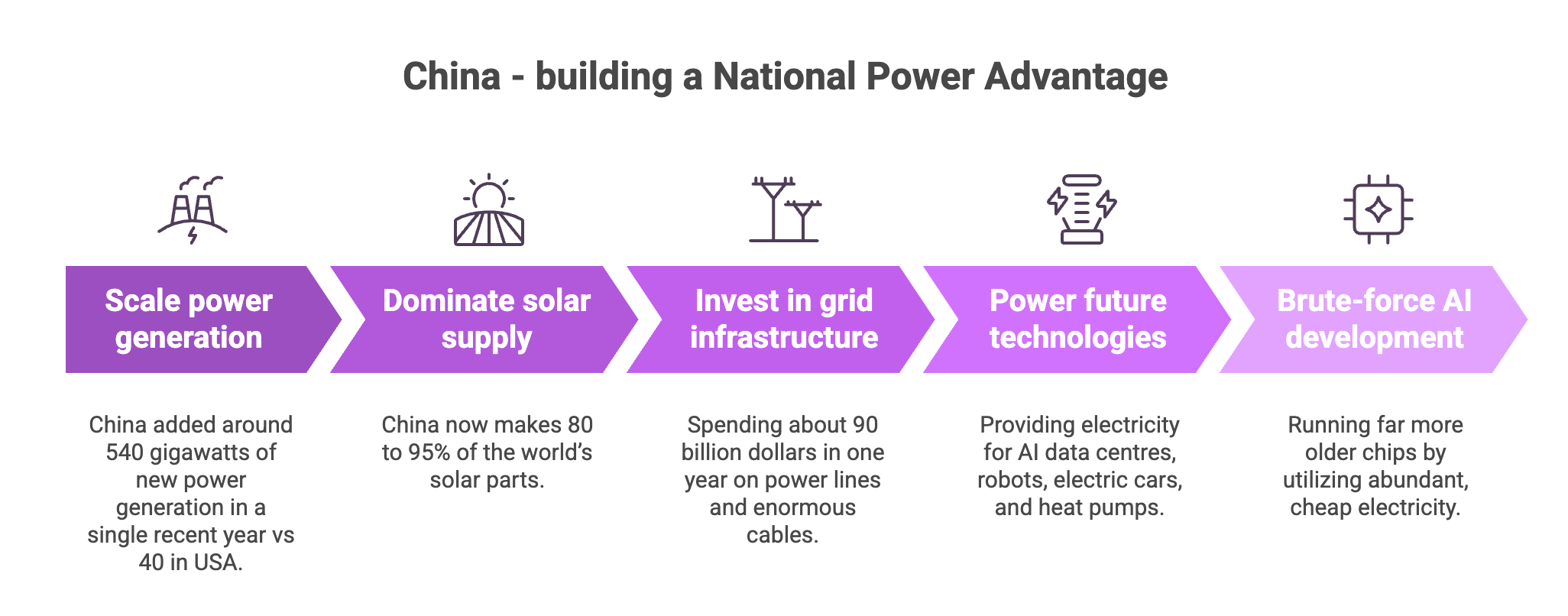
This connects straight to the AI race. The United States tried to slow China down by blocking it from the most advanced chips, so America is chip-rich but increasingly short of the power to run its data centres, while China is the mirror image, short of the best chips but swimming in cheap electricity. So China can brute-force it, running far more of the older chips it can get because it has the energy to feed them. The chips everyone assumed were the constraint may matter less than the power to run them, which few people were tracking. Building spare electricity is like laying railways before you know exactly what will run on them: you lay the track, and the economy rearranges itself around it.
Getting ahead of the heat: two jobs at once
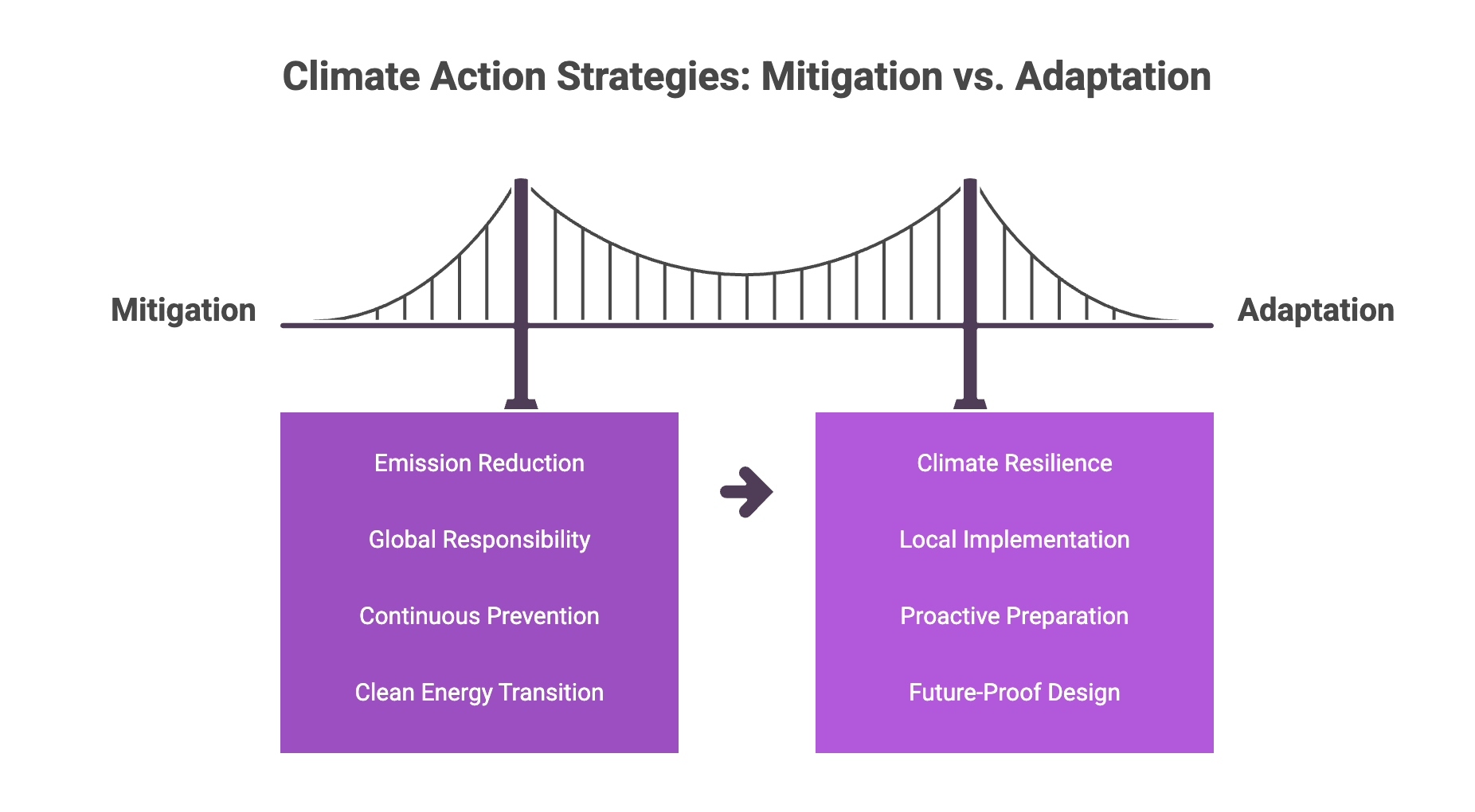
Some warming is already locked in, so humanity has two jobs running at the same time. Cutting emissions, to stop it getting worse, is mitigation. Coping with the heat already baked in is adaptation. And a lot of the adaptation is cheap, low-tech and already saving lives.
In Ahmedabad, India, after a heatwave killed more than a thousand people, the city started coating its roofs in reflective white paint. A reflective white roof bounces the sun’s heat back instead of soaking it up, running up to 30 degrees cooler on top and several degrees cooler inside, and the city reckons that one idea saves over a thousand lives a year. (Down to Earth, 360info) On the food side, India has bred new versions of its crops for heat and drought, including a pearl millet that grows in 60 days instead of the usual four months, so a farmer can harvest before the dry season hits. (Nature, ICRISAT) The trick to adaptation is that you have to do it before the heat hits, not in the middle of a bad year.
Much of it is about protecting people, not buildings. Most of those heat deaths are preventable: warn people a day ahead, check on the elderly, open cooled public spaces, shift working hours, and you save lives for almost nothing. Just 24 hours of warning before a dangerous heatwave can cut the harm by about 30%. There is a real contradiction to face here, because coping with heat often means air conditioning, which uses power and could leak potent gases, if not managed well. But in much of the world cooling is not a luxury, it is how people survive the summer, so the answer cannot be “don’t use it.” It is efficient air conditioners, running on clean power, in better-built buildings, with less harmful gases inside: make the cooling clean instead of banning it.
Fire is the same principle, prepare before the season rather than during it. The places that come through a bad fire summer best are the ones that did the boring work early: clearing the dry brush and dead wood that feed a fire, cutting firebreaks that a fire cannot jump, and running early warnings and rehearsed evacuations before there is smoke on the horizon. When the hot, dry, windy days come, and they will come more often now, that groundwork is the difference between a scare and a disaster. France moving 40,000 people off that coast in a day, with nearly all of them home again, is what being ready looks like.
For floods and storms, the rule is to build for the world that is coming, not the one that is gone: cities designed to soak up floods instead of funnelling them, and wetlands and mangroves restored along coasts, because a mangrove swamp works as a sea wall that also stores carbon and costs nothing to run, nature used as infrastructure. On the coast, some places will build defences and some will have to retreat, moving back from a shoreline that costs more to defend than to leave. The Maldives raising its islands is one end of that; a village moving inland is the other. Above all, a road, a railway, a power grid, a hospital or a home lasts 50 to 100 years, so it has to be built for the climate it will actually live through, hotter, wetter and stormier, not the one we grew up with.
Cutting emissions is a global job: a tonne of carbon saved in China helps a farmer in Kenya exactly as much as a tonne saved in Britain, because the air mixes, it is one atmosphere. But adapting is a local job: a tree planted in Paris cools Paris, a barrier on the Thames protects London, a drought-proof seed in India feeds India. So it really is two projects at once. Stop the temperature climbing as far as it otherwise would, and build a world that can live safely at the temperature we are already going to get.
Pulling carbon back out, and the last resorts
We also need to pull some carbon back out of the air, and we can now lock it away for good. In Iceland, carbon mixed into water and pumped into basalt rock turns 95% to stone within two years, and a team in Oman does the same even faster. (Eos, Oman Observer) There are also machines that suck carbon straight from the air, but they handle less than 0.1% of what is needed. They are a mop, not a tap: useful later, no excuse to leave the tap running. (Carbon Brief)
If none of that is enough there is a real last resort: cooling the planet fast by spraying a fine mist high in the sky to bounce some sunlight back out, the way a big volcano does. It is cheap and it works fast, and it is dangerous, because the moment you stop, the trapped heat comes racing back. Britain has put the first real money into studying it, while hundreds of scientists have asked for it to be banned. (Carbon Brief) It is the kind of thing you keep in an emergency drawer and hope you never open. The more ambitious long shot is solar panels in space, where a panel gets sunlight around the clock; the cost of getting to orbit has dropped 85 to 90% in a decade, which we covered in our Falling Price of Orbit special, and real power has already been beamed down from orbit in tests (World Economic Forum), though it is a project for the 2040s.
Two views on climate - the USA has regressed
One group of countries, China, the European Union and India, is building the cheapest power in history and the grid to carry it as fast as it can, while meeting short-term needs with some gas. Another, the United States, is spending public money to prop up oil and gas and slow the alternatives down. (Asgard News)
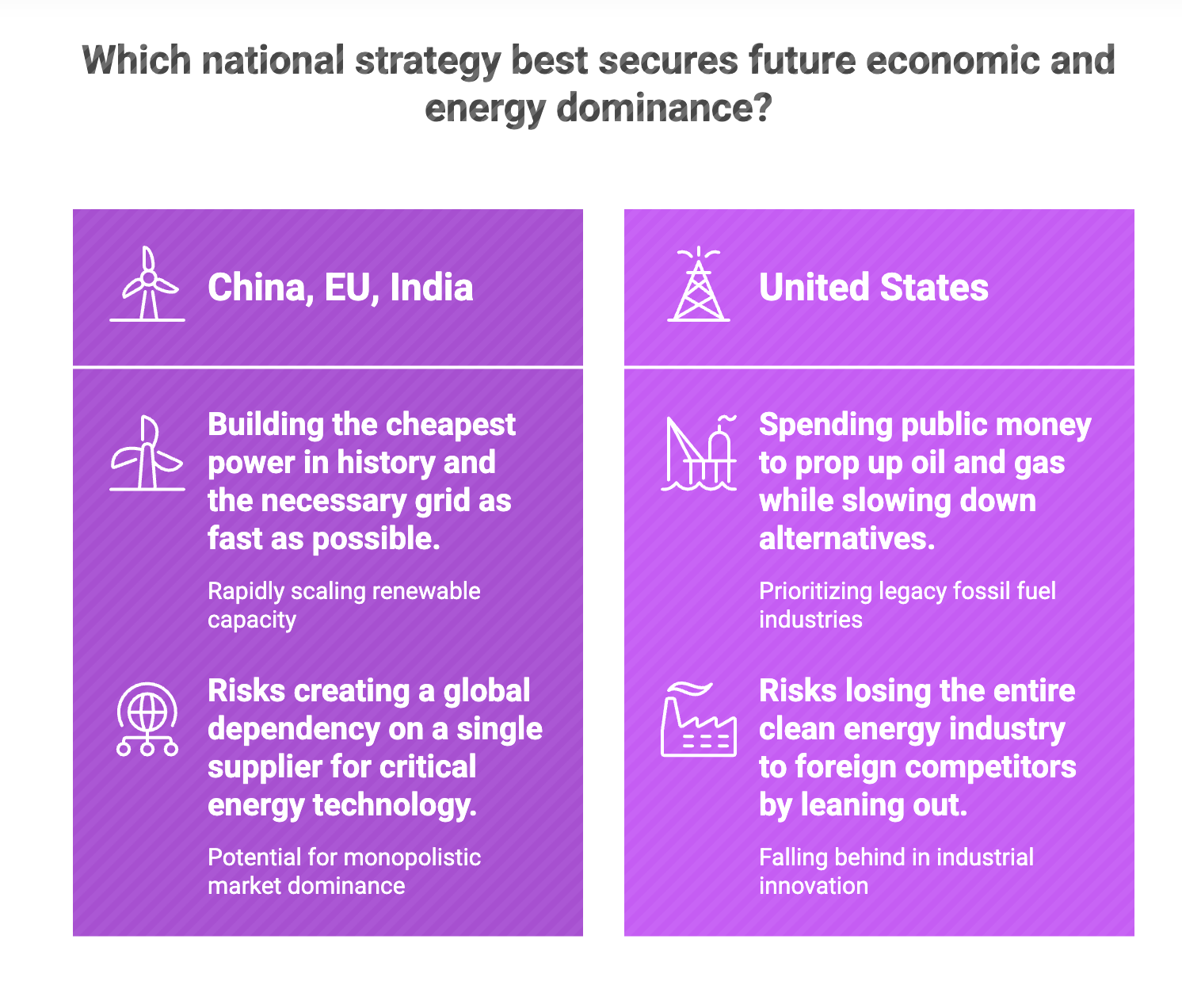
When the price of something is falling this fast, fighting it is like King Canute trying to hold back the tide: you lose anyway, just slowly and expensively. The real worry for America is not that clean energy loses, but that it looks up in ten years to find China owns the whole industry, and the cheap power the modern economy runs on, because China leaned in while America leaned out.
The counter-risk is real too: if a single country ends up completely dominant in the technology the world’s energy depends on, everyone relying on one supplier is its own kind of danger. So there is a real tension. But the direction is not really in doubt any more. Only the speed, and speed is exactly what the four-year clock is asking for.
What you can do about it
That leaves the most personal question. What has any of this got to do with you, and how do you protect yourself and your family, or even profit from the change?
The fastest lever is on your plate. Farm animals warm the planet about as much as every car, ship and plane put together, partly because cattle burp methane, and we give animals most of the world’s farmland for less than 20% of our food. (FAO, Our World in Data) You do not have to go vegan. If people just ate a bit less meat, food emissions would fall by roughly half, and it is in your hands three times a day.
The second is where your money sits, if you ever have any to spare. The world is about to pour trillions of dollars into cutting emissions and coping with this over the next decade, and that money is going somewhere. Right now a lot of clean-energy companies are cheaply valued, partly because America has turned cold on the whole sector, and it is a real possibility that as the economics keep biting, and as governments change, even the US swings back. This is not financial advice and nothing is guaranteed. But if there is a next great industry the way software was, this has a strong claim, and it is worth understanding while it is still out of fashion.
The third is just to understand the real story, so the next red map on your phone does not flatten you into doing nothing. Both despair and complacency leave you doing nothing.
Two things are true at once. Record heat and record fires are here, already killing people in their thousands. So is the cheapest power ever built, going up faster than anything before it. We no longer have to invent the fix; it is here, it is cheap, and it is scaling. The next few years decide which of those two facts shapes our children’s lives, and ours. The future, for a few more years, is up to us.
Glossary: the terms, explained
Carbon budget. The total amount of carbon we can still put in the air and keep a set chance of staying under a warming limit. Ours for 1.5 degrees is about 170 billion tonnes, roughly four years at today’s rate.
Watch: Is it too late to stop climate change? (Kurzgesagt x Our World in Data) · Voices: Outrage + Optimism podcast · Source: Global Carbon Project
1.5 degrees. The warming limit governments agreed to aim for in the Paris agreement, measured against temperatures before the industrial age. 2024 was the first full year the planet crossed it.
Watch: Kurzgesagt x Our World in Data climate video · Source: WMO
Excess mortality (how heat deaths are counted). Heat rarely appears on a death certificate; it triggers the heart or lung failure that does. So the toll is measured by comparing how many people died with how many normally would have, which is why it appears months later and is far higher than the official count.
Read: How Europe counts heat deaths (CBC) · Source: Heat-related mortality in Europe 2022 (Nature Medicine, via NBC)
Wet-bulb temperature. A measure that combines heat and humidity. Your body cools by sweating, and sweat only works if it can evaporate; in very hot, very humid air it cannot, so above a threshold a few hours outside can kill a healthy person. South Asia is where this is becoming common.
Source: IPCC AR6 WG2, Impacts and Adaptation
Tipping point. A threshold where part of the climate keeps changing on its own even after we stop pushing, like a switch that stays on. Ice sheets, coral reefs and permafrost are examples.
Watch: Is permafrost the tipping point of no return? (PBS) · Read: Nine tipping points (Carbon Brief) · Source: Armstrong McKay et al., Science
Permafrost and methane. Frozen ground up north holds about twice as much carbon as the whole atmosphere. As it thaws it leaks out, much of it as methane, a gas that traps around 80 times more heat than carbon over the short term.
Watch: PBS permafrost explainer · Source: Permafrost tipping point (Carbon Brief)
Territorial vs consumption emissions. Territorial counts emissions where goods are made. Consumption counts them where goods are used, adding the carbon in imports. It moves blame from the factory countries towards the shopping ones.
Watch: Who is responsible for climate change? (Kurzgesagt x Our World in Data) · Source: Consumption-based CO2 (Our World in Data)
Per-capita emissions. Emissions per person, not per country. On this measure one American emits about as much as two Chinese, or six Indians.
Watch: Who is responsible for climate change? (Kurzgesagt) · Source: Per capita emissions (WRI)
Levelised cost of electricity (LCOE). The full lifetime cost of building and running a power plant, divided by the electricity it makes, so you can compare sources fairly. On this measure, new solar and wind are now the cheapest.
Read: Solar is now the cheapest electricity in history (Carbon Brief) · Voices: Volts podcast (David Roberts) · Source: Lazard cost of energy
Marginal pricing (why your bill stays high). The electricity price is set by the most expensive plant that has to run to meet demand, usually gas. Build enough clean power and storage to push gas off the end of the queue for hours at a time, and the price falls with it.
Source: National Energy System Operator
Fossil-fuel subsidies. Direct government support keeps fossil fuels artificially cheap, roughly 700 to 900 billion dollars a year worldwide, more than renewables get. A far larger figure of about 7.4 trillion includes the unpriced costs of pollution and climate damage that society pays later.
Source: IMF fossil fuel subsidies · OECD · IEA clean-energy support
Capacity vs generation. Capacity is how many panels are installed (measured in terawatts). Generation is how much power they actually make. The sun is not always up, so 3 terawatts of panels make about 9% of the world’s electricity.
Source: Ember Global Electricity Review 2026
The grid. The network of power lines that moves electricity from where it is made to where it is used. Cheap solar is useless if the wires cannot carry it, which is why the grid is now the main blocker.
Voices: Telling the story of the grid (Volts) · Source: Grids (IEA)
Baseload and nuclear. Baseload is the steady power a grid needs day and night. Nuclear supplies it cleanly, running around the clock on a small footprint of land.
Source: World Nuclear Association
Breeder reactor and thorium. A newer reactor that makes more fuel than it burns, by turning cheap, common metal into new fuel. It can run on thorium, which India has in huge amounts.
Watch: Thorium reactors visualised and explained · Source: India’s first fast breeder (World Nuclear News)
Heat pump. A device that heats a home without burning anything, by moving heat from the cold air outside into the house. Because it moves heat rather than making it, one unit of electricity delivers three or four units of warmth.
Watch: How heat pumps work (Technology Connections) · Source: IEA, The Future of Heat Pumps
Green hydrogen. A clean fuel made by splitting water with clean electricity. It is the answer for jobs batteries cannot do, like heavy industry and some transport.
Watch: What is green hydrogen and will it power the future? · Source: Sustainable aviation fuel (IATA)
Mitigation vs adaptation. Mitigation is cutting emissions to stop it getting worse, and it is a global job, because a tonne saved anywhere helps everyone. Adaptation is coping with the heat already locked in, and it is a local job, because a barrier or a cool roof only protects the place it is built.
Source: IPCC AR6 WG2, Impacts and Adaptation
Cool roofs and passive cooling. Low-tech ways to keep buildings cool without burning power: reflective white paint, thick walls, breeze towers, shaded courtyards.
Source: Ahmedabad cool roofs (Down to Earth)
Storm surge and salinity. A cyclone pushes a wall of seawater inland (the surge), made higher by a risen sea. Even without permanent flooding, salt creeps into soil and wells, ruining farmland and drinking water. This is Bangladesh’s core threat.
Source: World Bank Bangladesh climate profile
Managed retreat. Deliberately moving people and infrastructure back from a coastline that costs more to defend than to abandon. The other end of the spectrum from building sea walls or raising islands.
Source: Preparing for rising seas in the Maldives (NASA)
Carbon removal. Pulling carbon back out of the air and locking it away, for example by turning it to stone in rock, or sucking it straight from the air with machines. Real, but still tiny.
Source: State of carbon removal (Carbon Brief)
Solar geoengineering. Deliberately cooling the planet by spraying a fine mist high in the sky to bounce sunlight back out, the way a volcano does. Cheap and fast, but risky and ungoverned.
Voices: Ted Parson on geoengineering (The Great Simplification) · Source: UK geoengineering research (Carbon Brief)
El Nino. A natural warming of the Pacific that weakens the winds carrying India’s monsoon, thinning the rain and putting the harvest at risk.
Source: El Nino monsoon risk (Down to Earth)
Sources
Wildfires and heat 2026: France evacuations (Al Jazeera) · Fires across Europe, mid-August (Reuters) · July 2026 hottest month (Yale Climate Connections) · US July 2026 record (NOAA NCEI) · France/Spain wildfires (World Weather Attribution) · UK 38.1°C record (PBS News)
Heat deaths: Europe late-June, 10,000+ in a week (CBC) · Europe summer toll over 25,000 (Bloomberg) · Germany near 12,000 (Clean Energy Wire) · UK May-June deaths (resilience.org) · Europe 2022, 61,000 (NBC News) · India 3,400 deaths per extreme-heat day (Frontiers) · US heat deaths doubled (JAMA) · US mortality through 2024 (Annals of Internal Medicine)
Climate science: Global Carbon Project 2025 · WMO 2024 · Copernicus · Paris agreement (UNFCCC) · Tipping points (Science) · Permafrost (Carbon Brief) · Arctic record (WMO) · UNEP Emissions Gap 2025 · IPCC AR6 WG1 physical science · Methane (IEA)
Coasts and exposure: Coastal population (The Conversation) · Flooded future, 300 million by 2050 (Climate Central) · Netherlands and the sea (CNN) · Thames Barrier (Carbon Brief)
Emissions and responsibility: EDGAR 2024 · Per capita (WRI) · Cumulative (Carbon Brief) · UK consumption footprint (DEFRA) · Consumption vs territorial (Our World in Data) · EU consumption emissions (SEI)
India and Bangladesh: Wet-bulb heat, monsoon, glaciers (IPCC AR6 WG2) · India heat and GDP (World Bank) · Heat and Indian wheat (World Bank) · Indian cities need $2.4tn (Reuters) · Bangladesh climate profile (World Bank) · Bangladesh heat costs (World Bank) · Rising storm tides (study) · Extreme rainfall (study) · Climate migration (World Bank Groundswell) · South Asia migration (World Bank)
Energy and price: Lazard cost of energy 2025 · IRENA solar cost · 91% of new renewables cheaper (IRENA) · Ember Global Electricity Review 2026 · China buildout (Global Energy Monitor) · Solar supply chain (IEA) · Grids (IEA) · Nuclear (WNA) · India breeder (WNN) · Cooling and heat pumps (IEA) · Triple nuclear pledge (S&P Global) · Space-based solar (WEF)
Subsidies: IMF fossil fuel subsidies · IMF 2025 data update · OECD fossil fuel support · OECD 2025 inventory · IEA fossil fuel subsidies · IEA clean-energy spending · IRENA energy subsidies
Solutions and adaptation: Food emissions (Our World in Data) · Livestock (FAO) · Basalt storage (Eos) · Carbon removal (Carbon Brief) · Geoengineering (Carbon Brief) · Ahmedabad cool roofs (Down to Earth) · Lives saved (360info) · Climate-resilient crops (Nature) · Pearl millet hybrid (ICRISAT) · Australia-Tuvalu treaty (Carnegie) · Maldives (NASA) · Carbon pricing (World Bank) · Basalt storage, Oman (Oman Observer)
Asgard News coverage: US spends billions against wind · Solar is Europe’s biggest source · UK solar farm switched off · Data centres restricted · Bangladesh’s first nuclear plant
The Bright Side, from Asgard News. Listen to Nova and Ravi talk the whole thing through in the companion podcast.
A few honest caveats
Every number in this piece comes with a margin of error, and three are worth stating plainly.
The four-year clock is an estimate, not a countdown. The 170-billion-tonne carbon budget is the middle of a range, not a fixed figure. Depending on how you measure warming and how the climate responds, the real number could be several years shorter or longer. Read it as “this decade, roughly” rather than a date on the wall. The conclusion survives either way: the budget runs out on any plausible estimate, and speed is still the whole game.
Permafrost works on a slower fuse than the fires do. The carbon locked in frozen ground is enormous, but it comes out over decades and centuries, not in a single summer. Think of it less as a switch about to flip next year and more as a tide rising behind everything else in this piece. The reason to move fast is the same either way: every degree of warming we prevent is ground that never has to thaw.
Capacity is not the same as power. China’s 540 gigawatts of new capacity in a year is real, but panels and turbines do not run at full tilt around the clock, and coal still carries a large share of China’s electricity. The buildout shows the direction of travel, not the destination reached.
Check out some more Frameworks on the Fast Frameworks Substack:
America at 250, by the Numbers
The Choose Your Bias Framework
The Identity Migration Framework
The Thirty-Three Kilometre War
The Decision Framework: DECIDE
The Alpha Engine Framework for Venture & Angel Investing
Don’t Hire an Agency. Build a Memetic Engine - The memetic engine framework
Fast Frameworks AI Tools: Cortex
The Exponential AI Adoption Framework
Moltbook and the Entity AI Framework
May every sunset bring you peace!
Entity AI, swarms and the future of work (Asymmetric Podcast)
Fast Frameworks Podcast: Entity AI-Episode 8: Meaning, Mortality, and Machine Faith
Fast Frameworks Podcast: Entity AI - Episode 7: Living Inside the System
Fast Frameworks Podcast: Entity AI – Episode 5: The Self in the Age of Entity AI
Fast Frameworks Podcast: Entity AI – Episode 4: Risks, Rules & Revolutions
Fast Frameworks Podcast: Entity AI – Episode 3: The Builders and Their Blueprints
Fast Frameworks Podcast: Entity AI – Episode 2: The World of Entities
Fast Frameworks Podcast: Entity AI – Episode 1: The Age of Voices Has Begun
The Entity AI Framework [Part 1]
The Promotion Flywheel Framework
The Immortality Stack Framework
Frameworks for business growth
The AI implementation pyramid framework for business
A New Year Wish: eBook with consolidated Frameworks for Fulfilment
AI Giveaways Series Part 4: Meet Your AI Lawyer. Draft a contract in under a minute.
AI Giveaways Series Part 3: Create Sophisticated Presentations in Under 2 Minutes
AI Giveaways Series Part 2: Create Compelling Visuals from Text in 30 Seconds
AI Giveaways Series Part 1: Build a Website for Free in 90 Seconds
Business organisation frameworks
The delayed gratification framework for intelligent investing
The Fast Frameworks eBook+ Podcast: High-Impact Negotiation Frameworks Part 2-5
The Fast Frameworks eBook+ Podcast: High-Impact Negotiation Frameworks Part 1
Fast Frameworks: A.I. Tools - NotebookLM
The triple filter speech framework
High-Impact Negotiation Frameworks: 5/5 - pressure and unethical tactics
High-impact negotiation frameworks 4/5 - end-stage tactics
High-impact negotiation frameworks 3/5 - middle-stage tactics
High-impact negotiation frameworks 2/5 - early-stage tactics
High-impact negotiation frameworks 1/5 - Negotiating principles
Milestone 53 - reflections on completing 66% of the journey
The exponential growth framework
Fast Frameworks: A.I. Tools - Chatbots
Video: A.I. Frameworks by Aditya Sehgal
The job satisfaction framework
Fast Frameworks - A.I. Tools - Suno.AI
The Set Point Framework for Habit Change
The Plants Vs Buildings Framework
Spatial computing - a game changer with the Vision Pro
The ‘magic’ Framework for unfair advantage