

A funnel is any system that turns volume into an outcome through a sequence of gates. This framework focuses on optimising the Funnel ‘operating system’ and tuning it for exponential output growth by deliberately structuring the funnel and using AI in the right places
If you can’t name your gates, you can’t fix your conversion.
The same funnel structure shows up everywhere:
Hiring (applications → interviews → offers)
Sales (leads → calls → close)
Product (signup → activation → retention)
Content (impressions → clicks → subscribers)
Fundraising (intros → meetings → term sheets)
The Funnel OS Framework
Volume × Gates × Gate rates → Outcome
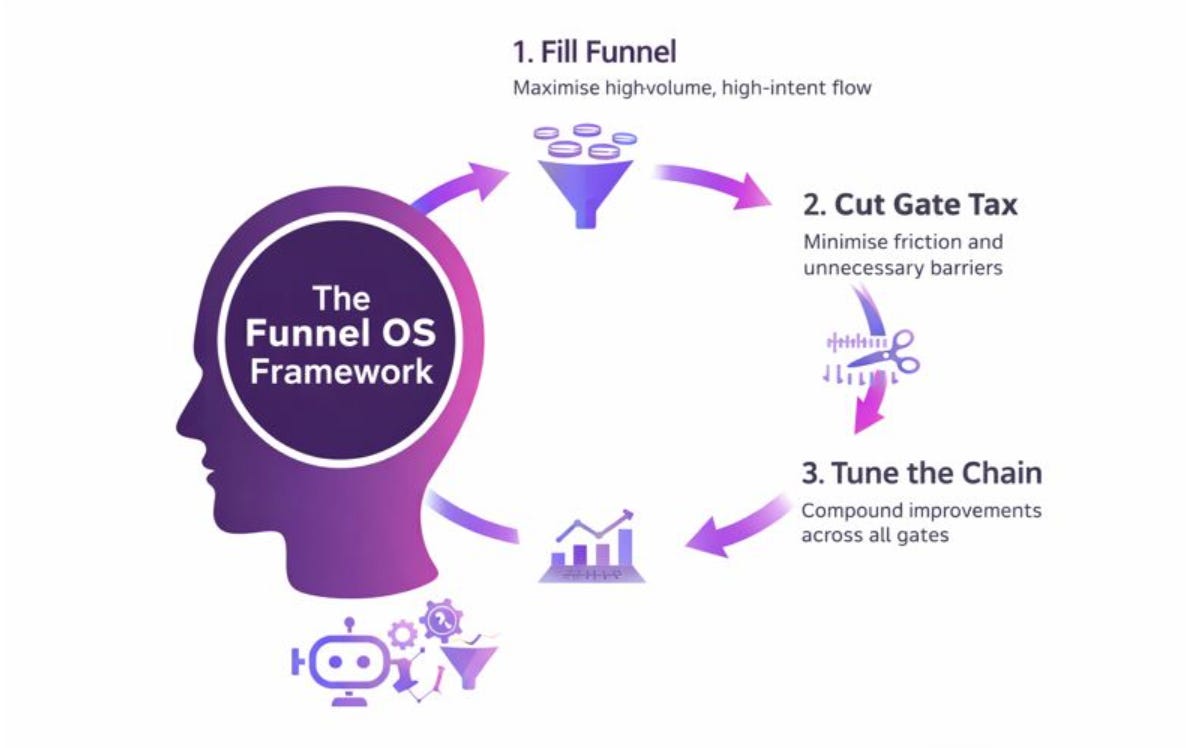
The wrong order leads to Gate Entropy (more steps, lower conversion, slower decisions). The right order leads to compounding growth.
Use AI to turbocharge each of the gates.
A Real Example: jobs.asgard.world
Jobs.asgard.world is an AI driven platform to help people find jobs.
At the top of the funnel, the platform has over 10 million fresh jobs around the world. Users upload their current CV. The platform extracts the users’ skills and experience. It then uses AI to match them to relevant jobs (in some cases hundreds of jobs), and the AI writes customised CVs and covering letters for each role – ensuring that the core keywords needed by the recruiters are covered, and the CVs are well structured and machine readable.
We ran a closed beta test with 100 users over 75 days. In this period, the platform produced:
42 users with interview calls
12 accepted roles
But outcomes were very different depending on how users ran the funnel:
55 users applied to between 0 and 2 roles. None of them got an interview call. 3 users applied to over 10 jobs but did not get any interview calls (they were in niche/senior roles). Of the 42 people who got interview calls, 5 people got over 5 calls each. And there was a clear difference in how these people ran the funnel.
The best-performing user got 12 offers. This person made 50 applications a day over 12 days (high volume of relevant roles at the top of the funnel). They used the optimised CV and covering letters, with further minor manual optimisations (low friction). And they were consistent in running the funnel everyday for many days
~50 applications/day for 12 days → ~600 applications
Over the next 40 days:
40 interviews
12 offers
The playbook:
Scale relevant volume [AI matching between candidate skills and job needs]
Improve conversion quality (ATS-readable CVs, job keywords, plain formatting).
Apply early. Timing is a gate.
The differentiators between people who got interview calls and those who didn’t were a) lack of application volume b) ignoring the customised CVs and using manual CVs which looked beautiful but weren’t machine readable or lacked keywords (causing a lower conversion rate) and c) lack of consistency.
1) Fill the funnel: maximise high‑intent volume
Most people buy cheap traffic and then wonder why conversion is terrible.
Pay for intent.
Example:
Facebook banner → Amazon purchase: 0.5–2%
Amazon banner → Amazon purchase: 15–30%
So you can pay 5× more per eyeball on Amazon and still win on ROAS.
2) Cut Gate Tax: minimum gates, maximum signal
Every gate is a tax.
Friction is the mechanism that jams the locks on the gates.
Every extra click, field, page load, or decision adds friction. Friction kills conversion.
Concrete examples of friction destroying conversion:
Checkout: forcing account creation before checkout.
Payments: hiding shipping costs until the final step.
Performance: slow page loads on mobile.
Forms: asking for “nice to have” fields (phone number, address, company size) too early.
Trust: unclear returns policy or missing delivery dates.
Timing: long delays between steps (e.g., “we’ll get back to you next week”).
Don’t anchor on a single universal number (it varies by context), but the direction is consistent: each extra step creates a material drop.
Every extra step costs:
conversion
time
trust
Keep only gates that do real work:
stop the wrong people early
let the right people through fast
3) Tune the chain: small lifts multiply
Once the funnel shape is right, the work is mechanical:
loosen gates that are accidentally tight
tighten gates that leak noise
remove ambiguity that causes drop‑off
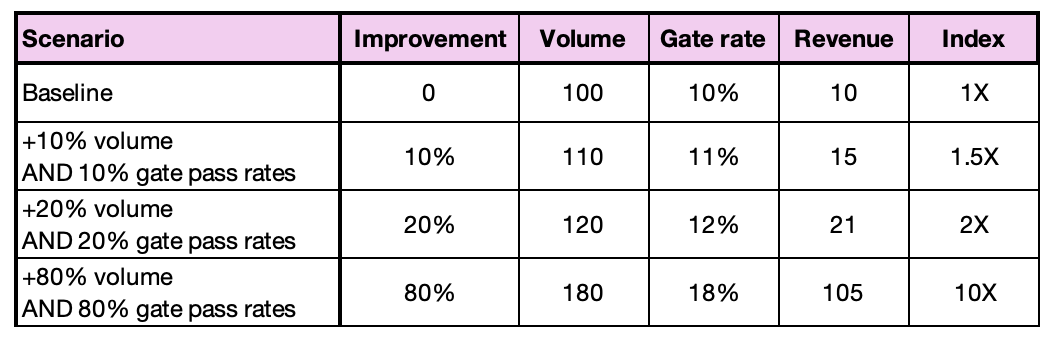
The Compounding Maths
Similar to what we saw with the hyper growth framework, we can optimise the output of each gate in a funnel in a linear way (through trial and error), but optimising multiple gates at the same time could lead to exponential compounding growth in output from the system.
Baseline:
100 people enter
3 gates in the funnel
each gate passes 10% and rejects 90%
each conversion is worth $100
“With 3 gates at 10% each, only 0.1% make it through: 100 × 0.1 × 0.1 × 0.1 = 0.1 conversions.”
The Funnel Map: Volume × Sensitivity
So, how can you use AI to turbocharge your funnel’s output? And which tasks should be run by humans vs which should be run by AI?
Consider two axes:
Volume: how much volume your funnel is designed to handle
Sensitivity: how expensive it is to be wrong (money, trust, regulation, reputation)
This uses the same “stakes” axis as The AI-Jobs Framework.
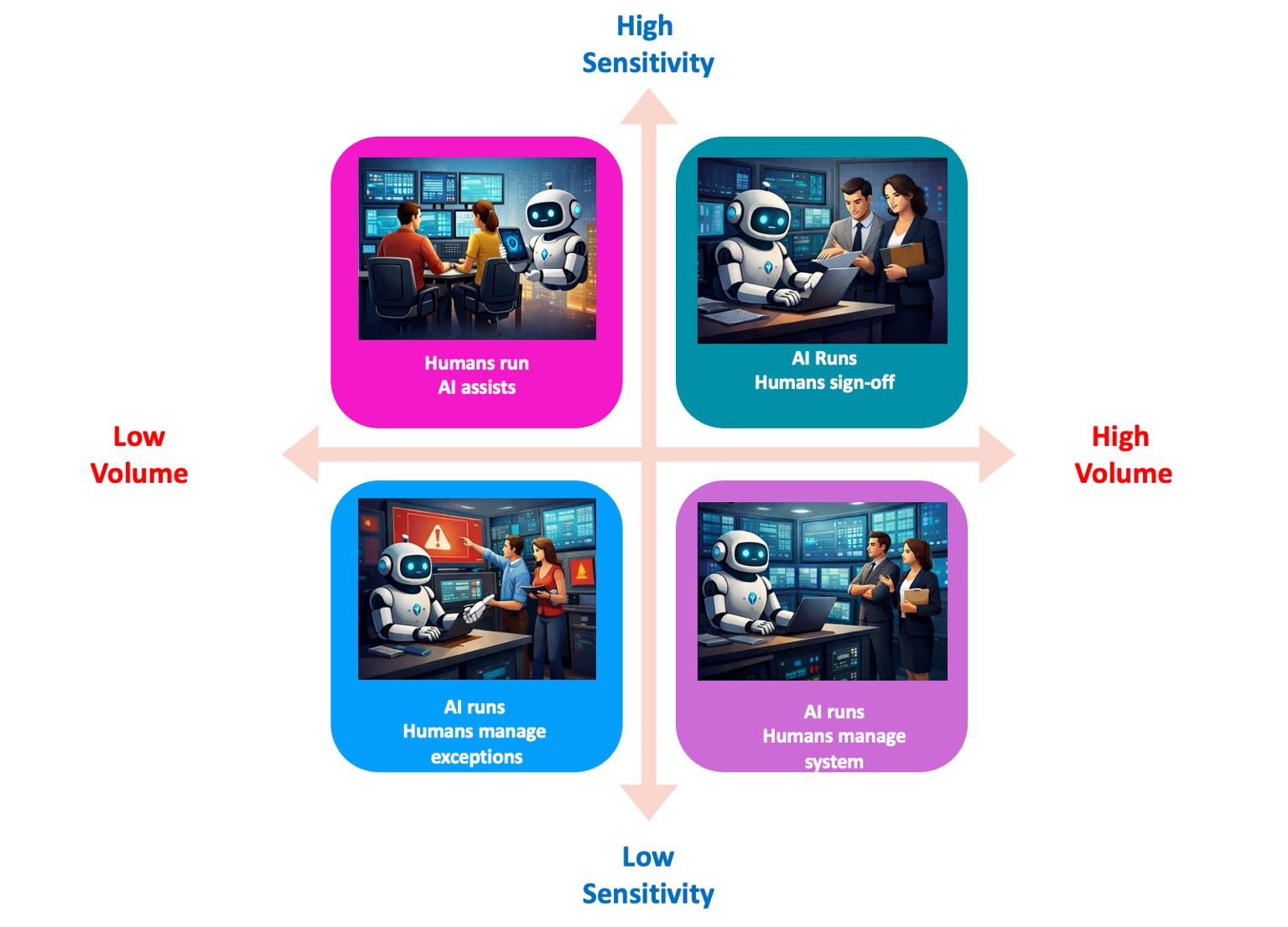
High volume – Low sensitivity
Examples: ecommerce checkout, content subscribe, freemium signup
Who runs the gate: AI runs the gate. Humans supervise.
Do differently: Remove friction, automate variants, and run fast tests to maximise throughput.
High volume – High sensitivity
Examples: hiring at scale (company POV), compliance onboarding
Who runs the gate: AI runs the gate under human-defined rules.
Do differently: Route intelligently, keep decisions explainable, and enforce clear escalation paths.
Low volume – Low sensitivity
Examples: simple support, community join, lightweight onboarding
Who runs the gate: AI runs end-to-end. Humans handle exceptions.
Do differently: Set hard escalation boundaries and monitor re-contact or failure loops.
Low volume – High sensitivity
Examples: fundraising, partnerships, enterprise sales, senior hiring
Who runs the gate: Humans run the gate. AI assists.
Do differently: Operate account-by-account. Humans own trust, narrative, and final calls.
The Operator Layer
Use AI like a junior operator you can delegate to.
Give it a wrapper: allowed actions, forbidden actions, escalation triggers.
Four jobs:
Watch: track what turns into hires/purchases, and find the gates bleeding conversions.
Decide: score fit/intent, route, propose which gate to delete/amend next.
Write: draft what moves someone to the next gate (CVs, emails, landing copy, content).
Iterate: propose variants, track winners/losers, segment (don’t average).
Make It Profitable. Then Scale It.
Rule: tune until it makes more money than it costs to operate.
At a minimum:
value per conversion > cost per conversion
payback fast enough to reinvest
Once unit economics are positive, you have a self-funding loop. A perpetual motion machine:
reinvest profit into more high‑intent volume
monitor drift and fix it
compound into scale
If you want the extreme version, this starts to look like a swarm. See The Swarming Framework.
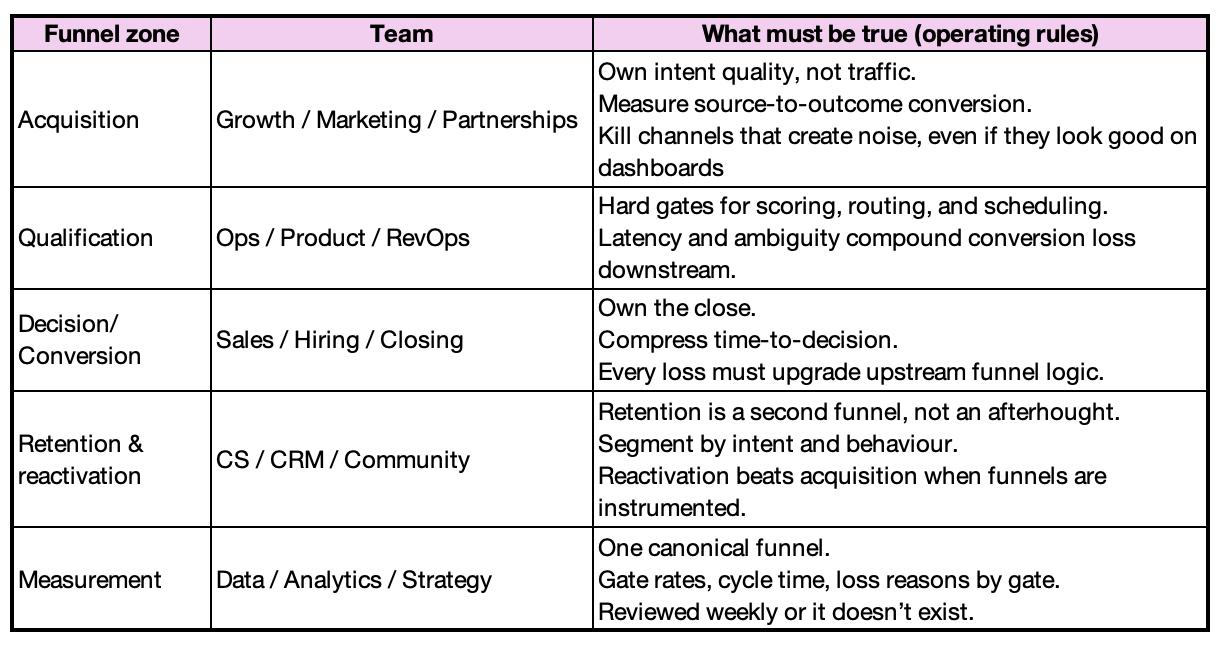
Organize your business around the funnel
Different teams must own specific parts of the funnel. Structure the organisation so each gate has clear ownership and KPIs, and ensure these are tracked and incentivised.
Where This Framework Applies
Hiring (candidate POV): apply → screens → interviews → offer
Hiring (company POV): sourcing → inbound → loop → close → onboarding
Ecommerce: impressions → clicks → PDP → cart → purchase → repeat
Freemium SaaS: visit → signup → activation → habit → upgrade
Content: impressions → clicks → subscribers → readers → referrals
Sales: leads → qualify → demo → proposal → close → renew
Fundraising: list → intro → meeting → partner → diligence → term sheet → close
Partnerships: outreach → discovery → pilot → contract → expand
Customer support: ticket → triage → diagnose → resolve → follow‑up
…and many more
In Summary
A funnel is a system. Its output is determined by the volume you feed in, the number of gates, and the pass rate of each gate.
Teams try to improve funnels by adding activity – more traffic, more steps, more tools. That usually increases entropy, not output.
The leverage comes from design. Name your gates. Remove the ones that do no real work. Fix the single gate that leaks the most before scaling volume.
AI doesn’t change this logic. It amplifies it. Used well, AI runs repeatable, high-volume gates and exposes where friction and drop-off occur. Used poorly, it scales noise and hides structural problems.
Small improvements across multiple gates compound. That is where exponential gains come from.
The job of leadership is to design the organisation around the funnel, assign clear ownership to each gate, and align incentives to the few metrics that actually drive funnel throughput and growth – while deciding which gates machines run and which require human judgment.
Check out some of my other Frameworks on the Fast Frameworks Substack:
May every sunset bring you peace!
Entity AI, swarms and the future of work (Asymmetric Podcast)
Fast Frameworks Podcast: Entity AI-Episode 8: Meaning, Mortality, and Machine Faith
Fast Frameworks Podcast: Entity AI - Episode 7: Living Inside the System
Fast Frameworks Podcast: Entity AI – Episode 5: The Self in the Age of Entity AI
Fast Frameworks Podcast: Entity AI – Episode 4: Risks, Rules & Revolutions
Fast Frameworks Podcast: Entity AI – Episode 3: The Builders and Their Blueprints
Fast Frameworks Podcast: Entity AI – Episode 2: The World of Entities
Fast Frameworks Podcast: Entity AI – Episode 1: The Age of Voices Has Begun
The Entity AI Framework [Part 1]
The Promotion Flywheel Framework
The Immortality Stack Framework
Frameworks for business growth
The AI implementation pyramid framework for business
A New Year Wish: eBook with consolidated Frameworks for Fulfilment
AI Giveaways Series Part 4: Meet Your AI Lawyer. Draft a contract in under a minute.
AI Giveaways Series Part 3: Create Sophisticated Presentations in Under 2 Minutes
AI Giveaways Series Part 2: Create Compelling Visuals from Text in 30 Seconds
AI Giveaways Series Part 1: Build a Website for Free in 90 Seconds
Business organisation frameworks
The delayed gratification framework for intelligent investing
The Fast Frameworks eBook+ Podcast: High-Impact Negotiation Frameworks Part 2-5
The Fast Frameworks eBook+ Podcast: High-Impact Negotiation Frameworks Part 1
Fast Frameworks: A.I. Tools - NotebookLM
The triple filter speech framework
High-Impact Negotiation Frameworks: 5/5 - pressure and unethical tactics
High-impact negotiation frameworks 4/5 - end-stage tactics
High-impact negotiation frameworks 3/5 - middle-stage tactics
High-impact negotiation frameworks 2/5 - early-stage tactics
High-impact negotiation frameworks 1/5 - Negotiating principles
Milestone 53 - reflections on completing 66% of the journey
The exponential growth framework
Fast Frameworks: A.I. Tools - Chatbots
Video: A.I. Frameworks by Aditya Sehgal
The job satisfaction framework
Fast Frameworks - A.I. Tools - Suno.AI
The Set Point Framework for Habit Change
The Plants Vs Buildings Framework
Spatial computing - a game changer with the Vision Pro
The ‘magic’ Framework for unfair advantage