

TL;DR — The Xeme Framework
Just as biology evolves through genes, and ideas spread through memes, in the Xeme Framework, I introduce the xeme as the way useful learning propagates in markets and organisations.
A xeme is the smallest transferable unit of learning created by a real-world test and embedded into a system.
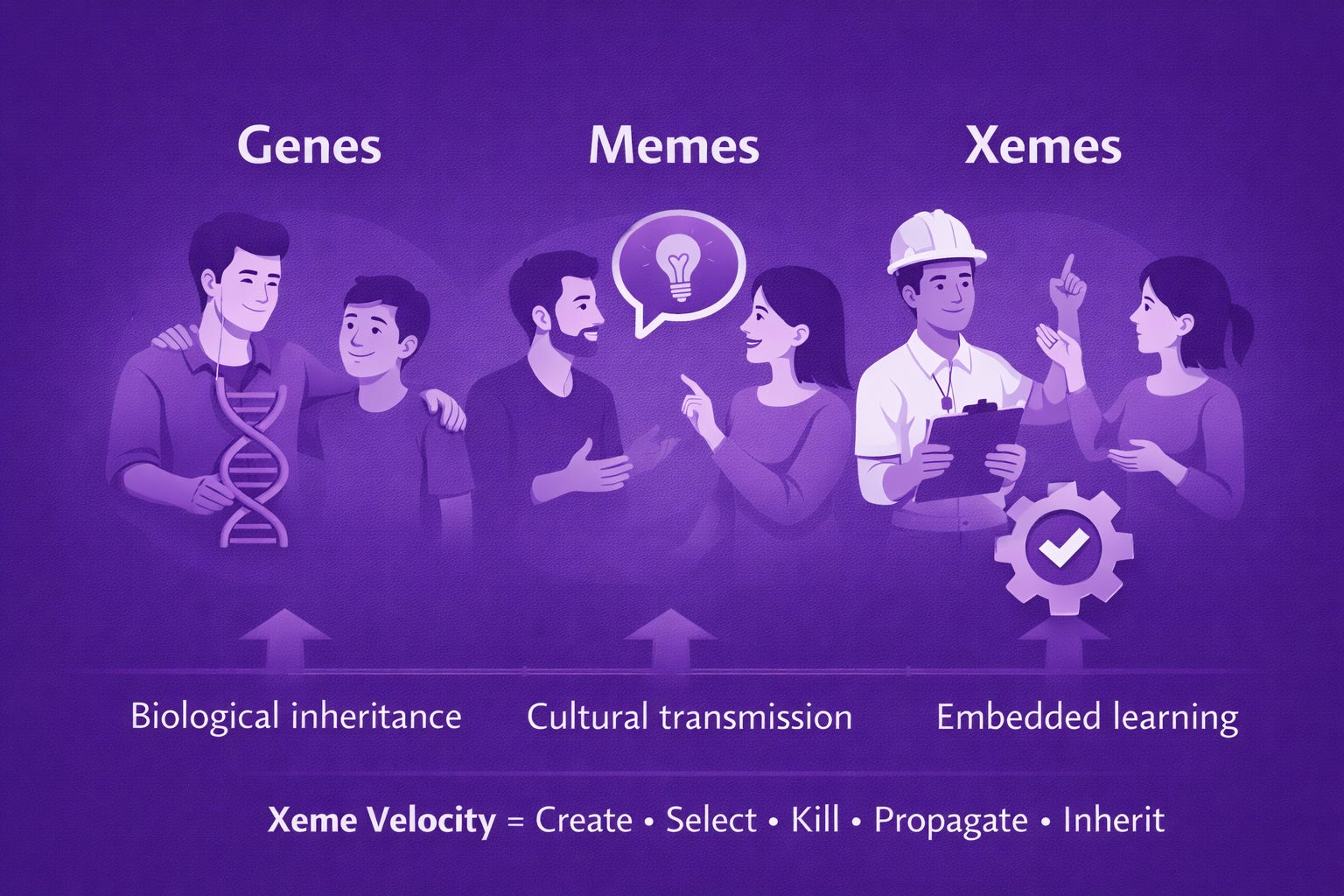
Competitive advantage comes from xeme velocity: how fast a system can create, kill, propagate, and inherit learning.
Systems that embed xemes into products, processes, and defaults compound progress. Systems that don’t end up relearning the same lessons again and again.
This framework is about how to harness xemes to drive hypergrowth.
China is used as a live case study, not because it is unique, but because its competitive environment makes xeme dynamics visible at full speed.
For years, China was where Western companies went to grow. Now it is where they are being outcompeted. Chinese companies have dominated at home across sectors and are rapidly expanding abroad.
In 2024, Porsche’s sales in China fell by roughly 28 percent. BMW’s dropped by more than 13 percent, pulling down global performance because China had been one of its most important profit pools. General Motors took a multi-billion-dollar write-down on its China business after sustained losses. Starbucks reported a double-digit fall in same-store sales in China while local competitors continued to expand. H&M saw sales collapse following consumer backlash and has since reduced visibility and ambition in the market.
These outcomes are often explained through geopolitics, regulation, or cultural missteps. All of those contribute. But even when you account for them, a deeper, more general pattern remains.
The core issue is structural.
Chinese markets generate learning at a rate that overwhelms old school organisations built for planning, control, and linear improvement. Companies that survive do so because they adapt faster, not because they forecast better.
China’s advantage is not just creativity, scale, or cheap labour. It is learning speed under pressure.
The Xeme Framework
The Xeme Framework shows how to build organisations that evolve and scale quickly
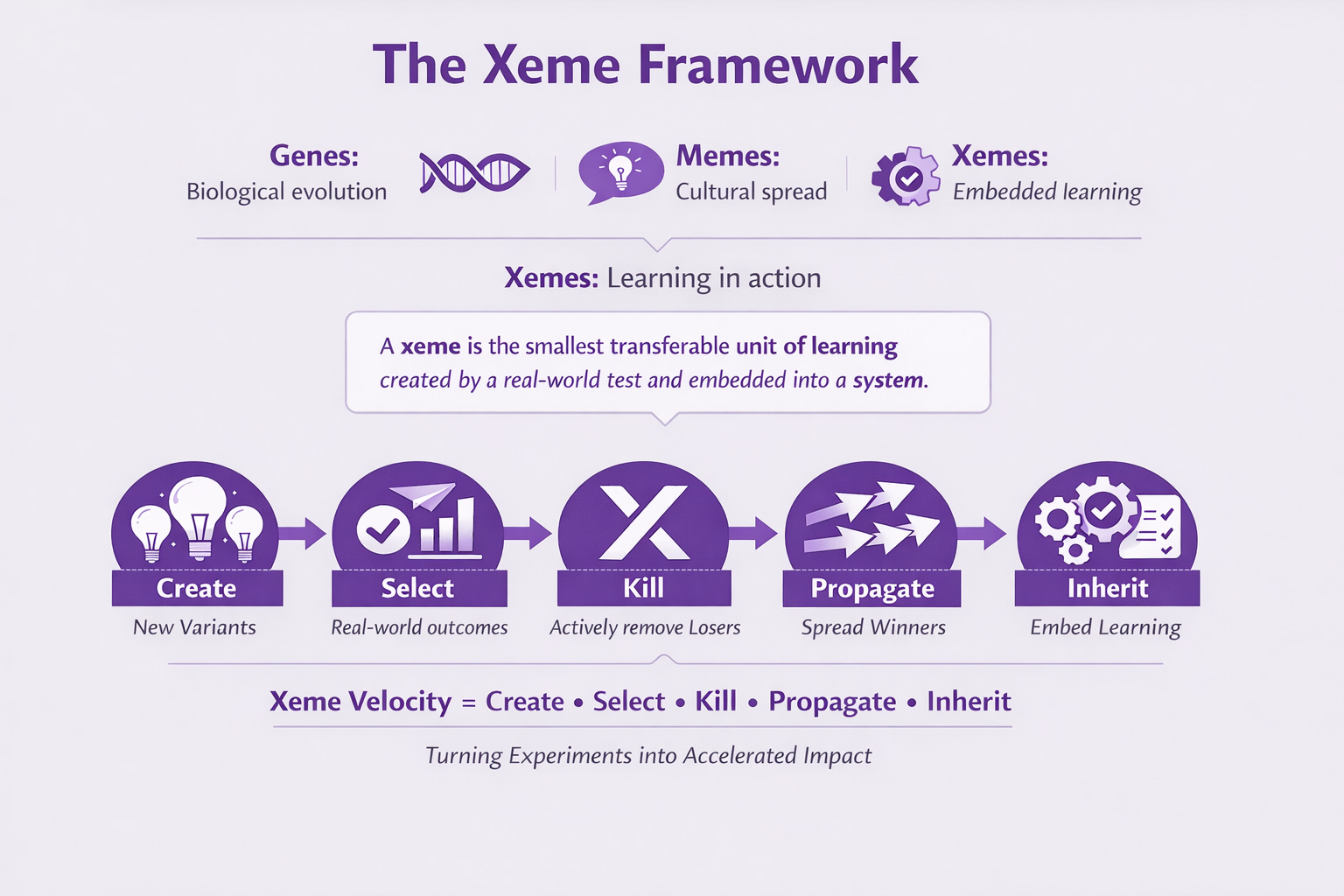
From genes to memes to xemes
In biology, evolution works because genes carry learning forward. Variation is tested by the environment. What fits survives through inheritance.
In culture, Richard Dawkins introduced the idea of the meme: a unit of cultural transmission that spreads through imitation. Memes compete for attention. The ones that resonate propagate.
Markets evolve in a similar way, but through execution rather than imitation.
A xeme is a term I constructed to describe this process. It is deliberately new, because existing business language blurs the difference between having an insight and changing how a system behaves.
A xeme is produced when something is executed in the market and results in a clear outcome.
If the outcome is positive, the xeme is retained and carried forward.
If the outcome is negative, the xeme is killed and disappears.
Xemes are not ideas, opinions, intentions, or post-mortems. They are earned through action and confirmed by behaviour.
The pace at which a system evolves depends on how many xemes it can create, select, kill, propagate, and inherit per unit time.
The Wheel as a xeme
An early xeme may have emerged when a human tested a round object and noticed that it rolled. The experiment worked. That learning did not remain an isolated observation. It was embedded.
First in a simple cart. Then in wheels. Later in pulleys, mills, gears, and transport systems.
Like genes in a biological system, xemes persist through inheritance. They are reused, recombined, and refined across generations of products and ideas.
You can trace the wheel in a modern car back to that early xeme: the retained learning that a circular form enables efficient rolling. Materials and tolerances have changed. The underlying learning has not.
This is why iteration alone is not enough.
Evolution comes from retaining what works and building on it.
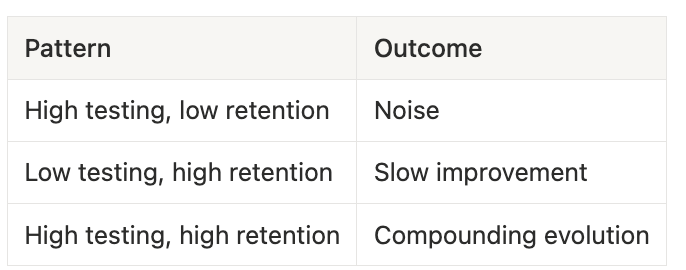
A system that runs many tests but forgets the learning generates activity without progress.
A system that runs few tests learns slowly.
A system that runs many tests and reliably embeds successful xemes evolves rapidly.
The importance of iterations vs the importance of time
We think compound interest is a function of time. Not so.
Iterations beat time. Compounding is not primarily a function of elapsed time. It is a function of how many iterations you can run in an iterated game. If you can create more iterations in a shorter period, you compound faster. A xeme is the compounding element of the system. The more winning xemes you generate and embed, the faster the system compounds.
How xeme systems actually evolve
All Darwinian systems share the same core logic. What differs is how efficiently each stage runs. To avoid ambiguity, it helps to separate the mechanics explicitly.
Creation (variation)
New candidates are introduced: features, prices, messages, bundles, processes, architectures, supply configurations.
Selection
The environment decides what survives. In markets, this shows up through behaviour and economics: conversion, repeat, cost, speed, willingness to pay, churn, substitution.
Killing
Failed variants must be removed.
In slow organisations, they linger, accumulate defenders, and consume attention.
High-xeme systems kill quickly and quietly, keeping the system clean.
Propagation
Winning xemes spread.
They move from one product to the next, from one team to another, from one category to adjacent ones.
Inheritance
Winning xemes are encoded into defaults, constraints, rules, systems, and architectures.
Propagation distributes winning variants.
Inheritance locks them into how the system now behaves.
Many organisations are weak at this final step. They generate activity and even insight, but they fail to encode learning. As a result, the same lessons are rediscovered repeatedly by different teams at different times and places.
Here’s what inheritance looks like in practice. A winning creative pattern stops being a one-off “great ad” and becomes a template enforced by tooling and default briefs. A winning price-pack architecture becomes the default SKU ladder reused across categories. A winning supply response becomes an MOQ and lead-time rule encoded in procurement systems.
In China advantage comes not just from higher test volume. It is faster killing, propagation, and inheritance of winning xemes that drives winning advantage.
What qualifies as a xeme
To prevent “xeme” collapsing into “insight”, a learning must meet all five conditions.
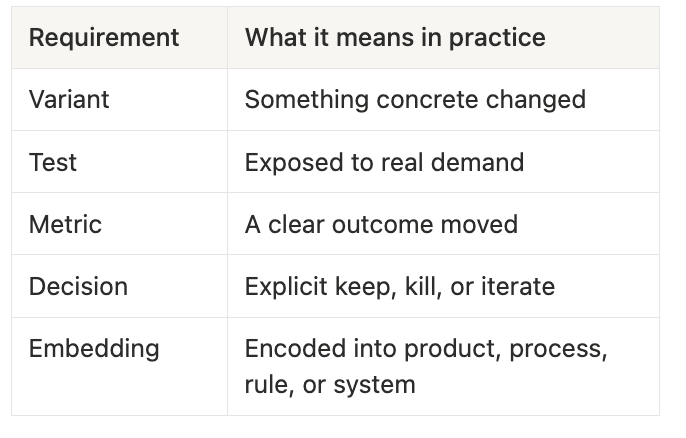
Until learning is embedded, it does not alter future behaviour.
A practical proxy for xeme velocity is:
Embedded decisions per week or month that survive a real-world test and show measurable impact above a defined threshold (or survive a holdout test).
This avoids confusing motion with progress.
Why China produces xemes so fast
China’s market combines three conditions that dramatically accelerate the xeme lifecycle.
First, experimentation is cheap. Launching a new product, format, bundle, or message rarely requires long planning cycles or heavy approval structures.
Second, feedback is immediate. Platforms, mobile payments, logistics, and social commerce expose real demand in near real time.
Third, selection pressure is intense. Weak ideas lose quickly to better ones. There is little protection for incumbents and limited tolerance for underperformance.
Together, these conditions turn the market into a continuous xeme engine.
How xeme velocity shows up in China
China does not win because it has a different playbook.
It wins because xeme velocity shows up clearly and relentlessly across five domains.
Each domain touches multiple stages of the xeme lifecycle, but each one accelerates a different constraint. Together, they form a system that learns faster than most Western organisations are built to handle.
1. Speed as strategy (xeme creation)
Speed matters because it determines how many xemes a system can generate.
Products are launched into live markets before they are finished. The market itself becomes the lab.
Each launch is a test. Each test either creates a xeme or kills one. Failure stays cheap. Delay becomes expensive.
Luckin Coffee illustrates this clearly. New drinks are launched continuously. Real transaction data decides the outcome fast. Losers disappear within days. Winners are rolled out across thousands of stores almost immediately.
This is not chaos or lack of discipline. It is industrial-scale xeme creation.
Learning comes from volume, speed, and ruthless pruning.
2. Platform-native operating models (xeme selection)
In the traditional AIDA funnel, learning is fragmented.
Awareness is built through mass media
Interest is captured through search
Desire is shaped through social
Action happens in retail or checkout
Each stage sits on a different platform, owned by different teams, measured by different metrics. Drop-offs happen between stages. When a consumer disappears, the system rarely knows why. When something works, the learning arrives late and partial. The signal weakens at every handoff.
A xeme needs a tight loop: variant → test → metric → decision.
Fragmented funnels weaken that loop. There is too much friction and too much loss of information between stages.
In China’s social commerce model, this fragmentation collapses.
A single 15-second shoppable video on Douyin can generate awareness, interest, desire, and action in one continuous interaction. The consumer sees, wants, and buys without leaving the environment.
Live commerce driven by shoppable video is already the core driver of growth and advantage in Chinese ecommerce. This is no longer experimental. It is the operating norm. You can identify winners and losers in Chinese consumer products simply by asking who has adapted to this reality and who has not.
The outcome is immediate. The signal stays clean. A xeme is created in real time.
Platforms in this world act as selection engines, not marketing channels.
3. Value engineering (xeme discovery under cost pressure)
Chinese firms do not compete by stripping features or racing to the bottom on price.
They compete by delivering the best possible product at a price the consumer is willing to pay, without compromising on either dimension.
They start with a price that clearly works in the market and engineer backwards. This forces trade-offs into the open: which features stay, which are removed, which components are redesigned, which suppliers are bypassed, which steps are automated.
Each trade-off is tested. Each test produces a xeme about what customers value and what they will pay for.
Some selection signals here are fast. Others arrive through returns, service rates, and repeat behaviour. Over time, these value xemes accumulate into deep advantage.
A concrete example is the Xiaomi YU7. In China, it delivers stronger features, functionality, and perceived quality than the Tesla Model Y, at a price closer to £25–30k. My Model Y in the UK costs around £53k.
Tesla has been forced to cut prices sharply in China to stay competitive. Xiaomi is still winning on features and quality. That is not branding. That is xeme-driven value engineering: fix the acceptable price, then iterate relentlessly until the product meets or exceeds expectations at that price.
4. Cultural fluency through fast testing (xeme creation, selection, and killing in meaning)
Culture behaves like an environment too.
In China, cultural meaning is not argued about in advance. It is tested in public, at speed.
Brands put out multiple cultural expressions quickly: tone, colour, language, symbolism, references, formats. Most don’t land. Some do. Each outcome produces a xeme about what feels current, authentic, or aspirational to a specific audience at that moment.
A good example is Li-Ning.
Li-Ning’s resurgence is often described through Guochao, a term that broadly means a “national trend”: modern consumer brands reworking Chinese cultural symbols and pride into contemporary, globally legible products. This did not come from a single rebrand or a flash of creative genius.
It emerged through repeated testing at the intersection of sport, streetwear, and Chinese cultural references. Early attempts varied widely in tone and execution. Many failed. A small number resonated strongly. Those winning cultural expressions were retained and reused across products, campaigns, and collaborations.
Over time, these retained cultural xemes formed a coherent foundation. New designs built on what had already proven to work. Demand accelerated. Copycats appeared. Li-Ning’s advantage came from iterating faster on the same cultural base, not from constantly searching for something new.
Cultural fluency here is not taste or intuition.
It is the ability to generate, kill, and inherit cultural learning faster than competitors.
5. Networked supply as a learning system (xeme propagation and inheritance)
Supply determines whether winning xemes can propagate.
This is where SHEIN is the clearest example.
SHEIN does not treat supply as a static cost centre. It treats it as a learning system. Designs are launched in micro-batches, sometimes as small as a few dozen units. Real demand data determines what survives. Losers are killed quietly. Winners are scaled rapidly.
Each production decision produces a xeme: about price elasticity, fit, fabric choice, lead time, quality tolerance, and trend decay. When a design xeme proves itself, SHEIN’s software-driven supplier network allows it to propagate across factories, regions, and categories almost immediately.
Crucially, these learnings do not live in decks or presentations. They are embedded into procurement rules, MOQ thresholds, lead-time assumptions, and supplier scoring systems. That is inheritance.
This is why networked supply matters. Without it, even the best product or cultural xeme remains local. With it, winning xemes become systemic advantage.
Xemes across domains
A xeme is the same idea everywhere. What changes is the forms in which it shows up across domains.
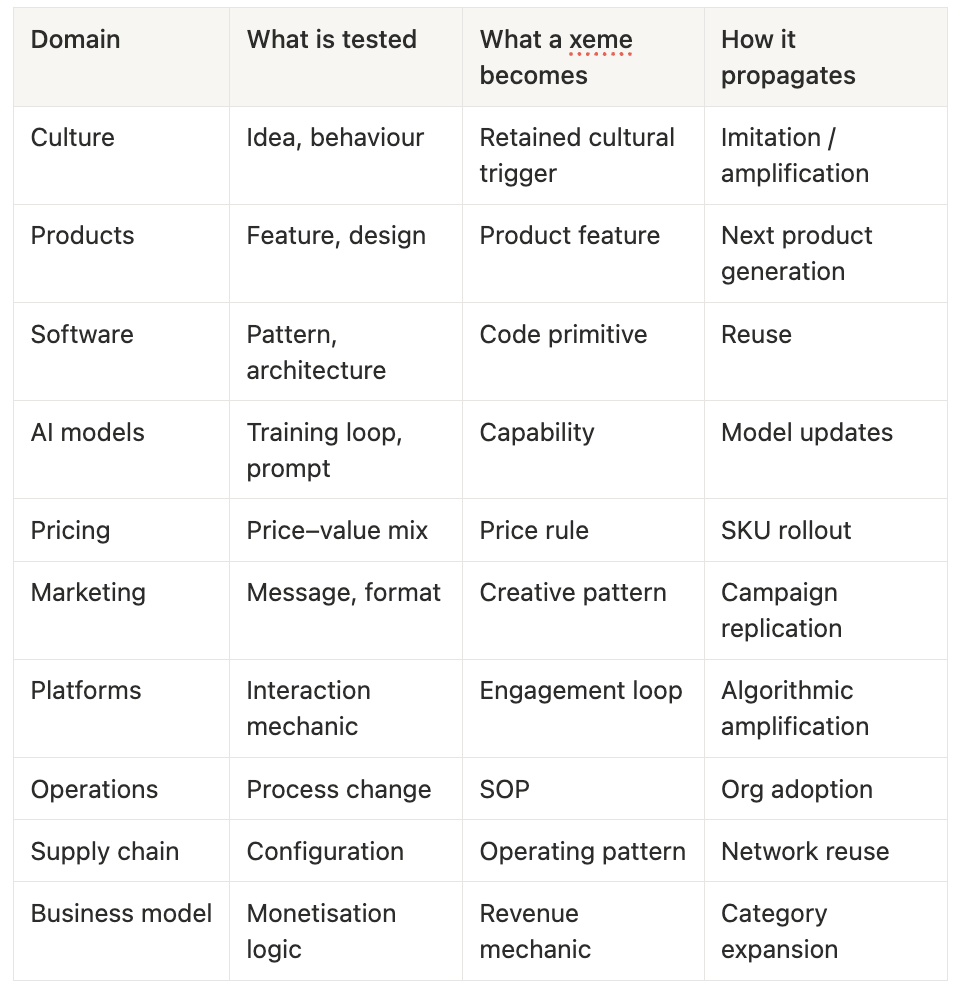
This is why the xeme is a useful abstraction. It explains learning across products, culture, technology, operations, and strategy using one underlying mechanism.
AI as a xeme accelerator
AI does not create intelligence. It accelerates evolution. It increases xeme velocity in three ways.
Creation
AI lowers the cost of generating variants: designs, copy, prices, code, workflows.
Selection
AI detects patterns earlier in messy data, reducing ambiguity about what is working.
Inheritance
AI makes retention easier. Winning learning can be encoded into models, workflows, recommendations, QA checks, pricing systems, and defaults.
This is why high-growth companies in very different places share the same underlying strength. NVIDIA’s advantage reflects decades of retained architectural and ecosystem xemes. Netflix’s advantage reflects continuous experimentation with strong institutional memory. OpenAI’s advantage reflects rapid deployment, wide feedback, and fast embedding of what works.
Xemes are not nationalistic.
They thrive wherever environments allow cheap experimentation, fast feedback, and reliable retention.
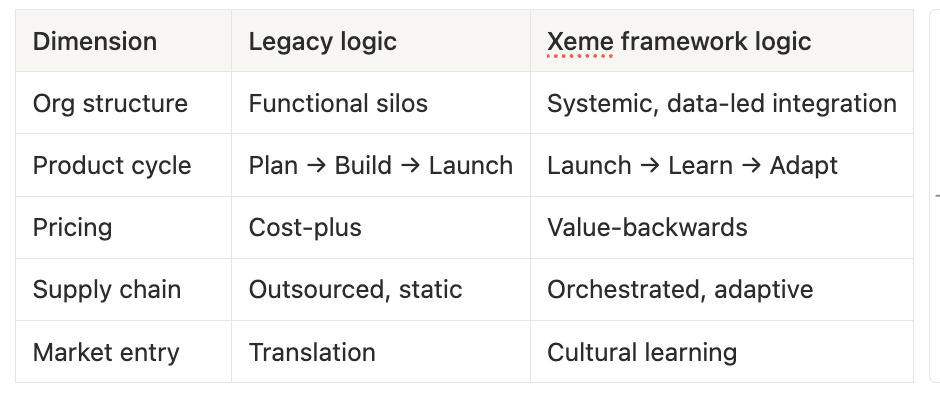
Structuring organisations to leverage xeme driven growth
Under sustained selection pressure, organisations reorganise themselves.
Why xeme velocity compounds
This is why performance often looks chaotic early on, then accelerates suddenly. The S-curve is accumulated xemes crossing a threshold. Remember, hyper growth is driven why iterations, not time. Compress maximum iterations in the minimum time.
Im my hyper growth framework I describe how linear sequential improvements in four dimensions - traffic, conversion, basket size and repeat rate create a multiplicative effect whose mathematical product results in a a exponential growth trend. Put simply, an organisation which creates an accelerating list of xemes on those 4 dimensions will scale exponentially.
So what should you do?
Make xemes visible. Track embedded decisions that survived market tests.
Lower the cost of failure and raise the cost of delay.
Collapse feedback loops wherever possible.
Build systems that retain and reuse learning.
Treat value and culture as testable systems, not declarations.
Structure the organisation in a way that creates and captures memes in ways where the result is multiplicative, not just additive.
The inevitable outcome
Ive always felt it is a superpower to see whats happening in China (and Silicon Valley) today - because that enables you to predict the future as other people and places do the same things a few years later. The Chinese model where speed of iteration is a core competitive advantage along with a data driven networked ecosystem will be the default model for winning companies over the next decade.
This is not about China winning. It is about environments selecting.
As competitive pressure increases and AI lowers the cost of variation, organisations that generate and retain xemes faster will evolve faster. Those built for slower learning loops will fall behind until the gap becomes structural.
China shows this future clearly because selection pressure is high and feedback loops are tight. The same logic spreads wherever those conditions appear.
Others will follow, not out of admiration, but because the environment leaves them no alternative.
Bibliography & Further Reading
The Xeme Framework draws on work across evolutionary biology, economics, platform theory, and real-world operating systems. The sources below are useful lenses for understanding how learning compounds through variation, selection, and inheritance.
Evolution, learning, and selection
On the Origin of Species — Charles Darwin https://www.gutenberg.org/ebooks/1228
The Selfish Gene — Richard Dawkins https://en.wikipedia.org/wiki/The_Selfish_Gene
An Evolutionary Theory of Economic Change — Richard Nelson & Sidney Winter
https://press.princeton.edu/books/paperback/9780674272286/an-evolutionary-theory-of-economic-change
Experimentation, fast learning, and institutional memory
The Lean Startup — Eric Ries
https://theleanstartup.com/book
Experimentation Works — Stefan Thomke
https://www.hbs.edu/faculty/Pages/profile.aspx?facId=6568
Netflix Tech Blog
https://netflixtechblog.com
China-specific competitive dynamics
AI Superpowers — Kai-Fu Lee
https://www.amazon.com/AI-Superpowers-China-Silicon-Valley/dp/132854639X
Rest of World — SHEIN supply chain analysis
https://restofworld.org/2022/shein-fast-fashion-supply-chain/
McKinsey — China consumer and retail insights
https://www.mckinsey.com/featured-insights/china
Social commerce and funnel collapse
Bain & Company — China social commerce
https://www.bain.com/insights/topics/china-social-commerce/
Financial Times — Livestream commerce in China
https://www.ft.com/content/6a1e2a9e-2b78-4e3a-9f93-ec7a4f87a3c5
Value engineering and backward design
Competing Against Luck — Clayton Christensen
https://www.amazon.com/Competing-Against-Luck-Innovation-Customer/dp/0062435612
Toyota — Toyota Production System
https://www.toyota-global.com/company/vision-and-philosophy/production-system/
AI as an accelerator of learning systems
OpenAI — Research and system cards
https://openai.com/research
NVIDIA — CUDA & developer ecosystem
https://developer.nvidia.com/cuda-zone
Landing AI — Data-centric AI (Andrew Ng)
https://landing.ai/data-centric-ai/
Further Reading: China today and how ideas propagate at scale
These articles document how competition, platforms, and social networks in China accelerate the creation, propagation, and inheritance of winning ideas, behaviours, and products.
China’s current competitive dynamics
The China struggle - has the China dream become a struggle?
Financial Times — China’s price wars are reshaping its consumer economy
https://www.ft.com/content/6f6e4f7a-9b6e-4a47-b2b4-4d6e6d9a0f8a
The Economist — Why China’s companies compete so fiercely
https://www.economist.com/business/2023/09/14/why-chinas-companies-compete-so-fiercely
McKinsey — The new Chinese consumer: What matters now
https://www.mckinsey.com/featured-insights/china/the-new-chinese-consumer

Propagation of memes, behaviour, and demand through networks
Rest of World — How Douyin turned short videos into China’s most powerful shopping channel
https://restofworld.org/2022/douyin-china-shopping/
MIT Technology Review — How recommendation algorithms shape culture at scale
https://www.technologyreview.com/2022/11/18/1063365/recommendation-algorithms-culture/
Optional: social-network diffusion (foundational)
Nature — The spread of behaviour in online social networks
https://www.nature.com/articles/s41586-020-03119-0
Check out some of my other Frameworks on the Fast Frameworks Substack:
May every sunset bring you peace!
Entity AI, swarms and the future of work (Asymmetric Podcast)
Fast Frameworks Podcast: Entity AI-Episode 8: Meaning, Mortality, and Machine Faith
Fast Frameworks Podcast: Entity AI - Episode 7: Living Inside the System
Fast Frameworks Podcast: Entity AI – Episode 5: The Self in the Age of Entity AI
Fast Frameworks Podcast: Entity AI – Episode 4: Risks, Rules & Revolutions
Fast Frameworks Podcast: Entity AI – Episode 3: The Builders and Their Blueprints
Fast Frameworks Podcast: Entity AI – Episode 2: The World of Entities
Fast Frameworks Podcast: Entity AI – Episode 1: The Age of Voices Has Begun
The Entity AI Framework [Part 1]
The Promotion Flywheel Framework
The Immortality Stack Framework
Frameworks for business growth
The AI implementation pyramid framework for business
A New Year Wish: eBook with consolidated Frameworks for Fulfilment
AI Giveaways Series Part 4: Meet Your AI Lawyer. Draft a contract in under a minute.
AI Giveaways Series Part 3: Create Sophisticated Presentations in Under 2 Minutes
AI Giveaways Series Part 2: Create Compelling Visuals from Text in 30 Seconds
AI Giveaways Series Part 1: Build a Website for Free in 90 Seconds
Business organisation frameworks
The delayed gratification framework for intelligent investing
The Fast Frameworks eBook+ Podcast: High-Impact Negotiation Frameworks Part 2-5
The Fast Frameworks eBook+ Podcast: High-Impact Negotiation Frameworks Part 1
Fast Frameworks: A.I. Tools - NotebookLM
The triple filter speech framework
High-Impact Negotiation Frameworks: 5/5 - pressure and unethical tactics
High-impact negotiation frameworks 4/5 - end-stage tactics
High-impact negotiation frameworks 3/5 - middle-stage tactics
High-impact negotiation frameworks 2/5 - early-stage tactics
High-impact negotiation frameworks 1/5 - Negotiating principles
Milestone 53 - reflections on completing 66% of the journey
The exponential growth framework
Fast Frameworks: A.I. Tools - Chatbots
Video: A.I. Frameworks by Aditya Sehgal
The job satisfaction framework
Fast Frameworks - A.I. Tools - Suno.AI
The Set Point Framework for Habit Change
The Plants Vs Buildings Framework
Spatial computing - a game changer with the Vision Pro
The ‘magic’ Framework for unfair advantage