

Iran can choke the Strait of Hormuz. Twenty per cent of the world’s oil passes through a waterway that Iranian anti-ship missiles can reach from the shore. Iran does not need to close it. The threat is enough to move markets, reposition navies, and wake up diplomats at midnight.
But Iranian oil tankers were also passing through that same strait, shipping crude to China and keeping Iran’s economy alive. Then the US announced it would interdict and stop all Iranian shipping traffic through Hormuz. Washington put a choke on Iran’s choke.
Now both sides are squeezing each other’s air supply. Iran can threaten global oil flow. The US can strangle Iran’s revenue. The question is who has more oxygen in their lungs and can last longer while being choked.
That question is impossible to answer if you do not know what kind of instrument each side is holding. There are two kinds of instruments, and they work completely differently.
Washington has spent years piling tariffs on Chinese goods. Hundreds of billions of dollars’ worth. China reroutes, substitutes, absorbs. It is painful but the goods still flow. That is the first kind of instrument: it raises costs, increases friction but nothing really stops.
When China restricted rare earth exports, the materials inside every advanced weapon, EV motor, wind turbine, and semiconductor, Washington panicked. While Tariffs raise costs, this could cut supply entirely. That is the second kind, the same kind as Hormuz. The flow is either on or off.
People call both these “pressure” and build strategy as if they are the same instrument. They are not.
The distinction
Think of a dimmer switch on a wall and an on/off switch next to it.
A dimmer controls brightness. Turn it down and the room gets darker, but you can still see.
An on/off switch controls whether there is any light at all. Flip it and the room goes black.
A tariff is a dimmer. It raises costs. You can still operate. You just pay more. Turn it high enough and it hurts, but the light stays on.
A choke point is an on/off kill-switch. It cuts the flow. There is no cost to calculate because there is nothing flowing. The light is off.
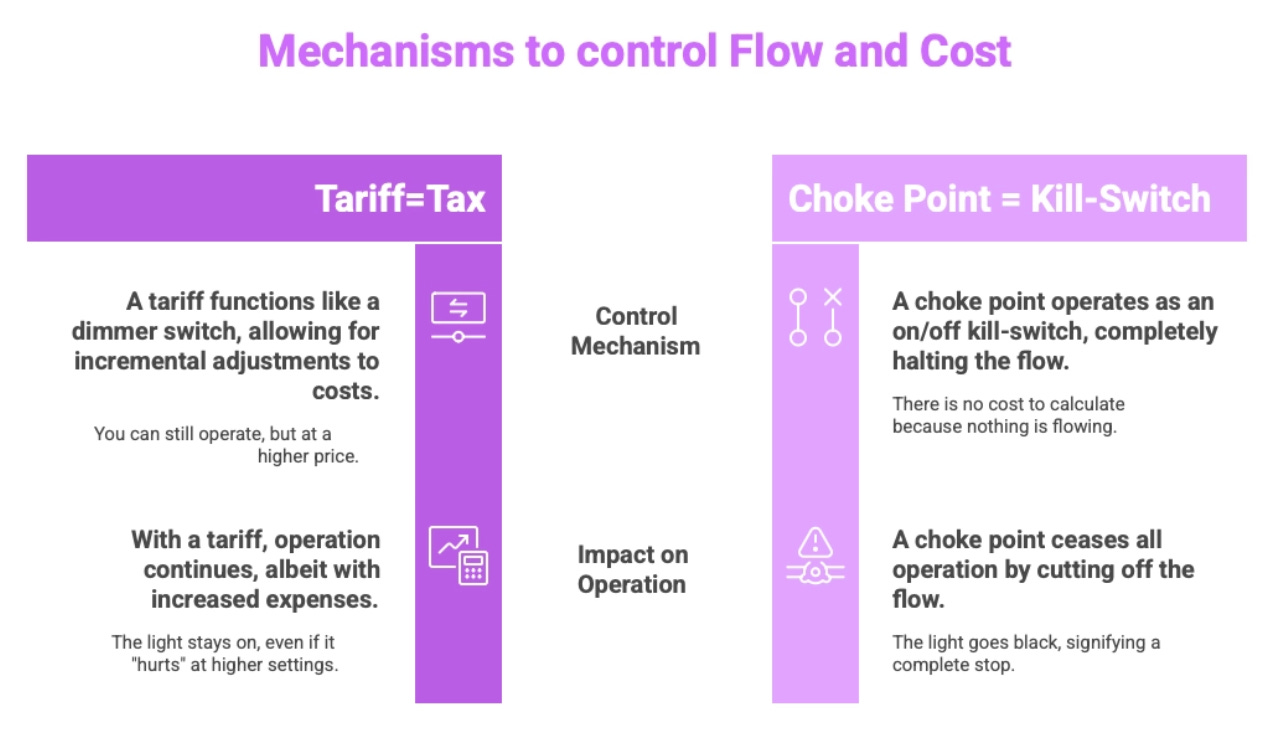
These are different instruments, not different intensities of the same one. A dimmer can be absorbed, rerouted, or waited out. A switch cannot. If you hold the switch, you do not even need to make threats. Everyone already knows.
People mix these up constantly, and the result is bad strategy. They throw dimmer-level tools at switch-level problems and wonder why nothing changes. Or they panic about a dimmer that someone could route around with six months of effort.
This is not only a geopolitics problem. You have switches in your own life: your biggest client, your landlord, your only supplier, the platform your business runs on, the person who signs your pay cheque. You probably have not mapped which ones are dimmers and which ones are switches. People usually find out the hard way.
The Framework
Two questions
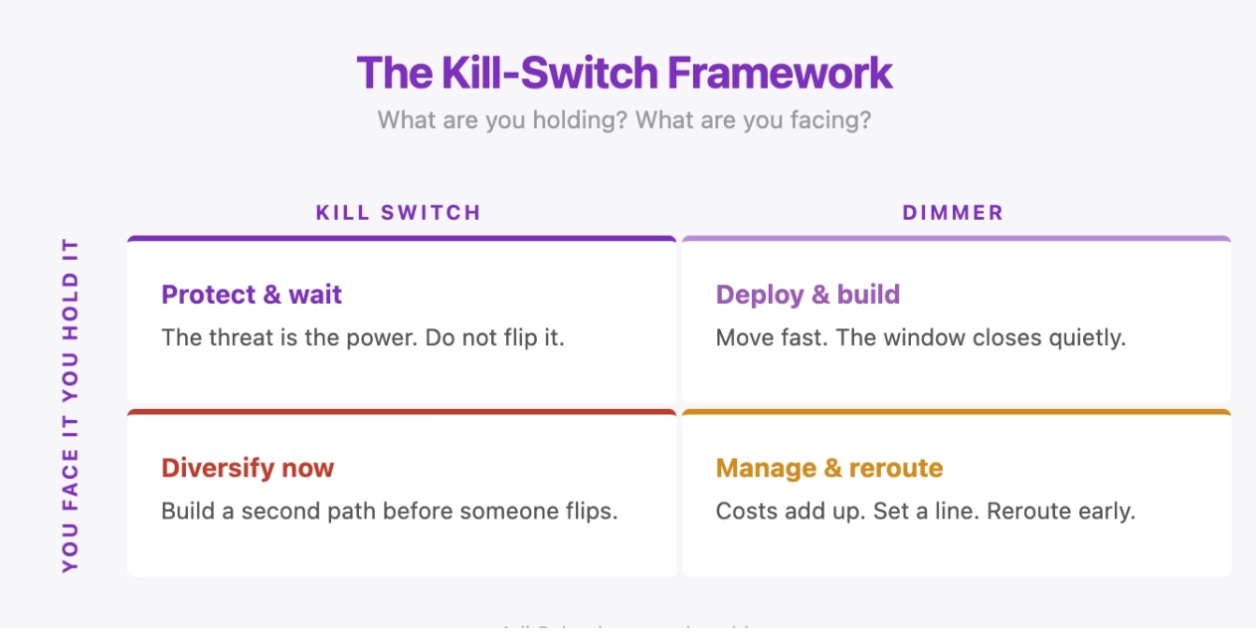
Before you do anything in a power situation, answer two questions. First: is the instrument in play raising costs or stopping flow? Second: are you holding it or facing it?
That gives you four positions, and each one needs a completely different response.
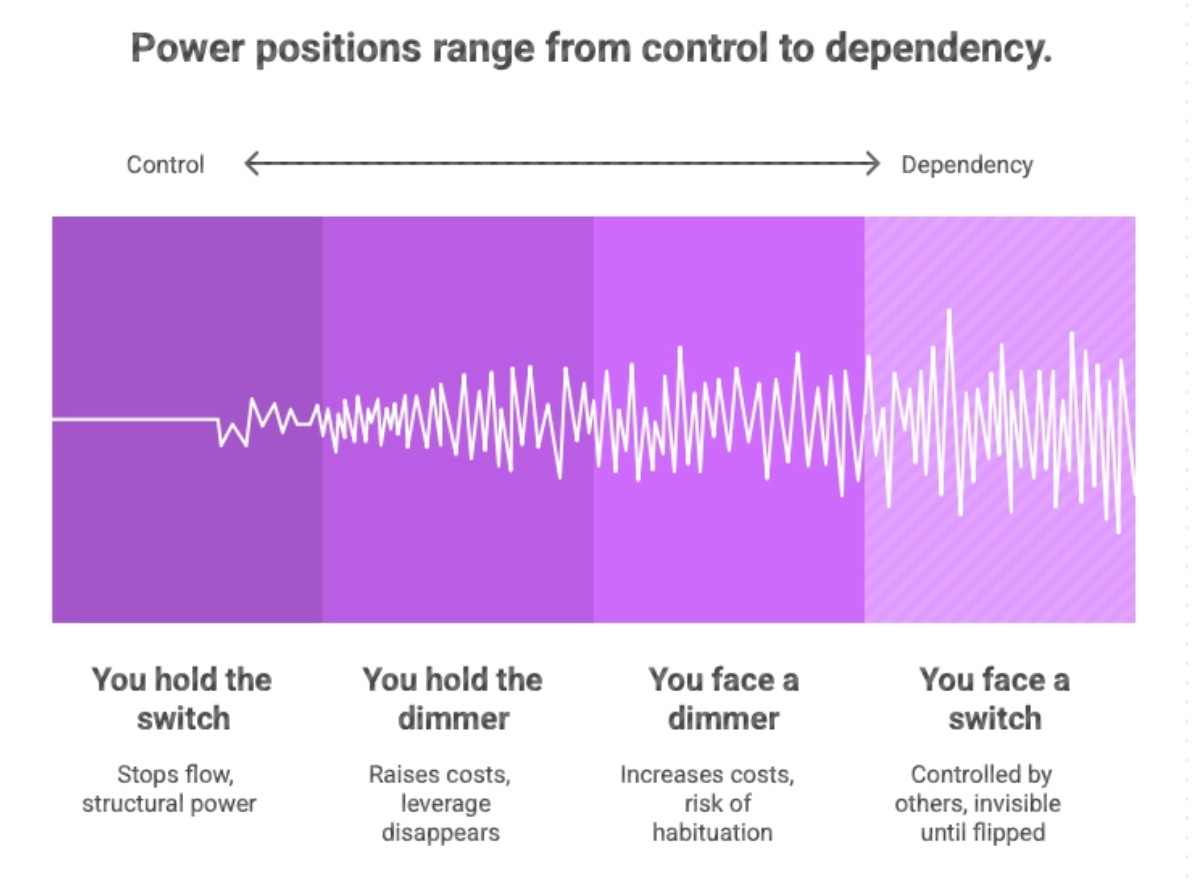
You hold the dimmer. You can make things expensive for the other side, but you cannot stop them. Your leverage disappears the moment they find a workaround or decide the cost is bearable. The window is short.
You hold the switch. You can stop flow. That is structural power, but the risk is that someone builds a way around you while you are not paying attention. Replacements get built slowly, and by the time you notice, you are no longer holding a switch.
You face a dimmer. Something is making you pay more to operate. It might be manageable. It might be slowly bleeding you dry. The danger is getting used to it, absorbing it by habit instead of by decision, and never asking whether there is a cheaper path.
You face a switch. Someone else controls whether you can operate at all. This is the worst position, and it is usually invisible until someone flips. The dependency was there long before the crisis. You just did not see it until someone flipped.
That is the whole diagnostic. The four positions map to a simple grid:

What each position demands
If you hold the switch, your instinct will be to use it. Resist the temptation. Once you flip a switch, the other side starts building around you and the threat disappears. Let them know you hold it, but do not demonstrate it. Use it as a backstop in negotiation, not an opener. Watch for replacements, because switches go stale. If you can, layer a second dependency underneath, so when the first one erodes you still have leverage. And do not squeeze for maximum value today. A switch held patiently gets stronger. Squeezed hard, it gets replaced. One more thing: holding a switch over someone wears down the relationship. In The Trust Framework, trust breaks when self-interest dominates. The moment the other side feels your switch as a weapon rather than a fact of the arrangement, trust collapses and they start building around you faster.
If you hold the dimmer, speed matters more than precision. Alternatives are always being built, and once they arrive your dimmer is worthless. Deploy it before the other side has options. Use the time it buys you to build toward something harder to replace. Stack several dimmers together if you do not have a real switch, because combined cost pressure can act like one. Sanctions plus tariffs plus logistics friction plus insurance restrictions plus compliance rules: no single one stops flow, but layered together they create a synthetic switch. But think about whether turning it up too hard makes the other side build the replacement faster. Sometimes holding back extends the window.
If you face a dimmer, this is a cost problem. It is not going to kill you tomorrow, but costs compound, and people routinely underestimate how fast. Work out the real compounding cost, not just the number on this month’s invoice. Start rerouting before the cost becomes baked into how you operate. Build alternatives so the other side knows you have choices, because leverage disappears when you have nowhere else to go. Pick a number in advance where you stop absorbing and start changing. And treat the pressure as a reason to do something you probably should have done already.
If you face a switch, you cannot fix it in the moment. This position needs the most time and the most honesty, because reducing a switch dependency is expensive, boring, and easy to put off. Find your switches before someone else activates them. Build a second path for every flow that matters, before you need it. Pay more for a backup supplier now, because that is cheap compared to having your only supplier disappear. Do not let the other side know they hold a switch until you have already started building around it. The long-term goal is to turn their switch into a dimmer by creating alternatives. Start now. (If you have read The Risk Framework, a switch you have not mapped is a Grey Rhino: high impact, high probability, and ignored until it charges.)
Four Examples
The United States and Iran
The US holds a real switch over Iran: SWIFT exclusion and dollar system denial. Iran cannot reach the global financial system, and building an alternative would take years and require cooperation from other major economies [Iran has been building a RMB denominated trade for 90% of its oil export to China to avoid the choke]. The switch is flipped and has been for a while. The US also uses secondary sanctions on Iran’s trading partners, which raise the cost of doing business with Iran but do not stop it. China and India still buy Iranian oil at a discount. That is a dimmer.
Iran holds several switches of its own. Hormuz is the obvious one: twenty per cent of global oil through a strait that Iranian missiles command, with the second-order problem that Gulf gas feeds global fertiliser production. But there is more. The Iran affiliated Houthis can close Bab el-Mandeb, the Red Sea chokepoint carrying twelve per cent of global trade, with exactly the same threat as the Iranians have made to Hormuz. If Hormuz and Bab el-Mandeb both close, ships rerouting from one cannot use the other. This takes out about 35% of oil and LNG flows and doubles the current problem for the world. The Cape of Good Hope becomes the only option, shipping costs jump five to ten times within weeks, and European factories running on Asian parts via Suez start shutting down within a month.
Saudi Arabia, the UAE, and Qatar get most of their fresh water from desalination plants on Gulf coastlines, within range of Iranian missiles. Knock those out and the result is political collapse, not a humanitarian crisis you can manage from a distance. No water, no people, no oil production. Iran can also reach Aramco’s Abqaiq processing facility (seven per cent of global oil) and Qatar’s Ras Laffan LNG terminal (a quarter of Europe’s gas).
Iran holds dimmers too, through proxy disruption that raises costs on neighbours and shipping. Painful, but nothing stops.
The pattern: the US SWIFT exclusion works because it is a genuine switch. The secondary sanctions leak because they are dimmers being used as if they were switches. The US keeps turning up dimmer-level instruments and expecting switch-level results. Iran holds more switches than it has ever used, and the fact that it has not used them is itself a form of leverage. (I wrote a scenario exploring what happens when both sides hold switches and one side decides to use theirs. The Thirty-Three Kilometre War runs the collision from first strike to negotiated settlement, with five embedded lessons on chokepoints, time pressure, and why the deal nobody celebrates is the one that holds.)
The United States and China
The strongest US instrument against China is the export control on EDA software and chip manufacturing equipment. China cannot design or build advanced semiconductors without Synopsys, Cadence, and ASML. Remove any one of those three and China’s path to advanced chips collapses. This controls access to frontier AI training, hypersonic guidance, advanced avionics, and independent 5G infrastructure. That is a switch.
The $145 billion in goods tariffs is a dimmer turned high. China absorbs it, reroutes through Vietnam and Mexico, and substitutes domestically over time. After a couple of years, China net exports are at their highest ever though direct US imports have fallen. [For more on this see the value creation framework]
China holds switches too. It controls sixty per cent of rare earth mining and eighty-five per cent of processing. It dominates cobalt, lithium, and graphite processing, and produces over ninety per cent of the world’s permanent magnets. Those magnets are in every EV motor, wind turbine, precision weapon, MRI machine, and industrial robot. Western stockpiles last three to seven years depending on the element. Without Chinese magnets, there are no American jets or missiles.
Then there are pharmaceuticals. China makes roughly eighty per cent of the active ingredients in Western generic drugs. The pill might be packaged in the US or India. The molecule inside comes from China. If that supply stops, hospitals start running out of basic antibiotics in about ninety days. That is a public health emergency inside a trade war.
ZPMC makes seventy per cent of the world’s port cranes, and they are installed in US and European ports, networked and software-controlled. China does not need to sink ships. It can refuse to service them or trigger a software problem across NATO port infrastructure.
China also builds over half the world’s commercial ships and controls more than eighty per cent of the global solar panel supply chain, from polysilicon to finished modules. If the green energy transition runs on Chinese manufacturing, every country chasing net zero targets is building a new dependency while trying to reduce an old one.
Both sides hold real switches. The tariffs are noise next to any of them.
The AI industry
ASML is the only company on earth that makes EUV lithography machines, the equipment needed to print chips below 3nm. One company in the Netherlands, no substitute. Anyone who wants leading-edge chips needs ASML’s machines.
TSMC is the only fab that can manufacture at the most advanced nodes at scale. Apple, Nvidia, and AMD have no other option. ASML makes the machine, TSMC runs it, and both sit near Taiwan. A conflict there would remove ninety per cent of the world’s advanced chip supply within months. Smartphones, data centres, cars, weapons, AI training clusters. All of them need those chips. From a Taiwan conflict to global industrial shutdown is about six months, and no policy can change that because the bottleneck is geography.
US export licensing on AI models and Chinese data localisation rules both raise costs and add friction, but workarounds exist for both. They are dimmers, though they could harden into switches if the restrictions tighten enough.
The two biggest switches in the AI industry belong to a Dutch company and a Taiwanese one. Washington and Beijing, for all their tariffs and export controls, hold dimmers.
Salary negotiation
This works at the individual level too.
You might hold a switch at work without knowing it. If you are the person who holds a decade of institutional knowledge, or the person whose departure means a key client relationship disappears, then certain things stop flowing when you leave. A competing job offer, by contrast, is a dimmer. It raises the cost of losing you, but the company can match it or let you go.
Your employer holds the obvious switch: they can eliminate your role. That is why salary negotiations feel scary. The employer also holds dimmers through withheld promotions or pay rises, which make staying less attractive but do not actually stop you from staying or going.
The problem is that both sides usually misread the board. Employees who hold real switches negotiate like they only hold a dimmer. They ask for a raise when they should be making the dependency visible. Employers threaten termination as if it costs nothing, when using it destroys the thing they were trying to keep. Figure out what you actually hold and what they actually hold before you walk in.
Building a business on someone else’s platform
A friend of mine built a skincare brand on Instagram. Seventy per cent of her revenue came through Instagram Shop and DMs. She had 180,000 followers, strong engagement, and growing sales. Then Instagram changed the algorithm in early 2024, and her reach dropped by half overnight. Sales followed. She had no email list, no independent website with real traffic, and no wholesale channel. Instagram held the switch on her distribution, and she had never thought of it that way because the relationship felt like a partnership. It was not. It was a dependency.
The platform fee Instagram charged her, the ad spend she needed to stay visible, those were dimmers. She could absorb them or optimise around them. The algorithm change was different. It did not raise her costs. It cut her access to customers. That is a switch.
She now runs a Shopify store, has a 40,000-person email list, and treats Instagram as one channel among several. Her revenue per follower is lower than it was at the peak, but no single platform can shut her down. She converted the switch into a dimmer by building alternatives. It took a year and it cost money she would rather not have spent, but she did it before the next algorithm change, not after.
Every founder building on a platform they do not control, whether that is Shopify, Amazon, the App Store, YouTube, or a cloud provider, should run this diagnostic. If the platform can turn off your access to customers or infrastructure, that is a switch. If it can raise your fees, that is a dimmer. Know which one you are facing.
What the AI age is doing to this
The categories are not permanent.
AI speeds up how fast replacements get built, which means some switches are turning into dimmers. Five years ago, if you needed a custom internal tool for your company, you needed a developer or an agency to build it. They held a switch. Without them, the tool did not get built. Today, a product manager with an AI code generation tool can build a working internal tool in an afternoon. The developer still adds value on harder problems, but the switch is gone. What remains is a dimmer: the developer makes things better and faster, but you can now proceed without them for a growing number of tasks. This single insight has resulted in the Saasacre. For more on this read [The Exponential AI Evolution Framework].
That same dynamic is playing out across translation, legal research, graphic design, data analysis, and financial modelling. Anywhere a specialist held a switch because “only they could do this,” AI is compressing the timeline for someone else to do a version of it. The switch does not break overnight. It softens into a dimmer over months, and the person holding it often does not notice until clients start asking for lower rates.
Going the other direction, API lock-in and data dependency and infrastructure concentration are turning some dimmers into switches. Companies build on top of platforms and do not notice the relationship changing. It starts as a cost (”they raised their API price”) and by the time it becomes a flow problem (”they turned off our access and we cannot operate”), the switch has already been thrown. In any situation now, ask whether the category is stable or moving. A switch you hold today might be eroding as alternatives get built. A dimmer you face today might be hardening into a switch as your options narrow. Run the diagnosis regularly, not once.
The negotiation principle
Most negotiations are decided by dependency structure before anyone sits down. The conversation is where it becomes visible, not where it gets resolved. Before you sit down, run the diagnosis.
If you hold a dimmer, move fast. The other side is already looking for alternatives. If you hold a switch, be patient. You do not need to press it. Just make sure they know you could.
If you face a dimmer, manage the cost. Decide what you will absorb, what you will reroute, and at what price you stop absorbing and start changing. If you face a switch, the negotiation is not where you fix it. You needed to fix it before you sat down. Map your dependencies. Build alternatives before you need them.
The diagnosis tells you what position you are in. What to do once you sit down is a separate skill. The High-Impact Negotiation Frameworks series covers tactics for each stage of the conversation, from opening to close.
Apply it
Take a piece of paper. Draw four boxes. Switches you hold, switches that hold you, dimmers you hold, dimmers you face. Then fill them in across every part of your life, not just work.
Work. Does your employer need you, or could they replace you in a month? Is your pay rise being withheld (dimmer) or is your entire role at risk (switch)? Do you hold knowledge or relationships that would stop flowing if you left? If you are a freelancer, how many of your clients could you lose before income stops entirely?
Business. If you run a company, which suppliers could cut off your operations and which ones just raise your costs? Could your biggest customer walk away and leave you with a hole that takes a year to fill? Is your distribution built on a platform you do not control? Do you hold any pricing power that actually stops a competitor, or are you just making things more expensive for them?
Family and home. If you have a single household income, that is a switch someone else holds over your family’s financial life. A second income, even a small one, converts it into a dimmer. Your mortgage is a dimmer your bank holds. Your lease renewal, if you have nowhere else to go in the area, might be a switch your landlord holds. Childcare from one provider with no backup is a switch. Childcare from two providers is a dimmer.
Health. A specialist you depend on who is the only one in your area holds a switch. A chronic condition that can be managed with medication is a dimmer you can live with. A condition that requires a specific drug from a single manufacturer is a switch someone else holds. People rarely think about health through this lens until a supply or access problem makes it obvious.
Relationships. An aging parent who depends entirely on one child for care has handed that child a switch, whether either of them thinks of it that way. A friendship or partnership where one person controls access to a shared social circle holds a kind of switch. These are uncomfortable to name, but they shape decisions whether you name them or not.
When to run it. Do the full diagnostic once, on paper, across all five domains. After that, run a quick check whenever something changes: a new contract, a new supplier, a new platform, a job change, a lease renewal, a shift in a key relationship. Once a quarter, look at your map again and ask two things. First, have any of your dimmers hardened into switches since last time? Second, have any of your switches started to erode? The categories move, and a map you drew six months ago may already be wrong.
Somewhere in your life right now, someone holds a switch over you and you have not built an alternative. You know which one it is. You have been meaning to deal with it. Draw the four boxes tonight. The entry you least want to write down is the one you need to act on first.
Check out some more Frameworks on the Fast Frameworks Substack:
The Identity Migration Framework
The Thirty-Three Kilometre War
The Decision Framework: DECIDE
The Alpha Engine Framework for Venture & Angel Investing
Don’t Hire an Agency. Build a Memetic Engine - The memetic engine framework
Fast Frameworks AI Tools: Cortex
The Exponential AI Adoption Framework
Moltbook and the Entity AI Framework
May every sunset bring you peace!
Entity AI, swarms and the future of work (Asymmetric Podcast)
Fast Frameworks Podcast: Entity AI-Episode 8: Meaning, Mortality, and Machine Faith
Fast Frameworks Podcast: Entity AI - Episode 7: Living Inside the System
Fast Frameworks Podcast: Entity AI – Episode 5: The Self in the Age of Entity AI
Fast Frameworks Podcast: Entity AI – Episode 4: Risks, Rules & Revolutions
Fast Frameworks Podcast: Entity AI – Episode 3: The Builders and Their Blueprints
Fast Frameworks Podcast: Entity AI – Episode 2: The World of Entities
Fast Frameworks Podcast: Entity AI – Episode 1: The Age of Voices Has Begun
The Entity AI Framework [Part 1]
The Promotion Flywheel Framework
The Immortality Stack Framework
Frameworks for business growth
The AI implementation pyramid framework for business
A New Year Wish: eBook with consolidated Frameworks for Fulfilment
AI Giveaways Series Part 4: Meet Your AI Lawyer. Draft a contract in under a minute.
AI Giveaways Series Part 3: Create Sophisticated Presentations in Under 2 Minutes
AI Giveaways Series Part 2: Create Compelling Visuals from Text in 30 Seconds
AI Giveaways Series Part 1: Build a Website for Free in 90 Seconds
Business organisation frameworks
The delayed gratification framework for intelligent investing
The Fast Frameworks eBook+ Podcast: High-Impact Negotiation Frameworks Part 2-5
The Fast Frameworks eBook+ Podcast: High-Impact Negotiation Frameworks Part 1
Fast Frameworks: A.I. Tools - NotebookLM
The triple filter speech framework
High-Impact Negotiation Frameworks: 5/5 - pressure and unethical tactics
High-impact negotiation frameworks 4/5 - end-stage tactics
High-impact negotiation frameworks 3/5 - middle-stage tactics
High-impact negotiation frameworks 2/5 - early-stage tactics
High-impact negotiation frameworks 1/5 - Negotiating principles
Milestone 53 - reflections on completing 66% of the journey
The exponential growth framework
Fast Frameworks: A.I. Tools - Chatbots
Video: A.I. Frameworks by Aditya Sehgal
The job satisfaction framework
Fast Frameworks - A.I. Tools - Suno.AI
The Set Point Framework for Habit Change
The Plants Vs Buildings Framework
Spatial computing - a game changer with the Vision Pro
The ‘magic’ Framework for unfair advantage
Interesting framework - clear, practical, and makes you think about control, decisions, and consequences in a structured way. Really liked this read.