

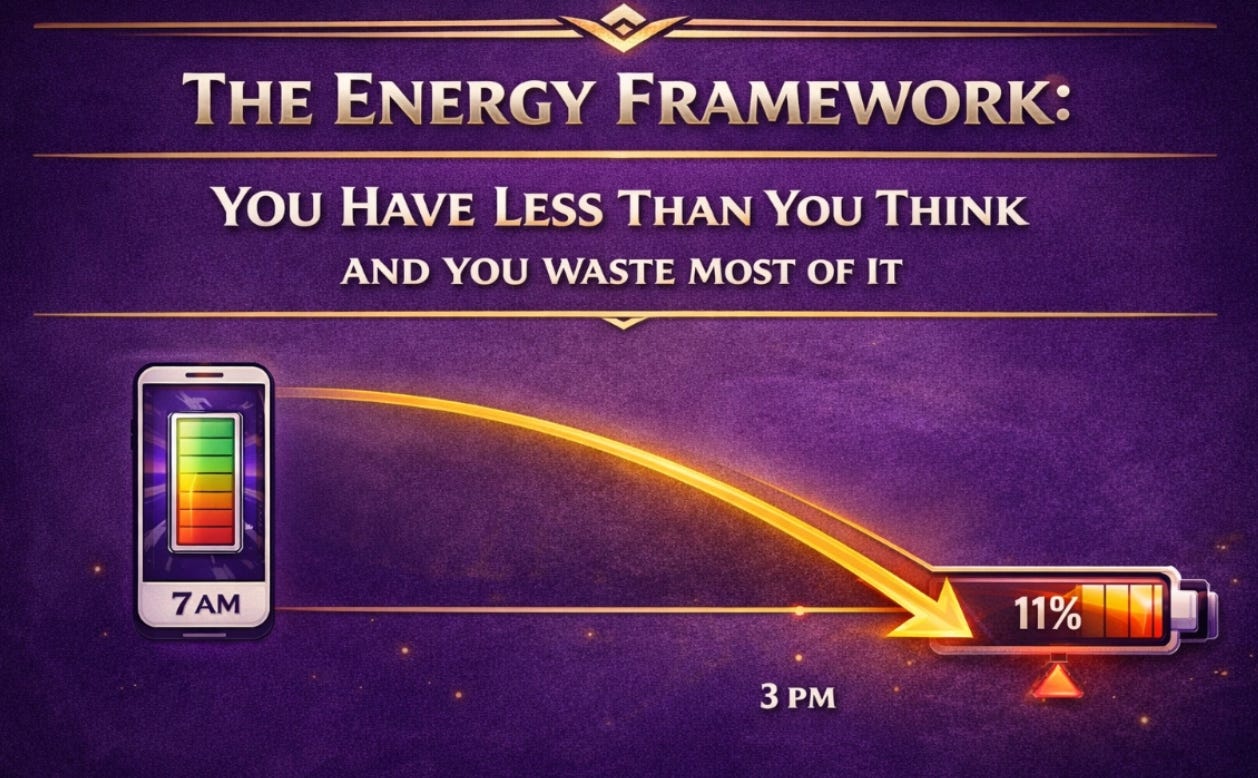
A fully charged phone battery looks generous at 7am. By 2pm, with the screen on all day, three apps running in the background, and the brightness cranked up, it is at 11% and you are hunting for a cable. Nothing broke. You just spent faster than you recharged.
Your brain works the same way. You wake up with a full charge. By midday, if you have answered forty emails, sat through two meetings that could have been messages, made six decisions you will not remember by Friday, and let three notifications hijack your train of thought, your battery is nearly flat. And the actual work, the thing that matters, the call that requires real judgment, is scheduled for 3pm.
Anyone can work hard. Most people do. The ones who are still sharp at 3pm are not working harder. They are spending their energy on fewer, better things.
This framework is about how to spend your energy. You have a daily budget of peak hours and good decisions, and it is smaller than you think. You have four batteries, not one, and they drain and recharge independently. There are drains that do most of the damage, a kind of recovery that actually works (it is not rest), and one question about direction that decides whether all your other effort counts or gets wasted. The system runs on a simple rhythm: daily, weekly, monthly, quarterly. If you follow it, you will protect more of your capacity than most people realise they are wasting.
The Daily Budget
Most people never plan around it. You have a small handful of real peak hours per day, usually closer to two or three than to eight. That is the window where your brain can do its best thinking: solve hard problems, make judgment calls, produce original work, hold complexity in your head without dropping pieces.
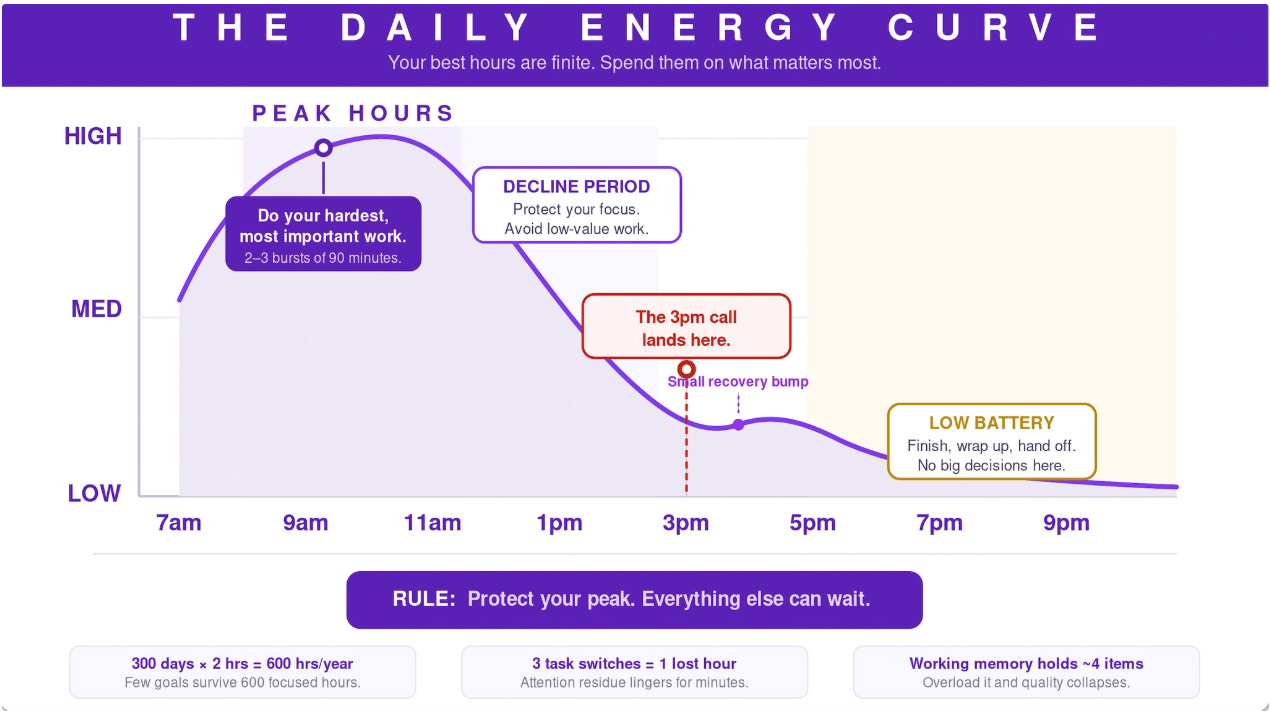
If you are not sure which hours these are, use a simple test: they are the hours when you can read something dense and it stays in your head, when you can write cleanly without rereading every sentence, when you can hold five moving parts in your mind without reaching for notes. For most people, that is earlier than they want it to be.
Jim Loehr and Tony Schwartz, who spent decades studying elite performers from athletes to surgeons, found that the best performers do not work longer. They work in focused bursts of roughly 90 minutes, then recover. Two bursts is a good day. Three is exceptional. After that, cognitive quality drops off a cliff. You are still at your desk. You are still typing. But the email you draft in hour four rambles. The document you review misses things you would have caught at 9am. The decision you make at 4pm is the one you reverse on Tuesday. The output looks like work. The quality says otherwise.
Sustainable output = peak hours protected × decision quality maintained × recovery built in.
The same budget applies to your attention. Your brain can only process so much at once, and every task that needs focus competes for that space. Sophie Leroy’s research on attention residue showed that when you switch from one task to another, part of your mind stays stuck on the previous task for minutes afterward. You know the feeling: you leave a meeting, sit down to write, and it takes ten minutes before the writing makes sense again. On top of that, working memory holds about four things at once, and sustained attention gets worse by the hour whether you feel it or not. You only have so much, and it breaks apart when you load too much onto it.
There is also evidence that willpower itself works like a fuel tank. In practice, every decision you make, from what to eat for breakfast to whether to approve a hire, seems to draw from the same pool. The original studies overstated the size of the effect, but the practical observation holds: your early decisions tend to be clean and your late ones tend to be sloppy. Whether that is because your willpower ran dry or because your attention got overloaded, the result is the same. You have a finite number of good decisions per day, and the number is smaller than you think.
In my Decision Framework, I describe the Impact Gate: a filter that sorts decisions by whether they actually matter before you spend any energy on them. Most decisions do not get through the gate. That is the point. Every low-stakes decision you let through uses up attention that your high-stakes decisions need. AI has made this worse, not better. More tools means more options, and more options means more decisions. I will come back to this in the Drain Map.
Put these together and you get a planning default for the daily energy budget. A few peak hours. A handful of real decisions. Everything else should either be on autopilot (habit), delegated, or eliminated. The person who fills their best hours with email and meetings and saves the hard thinking for 4pm is not disciplined. They are wasting their most expensive resource on their cheapest tasks. And none of this matters if the ladder is leaning against the wrong wall.
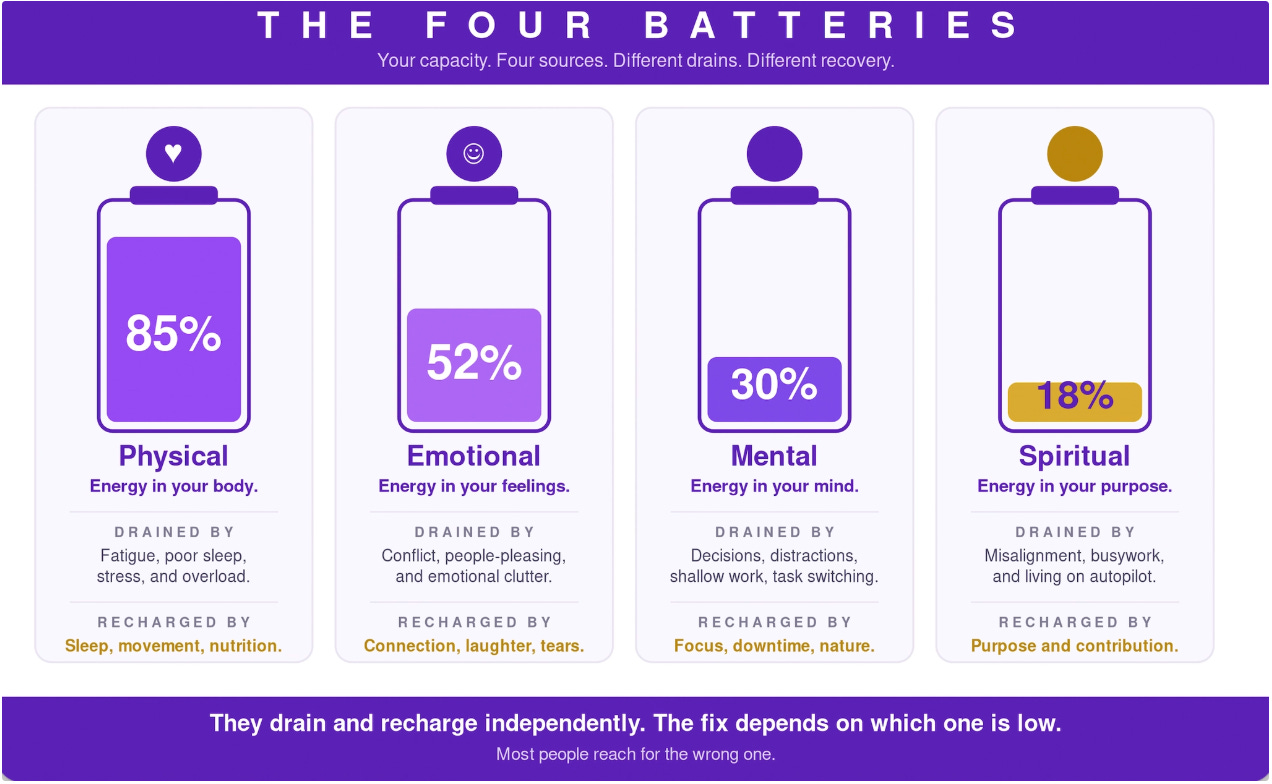
Four Batteries, Not One
For years I treated energy as a single tank. When I was tired, I rested. When rest did not work, I rested harder. I took weekends off, I slept more, I went on holiday. And I would come back and within three days feel exactly as depleted as before. The rest was real. The recovery was not. I was refuelling the wrong tank.
Loehr and Schwartz identified four types of energy. The important part is that they drain and recharge independently. You can be physically fine but emotionally wrecked. Mentally sharp but spiritually empty. Understanding which battery is low changes what kind of recovery you need. Reaching for the wrong one feels worse than doing nothing, because you did the “right thing” and nothing changed.
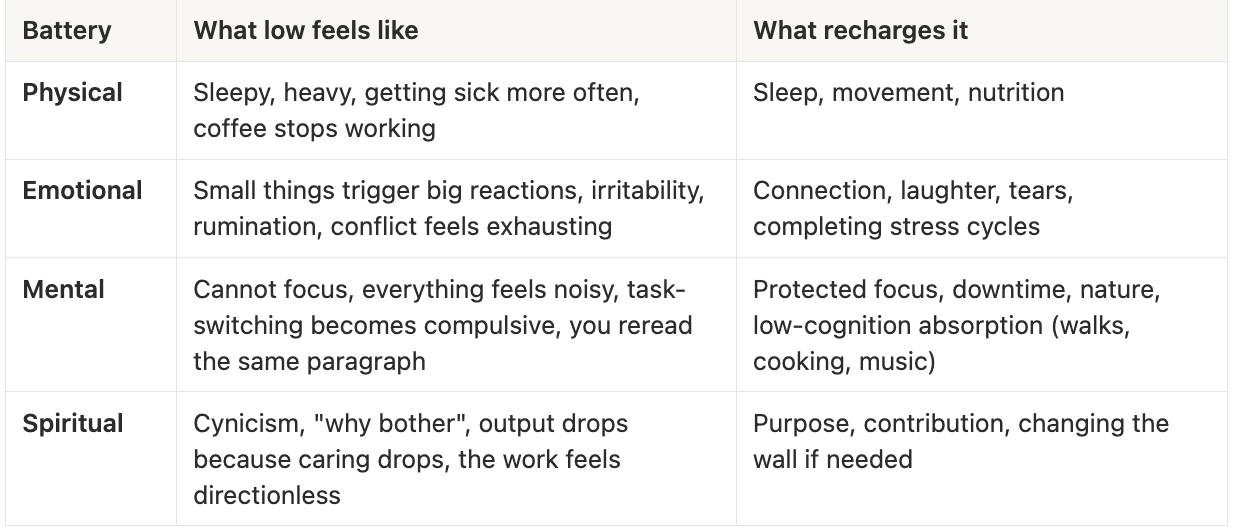
A quick diagnostic makes the difference between a true fix and a placebo.
Physical energy is the foundation. Sleep, movement, nutrition. If you are sleeping six hours when your body wants eight, no amount of willpower or coffee will give you back what the missing sleep took. The research is consistent: one week of sleeping six hours a night leaves your brain performing as badly as if you had stayed awake for 48 hours straight. You do not feel impaired. You are. Physical energy is the battery that powers all the others.
Emotional energy is the quality of your internal state. Frustration, resentment, anxiety, and conflict drain this battery fast. A difficult conversation with a colleague can cost you more energy than four hours of focused work. Emily and Amelia Nagoski showed that stress and the stressor are different things. You can remove the stressor (finish the project, end the argument) and still carry the stress because the body’s stress cycle was never completed. The cycle completes through physical discharge: exercise, laughter, tears, physical connection. If you skip the discharge, the stress stays in your body even after the cause is gone.
Mental energy is focus and concentration. This is the battery that holds the two to three peak hours. It drains when too many things compete for your attention: too many open tasks, too many decisions, too much jumping between things. Every time you switch from one task to another, your brain pays a switching cost. It needs time to load the new context and let go of the old one. Three switches in an hour can destroy the entire hour. AI tools often make this worse, not better. If an AI tool interrupts your focus to save you time, it costs you more than it saves.
Spiritual energy is purpose and direction. Not religion. The feeling that your effort is connected to something that matters to you. In my Identity Migration Framework, I describe how people whose identity sits at the purpose level can absorb setbacks that would crush someone anchored at the task level. Purpose energy is what keeps you going when the other three batteries are low. It is also the slowest to recharge when it drains, which is why burnout that reaches the purpose level takes months or years to recover from, not days. AI is pressing on this battery from two directions. For driven people, it creates anxiety: expectations rise faster than achievement, and you feel like you are falling behind no matter how hard you work. For disengaged people, it creates apathy: everything becomes easy to produce, nothing feels worth producing. Both drain the spiritual battery. Both feel like personal failure. Neither is.
That diagnostic changed everything for me. Once I could name which battery was low, the right recovery became obvious. When I was physically exhausted, I needed sleep, not a pep talk. When I was emotionally drained, I needed connection, not a day off. When I was mentally fried, I needed a walk in the woods, not another podcast. When I had lost my sense of purpose, I needed to revisit the wall my ladder was leaning against, not optimise my morning routine. Every time I had tried to rest my way out of exhaustion and failed, it was because I was recharging the wrong battery.
Flow vs Longevity
Most productivity writing treats flow as the goal. Get into flow. Stay in flow. Protect your flow state. There is a cost to this that the productivity writers leave out.
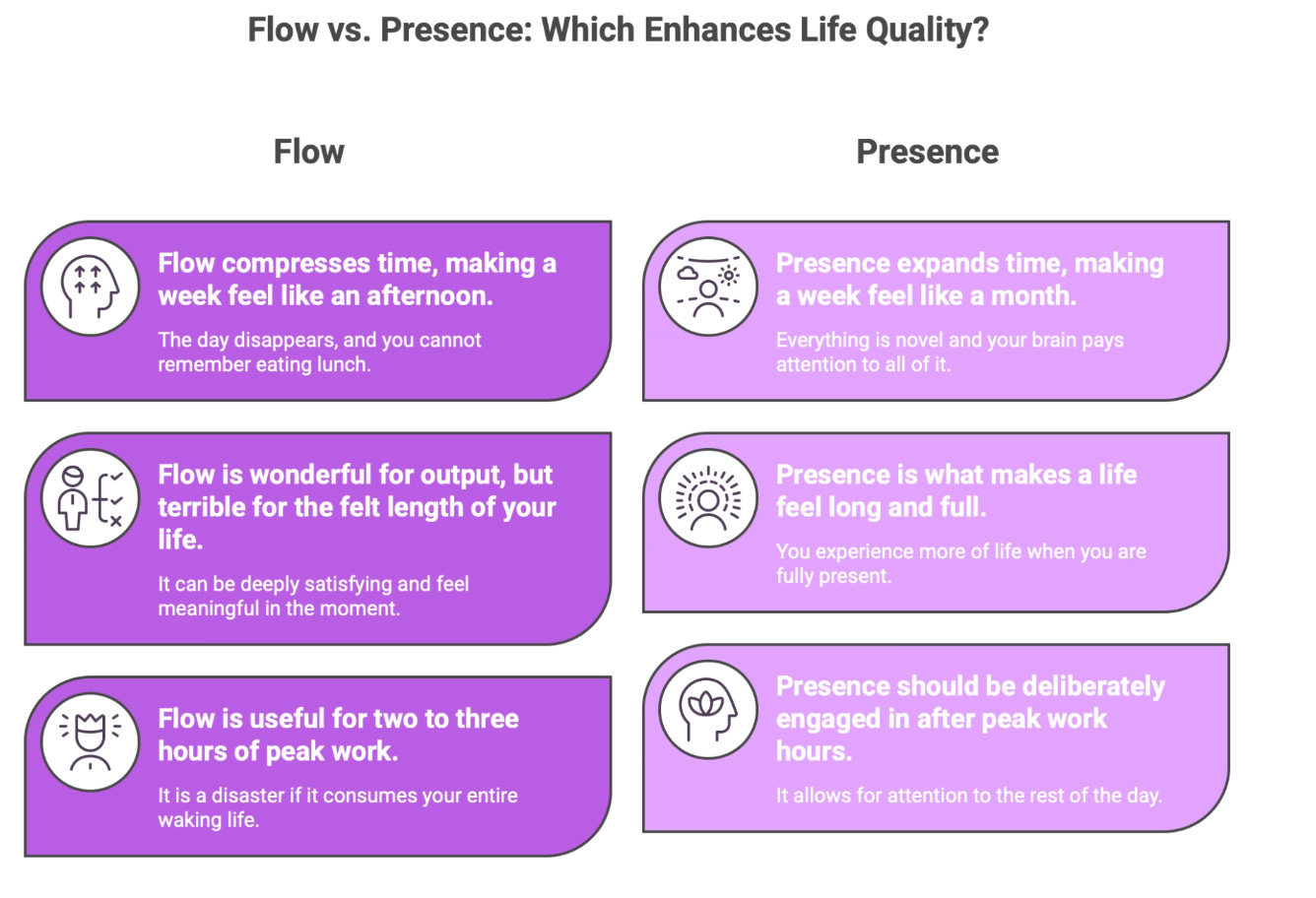
In my Life Quality Framework, I define life quality as attention divided by time. The richer your experience, the more attention you were paying. When you are fully present, time feels long and full. A week on holiday in a new country feels like a month because everything is novel and your brain is paying attention to all of it. A week at your desk in flow feels like an afternoon because your brain has compressed everything into a single focused stream.
Flow is wonderful for output. It is terrible for the felt length of your life.
This is not to say flow is bad. Flow feels meaningful in the moment. It can be deeply satisfying. Effort and skill align, time stops mattering, and the work feels like it matters. The problem is flow as a default mode of living. In that mode, you get a lot done and experience very little of it. The day disappears. You look up and it is dark outside and you cannot remember eating lunch. That is useful for the two to three hours of peak work. It is a disaster if it consumes your entire waking life. The person who lives in permanent flow gets a great deal done and, at the end of the year, feels like the year lasted three months.
The operating system here treats flow as a tool, not a lifestyle. Use flow for the peak hours. Then come out of it deliberately and pay attention to the rest of the day. Walk somewhere without headphones. Eat a meal without a screen. Have a conversation where you are not thinking about what you need to do next. That attention is what makes a life feel long and full. Flow compresses. Presence expands. You need both, on purpose, not by accident.
The Drain Map
Four drains do most of the damage.
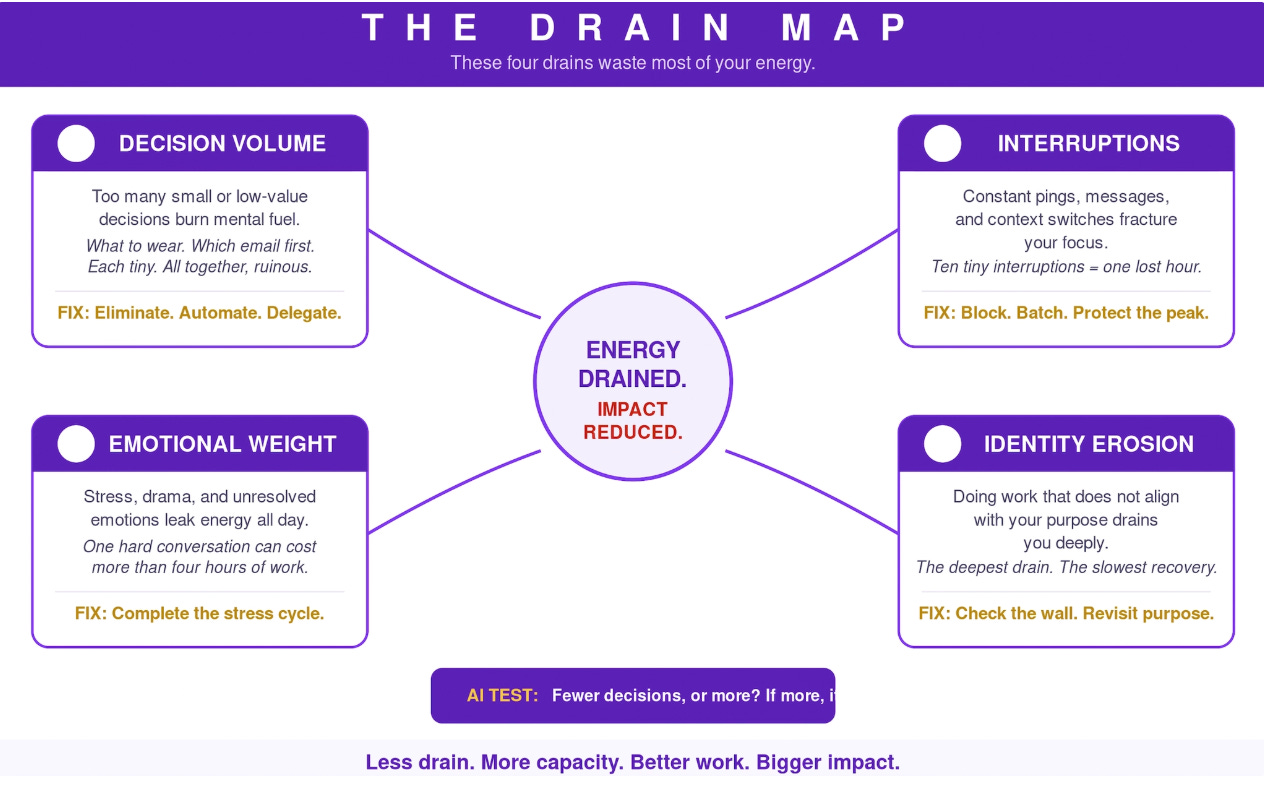
Decision volume. Too many items on the runway. What to wear. Which meeting to accept. How to respond to an email that does not matter. Each one costs almost nothing on its own. Added up over a day, they cost you everything. Eliminate, automate, or delegate as many as you can. Wear the same thing. Batch your email to two slots. Set default rules for meeting acceptance. Each one you remove from the queue saves attention for the work that actually requires your judgment. In my Time Mastery Framework, I describe how the first two hours of your day should be reserved for your Big Thing, with no meetings, no email, no internet. That is not a productivity hack. It is battery protection.
AI saves energy only if you use it to eliminate decisions, not to create more of them. An AI that auto-files your low-priority email saves you a decision. An AI that shows you three draft replies and asks you to pick one adds a decision. The test is always: fewer decisions, or more?
Interruptions. Decision volume is too many items on the runway. Interruptions are forced mid-flight diversions. A quick glance at your phone. A Slack message. A colleague asking “got a minute?” Each one yanks you out of whatever you were doing and forces a reload. Your brain does not cleanly release the previous task. It lingers. Three interruptions in an hour can destroy the entire hour. Each one is tiny. But ten tiny interruptions in your best hour and the hour is gone. Your best work gets eaten by things that took ten seconds each.
Identity erosion. This is what spiritual battery drain feels like in modern life. If you notice that you are working harder but caring less, or caring more but producing less, the spiritual battery is the one running flat. In my Identity Migration Framework, I map how this pattern is accelerating. The anxiety version: you watch AI-generated output flood your field and feel like you are falling behind no matter how fast you run. The apathy version: AI makes everything easy to produce and nothing feels worth the effort anymore. Both are energy drains. Both end at the same place. Working harder does not fix either one.
Recovery Is Not Rest
Most people think recovery means sitting on the sofa. It does not.
Hans Selye, the endocrinologist who founded modern stress science, mapped the body’s response to sustained pressure. The pattern has three phases. First, alarm: the body activates, cortisol spikes, you feel the stress. Second, resistance: the body adapts, you push through, you feel like you have adjusted. Third, exhaustion: the body’s reserves run out and systems start failing. The dangerous part is that the resistance phase feels like strength. You think you are handling it. You are actually spending down a finite reserve, and the transition from resistance to exhaustion is a cliff, not a slope. You do not feel it coming. You just fall off.
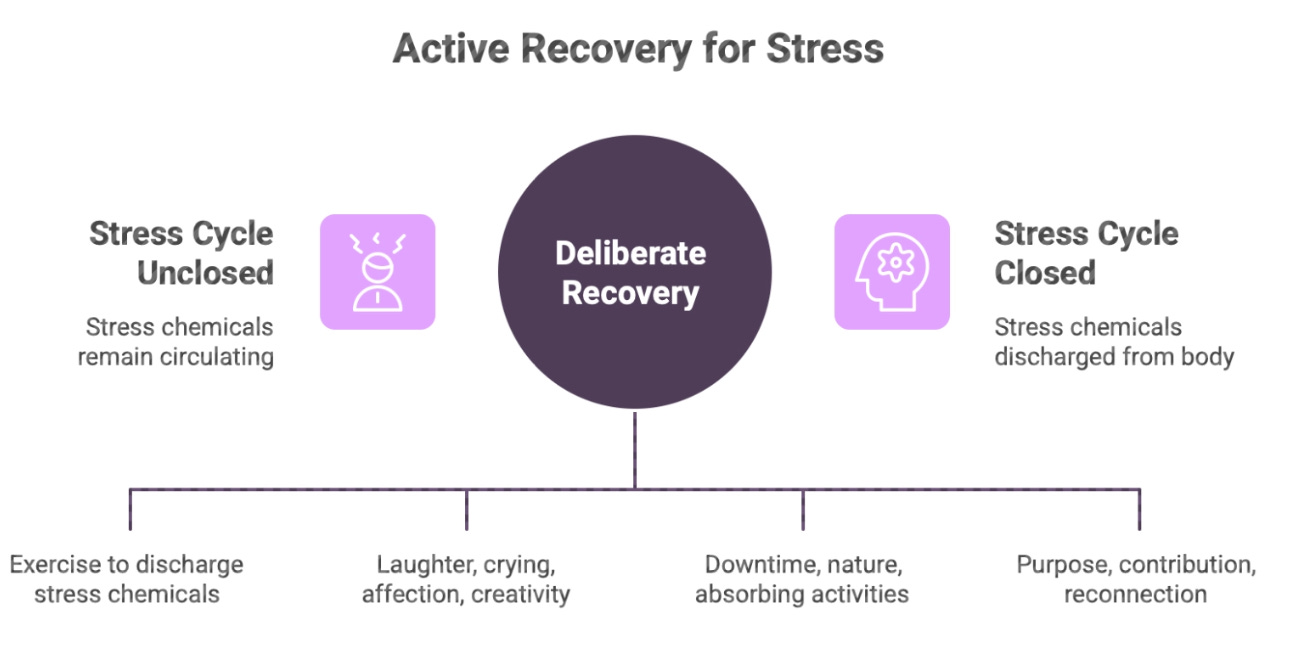
Recovery has to be deliberate because the body does not automatically complete the stress cycle. The Nagoskis showed that stress creates a loop in the body that needs closing. The stressor might end (the deadline passes, the argument resolves) but the stress chemicals are still circulating. They stay until the body discharges them through physical action. Exercise is the most reliable discharge. Laughter, crying, physical affection, and creative expression also work. Scrolling your phone does not. Watching television does not. Sitting still and “relaxing” does not close the cycle. The stress stays in the body, accumulates, and eventually tips you from resistance into exhaustion.
Recovery is active. It requires doing something, not doing nothing.
Each of the four batteries recharges differently. Physical energy recharges through sleep, movement, and nutrition. Emotional energy recharges through connection, laughter, and completing stress cycles. Mental energy recharges through downtime, nature, and activities that absorb you without demanding focus (cooking, walking, music). Spiritual energy recharges through purpose, contribution, and anything that reconnects you to why you are doing what you are doing.
If you are depleted tonight and have twenty minutes, here is the lowest-effort version of active recovery for each battery. Physical: a twenty-minute walk outside, no destination. Emotional: call one friend and talk about something that is not work. Mental: cook something simple with no screen running. Spiritual: write one sentence about what you want this work to do for someone else. None of these require motivation. They require a decision to start, and the decision takes less energy than staying on the sofa pretending to rest.
The Wall Question
In my Ladder and Wall Framework, I describe how your career has two parts: the ladder (your skill, the thing you climb) and the wall (the direction, the thing the ladder leans against). Most energy advice is about climbing the ladder more efficiently. Sharpen your focus. Protect your peak hours. Batch your decisions. That is all useful. But the single energy decision that matters most is not about the ladder. It is about the wall.
If the wall is wrong, all the energy management in the world is wasted. You are climbing efficiently in a direction you did not choose and do not want. The spiritual battery drains not because you are working too hard but because the work is taking you somewhere that does not matter to you. That is the kind of fatigue that no amount of sleep, exercise, or time management can fix.
The Ladder and Wall Framework describes platforms: the flat spaces between climbs where you stop and look around. While you are climbing, your attention is narrow and upward. You cannot see the wall clearly. On a platform, you get distance. You can ask: is this wall still the right one? Is the energy I am spending taking me somewhere I actually want to arrive?
If the answer is no, the most energy-efficient thing you can do is change walls. It feels like a loss in the short term. Every wall change resets your position on the ladder. But a person climbing the right wall at half speed will arrive somewhere meaningful. A person sprinting up the wrong wall will arrive somewhere meaningless, faster. If the wall is right, every hour you protect and every drain you cut makes your life better. If the wall is wrong, none of it matters.
Burnout: The Cliff You Cannot See
Herbert Freudenberger coined the term “burnout” in the 1970s studying volunteer clinic workers. His original description had three signs: exhaustion (the body gives out), cynicism (you stop caring about the work), and reduced efficacy (you keep working but the results get worse). All three have to be present. Being tired is not burnout. Being cynical is not burnout. The combination of all three, sustained over weeks, is.
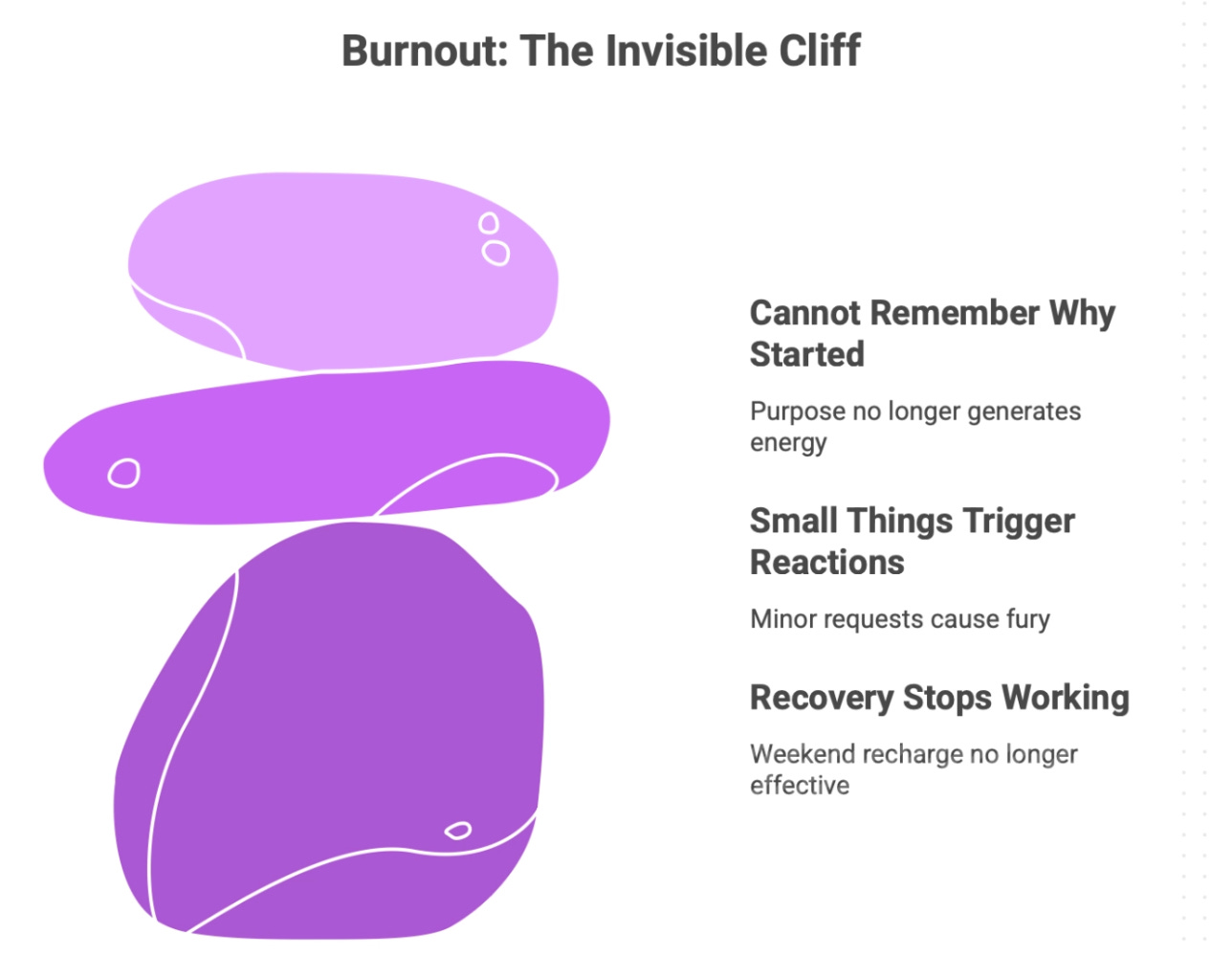
The reason burnout is dangerous is Selye’s cliff. In the resistance phase, you feel functional. You are tired but you are managing. The slide from resistance to exhaustion happens fast and without warning. One week you are grinding but coping. The next week you cannot get out of bed, or you find yourself staring at a screen for twenty minutes without processing a single word. The cliff is invisible from the resistance phase. You only see it after you have gone over it.
Three early warning signs, before the cliff:
Recovery stops working. A weekend used to recharge you. Now it does not. Sleep does not feel restorative. Exercise feels like another obligation. The activities that used to refill your batteries no longer do. This means your reserves are running low and the exhaustion phase is approaching.
Small things trigger big reactions. A minor request from a colleague makes you furious. A routine email feels overwhelming. The emotional battery is so low that things which would normally be nothing now feel like everything.
You cannot remember why you started. The purpose that used to fuel the work has gone quiet. You can still describe it if someone asks, but it does not generate energy anymore. The spiritual battery is flat. This is the deepest kind of empty, and the slowest to come back from.
If you recognise these signs, the right response is not to push through. It is to stop climbing and find a platform. Revisit the wall. Recharge the specific battery that is lowest. And give it more time than you think it needs, because the damage from the resistance phase builds up invisibly.
The Complete Picture
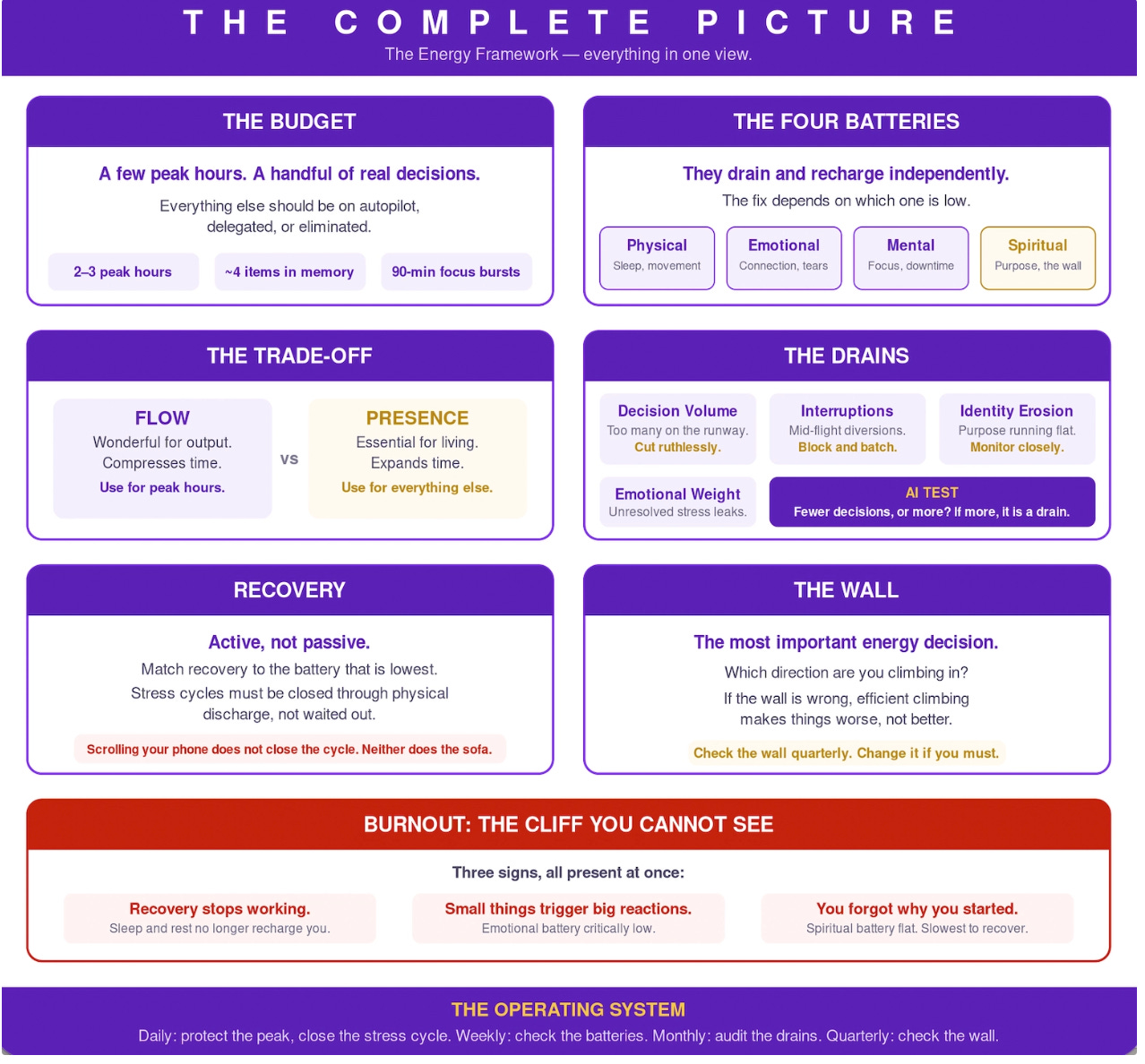
The budget: A few peak hours. A handful of real decisions. Everything else should be on autopilot, delegated, or eliminated.
The batteries: Physical (sleep, movement, nutrition), emotional (connection, stress cycle completion), mental (focus, protected from interruption), spiritual (purpose, the wall question). They drain and recharge independently. The fix depends on which one is low, and most people reach for the wrong one.
The trade-off: Flow is for output. Presence is for living. Use flow for the peak hours. Come out of it deliberately for everything else.
The drains: Decision volume, interruptions, identity erosion. Cut the first two. Monitor the third. Test every tool, including AI, by whether it leaves you with fewer decisions or more.
Recovery: Active, not passive. Match the recovery to the battery that is lowest. Stress cycles must be closed through physical discharge, not waited out.
The wall: The most important energy decision is which direction you are climbing in. If the wall is wrong, efficient climbing makes things worse, not better.
Burnout: Three signs: exhaustion, cynicism, reduced efficacy. The cliff between resistance and exhaustion is invisible. Watch for recovery failing, small triggers causing big reactions, and purpose going silent.
The Operating System
This is the smallest set of moves that keeps all four batteries from discharging.
Protect the budget. Recharge the batteries. Watch the wall. When something feels off, run this diagnostic: if your output is dropping, check the mental battery and the drains. If your mood is dropping, check the emotional battery and whether you are completing your stress cycles. If your motivation is dropping, check the spiritual battery and the wall.
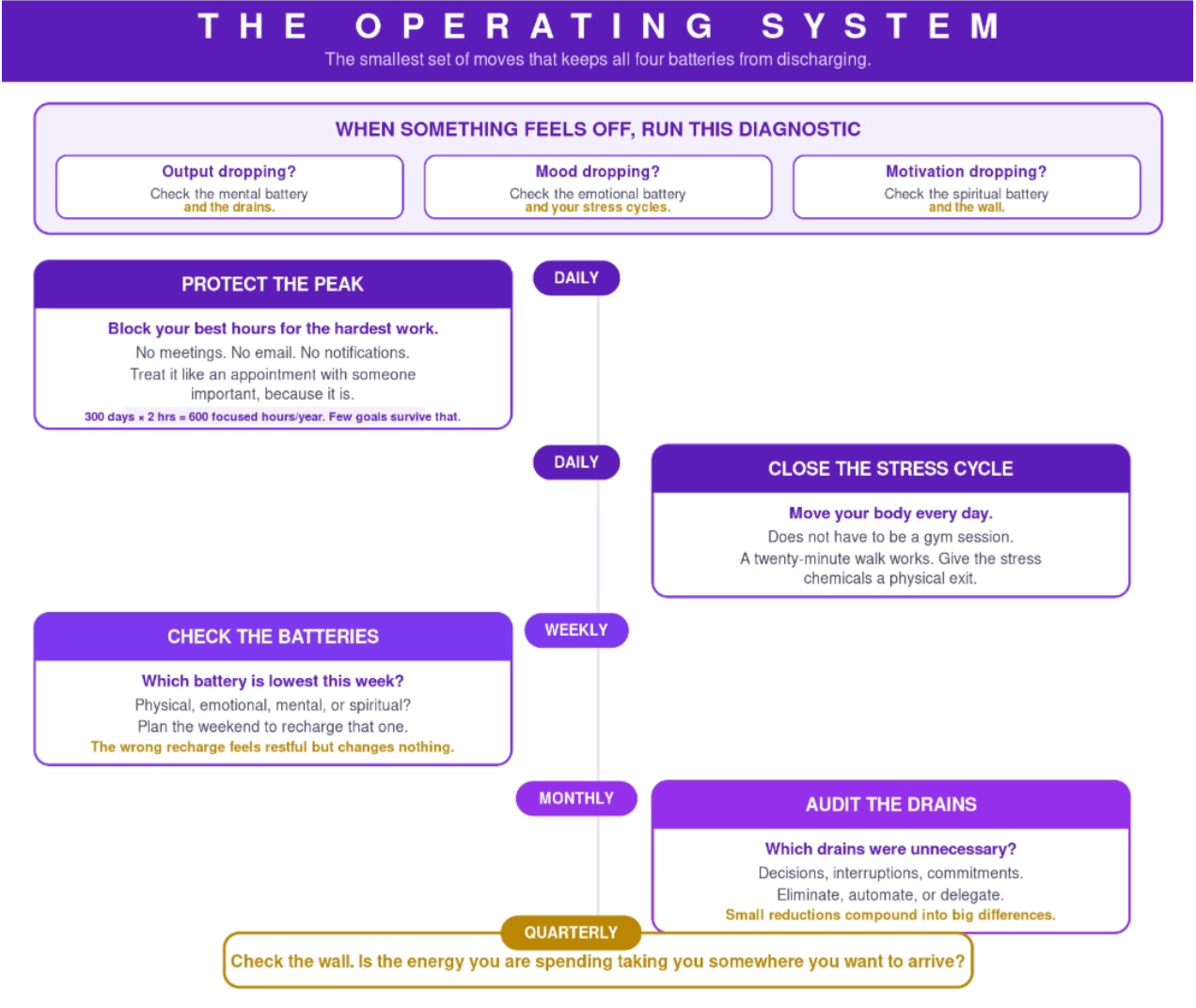
Daily: protect the peak. Block your best hours for the hardest work. No meetings, no email, no notifications. Treat this block the way you would treat an appointment with someone important, because it is. Batch everything else into the remaining hours. In my Time Mastery Framework, I describe how 300 working days at two hours per day gives you 600 hours of focused work per year. Very few goals survive 600 focused hours. The problem is never the total time available. The problem is how much of it you protect.
Daily: close the stress cycle. Move your body every day. It does not have to be a gym session. A twenty-minute walk works. The point is to give the stress chemicals a physical exit. If you skip this, the stress accumulates regardless of whether the stressor is still present.
Weekly: check the batteries. Take five minutes at the end of each week and ask: which battery is lowest? Physical, emotional, mental, or spiritual? Plan the weekend to recharge that one specifically. A weekend that recharges the wrong battery feels restful but leaves you depleted in the area that actually matters.
Monthly: audit the drains. Look at the decisions, interruptions, and commitments that consumed your energy this month. Which ones were necessary? Which ones can be eliminated, automated, or delegated? Each unnecessary drain you remove frees up space for the things that matter. This compounds. Small reductions in waste, repeated monthly, add up to a big difference over a year.
Quarterly: check the wall. Step onto the platform. Look around. Is the wall still right? Is the energy you are spending taking you somewhere you want to arrive? If the answer is yes, keep climbing. If the answer is uncertain, stay on the platform until it becomes clear. If the answer is no, change walls. Changing walls costs a lot up front. It is the best investment you will ever make.
Applications
Early career: Your batteries are large and they recharge fast. The danger is not burnout but misdirection. You have so much energy that you can climb any wall at speed, which makes it easy to climb the wrong one for years before you notice. Use the quarterly wall check early. It is cheaper to change walls at 25 than at 45. In my Promotion Flywheel Framework, I describe how the Big Thing requires two protected hours per day. That is not just a career strategy. It is an energy strategy. The two hours protect your best output from being consumed by other people’s priorities.
Mid-career: Your batteries are smaller than they were and they recharge slower. The danger is the resistance phase: you feel like you are coping, but your reserves are quietly running out. Mid-career is where most burnout happens, because the demands have risen (leadership, family, financial obligations) while the energy supply has not. Audit the drains ruthlessly. Protect the peak hours. And take the wall question seriously. Many mid-career crises are not about workload. They are about climbing a wall that stopped mattering five years ago and running out of spiritual energy as a result.
Leadership: Your job has shifted from doing the work to making decisions about the work. That means your daily decision budget is the bottleneck. Every unnecessary decision that reaches your desk is a tax on the decisions that matter. Build systems that handle routine decisions without you: clear delegation, decision frameworks your team can apply, defaults that only escalate when they should. In my Team Design Framework (to be published), I describe how a well-designed team structure is also an energy structure: it routes decisions to the people with the most context, preserving your capacity for the decisions only you can make.
Career transitions: Changing walls drains all four batteries simultaneously. You are physically stressed (new routines, disrupted sleep), emotionally exposed (new relationships, loss of old ones), mentally overloaded (everything is unfamiliar), and spiritually uncertain (you left the old purpose and the new one has not yet formed). Budget for this. Transitions take more energy than normal climbing, and most people underestimate the cost by two or three times. Build extra recovery into the transition period. Do not expect your normal output levels for the first six months.
Parenting: Children drain the emotional and physical batteries relentlessly and recharge the spiritual battery in ways nothing else can. The danger is that parents sacrifice all recovery time, treating it as selfish. It is not selfish. A parent running on empty is less patient, less present, and less able to give the attention that children need. Protecting your own recovery is not a luxury. You cannot give what you do not have. And the flow-versus-presence trade-off matters here more than anywhere: the years with young children go fast precisely because parents spend them in survival flow. Slow down. Pay attention. Those years will feel longer and richer for it.
You woke up this morning with a full charge. Tomorrow you will wake up with a full charge again. You can recharge overnight. You cannot get the day back. Protect the peak hours. Close the stress cycle. Check the wall. And every now and then, put the phone in your pocket, take your headphones out, and walk somewhere slowly enough to remember it.
Bibliography:
Baumeister, R.F., Bratslavsky, E., Muraven, M., & Tice, D.M. (1998). Ego depletion: Is the active self a limited resource? Journal of Personality and Social Psychology, 74(5), 1252–1265. doi.org/10.1037//0022-3514.74.5.1252
Cowan, N. (2001). The magical number 4 in short-term memory: A reconsideration of mental storage capacity. Behavioral and Brain Sciences, 24(1), 87–114. doi.org/10.1017/s0140525x01003922
Freudenberger, H.J. (1974). Staff burn-out. Journal of Social Issues, 30(1), 159–165. doi.org/10.1111/j.1540-4560.1974.tb00706.x
Leroy, S. (2009). Why is it so hard to do my work? The challenge of attention residue when switching between work tasks. Organizational Behavior and Human Decision Processes, 109(2), 168–181. doi.org/10.1016/j.obhdp.2009.04.002
Loehr, J., & Schwartz, T. (2003). The Power of Full Engagement: Managing Energy, Not Time, Is the Key to High Performance and Personal Renewal. Free Press. simonandschuster.com
Mackworth, N.H. (1948). The breakdown of vigilance during prolonged visual search. Quarterly Journal of Experimental Psychology, 1, 6–21. doi.org/10.1080/17470214808416738
Nagoski, E., & Nagoski, A. (2019). Burnout: The Secret to Unlocking the Stress Cycle. Ballantine Books. penguinrandomhouse.com
Selye, H. (1936). A syndrome produced by diverse nocuous agents. Nature, 138, 32. nature.com/articles/138032a0
Check out some of my other Frameworks on the Fast Frameworks Substack:
The Identity Migration Framework
The Thirty-Three Kilometre War
The Decision Framework: DECIDE
The Alpha Engine Framework for Venture & Angel Investing
Don’t Hire an Agency. Build a Memetic Engine - The memetic engine framework
Fast Frameworks AI Tools: Cortex
The Exponential AI Adoption Framework
Moltbook and the Entity AI Framework
May every sunset bring you peace!
Entity AI, swarms and the future of work (Asymmetric Podcast)
Fast Frameworks Podcast: Entity AI-Episode 8: Meaning, Mortality, and Machine Faith
Fast Frameworks Podcast: Entity AI - Episode 7: Living Inside the System
Fast Frameworks Podcast: Entity AI – Episode 5: The Self in the Age of Entity AI
Fast Frameworks Podcast: Entity AI – Episode 4: Risks, Rules & Revolutions
Fast Frameworks Podcast: Entity AI – Episode 3: The Builders and Their Blueprints
Fast Frameworks Podcast: Entity AI – Episode 2: The World of Entities
Fast Frameworks Podcast: Entity AI – Episode 1: The Age of Voices Has Begun
The Entity AI Framework [Part 1]
The Promotion Flywheel Framework
The Immortality Stack Framework
Frameworks for business growth
The AI implementation pyramid framework for business
A New Year Wish: eBook with consolidated Frameworks for Fulfilment
AI Giveaways Series Part 4: Meet Your AI Lawyer. Draft a contract in under a minute.
AI Giveaways Series Part 3: Create Sophisticated Presentations in Under 2 Minutes
AI Giveaways Series Part 2: Create Compelling Visuals from Text in 30 Seconds
AI Giveaways Series Part 1: Build a Website for Free in 90 Seconds
Business organisation frameworks
The delayed gratification framework for intelligent investing
The Fast Frameworks eBook+ Podcast: High-Impact Negotiation Frameworks Part 2-5
The Fast Frameworks eBook+ Podcast: High-Impact Negotiation Frameworks Part 1
Fast Frameworks: A.I. Tools - NotebookLM
The triple filter speech framework
High-Impact Negotiation Frameworks: 5/5 - pressure and unethical tactics
High-impact negotiation frameworks 4/5 - end-stage tactics
High-impact negotiation frameworks 3/5 - middle-stage tactics
High-impact negotiation frameworks 2/5 - early-stage tactics
High-impact negotiation frameworks 1/5 - Negotiating principles
Milestone 53 - reflections on completing 66% of the journey
The exponential growth framework
Fast Frameworks: A.I. Tools - Chatbots
Video: A.I. Frameworks by Aditya Sehgal
The job satisfaction framework
Fast Frameworks - A.I. Tools - Suno.AI
The Set Point Framework for Habit Change
The Plants Vs Buildings Framework
Spatial computing - a game changer with the Vision Pro
The ‘magic’ Framework for unfair advantage
Aditya, this is making a bunch of things roll around in my head at once. Thank you! I'll come back with more but here are a few thoughts on the batteries that I'm sharing for your scrutiny.
1. The spiritual battery corroborate my experience of doing work that felt purposeless, not just in a big life-sense way but day to day where my work felt not adding up to anything meaningful. A good description of that I've read is the broken steering syndrome (https://x.com/eshear/status/1561120325584109574).
2. The emotional battery tracks with congruence. The shorter the gap between who I'm pretending to be (or projecting myself as) and who I truly am, the more emotionally at ease I am. Fake laughter takes its toll.
3. When does burnout happen? Is it emotional and spiritual exhaustion beyond the point of recovery assuming physical and mental exhaustion are easier to spot and more straightforward to fix? I'm positing this with a specific thought in mind: how come social workers who work tirelessly day in and day out for years do not get burned out but other paid professionals do?
Again, thank you for this post.