

TL;DR
You already have a bias, built into you by evolution and sharpened daily by whatever app is open on your phone. The real question was never whether you have one. It’s whether you picked it on purpose or let an algorithm pick it for you. By almost every long-run measure, poverty, child mortality, life expectancy, violent crime, the world has been getting better for decades. Your feed rarely shows you that, because bad news travels faster than good news does. Read the full argument below, or just take the offer: every reader of this substack gets a free month of Asgard News Pro. Go to asgard.news, sign up, and send me the email address you used so I can upgrade you.
A newsroom has a hundred stories to choose from. Ninety-nine are planes that landed safely. One is a plane that crashed. You already know which one will lead..

Journalism didn’t invent that instinct - it builds on human instinct.
Your brain isn’t built to notice millions of lives slowly getting better. It’s built to spot danger fast. A plane crash grabs your attention because it might be a threat to you. A billion quiet mornings where nothing went wrong don’t grab your attention at all.
Psychologists have names for this. Negativity bias means bad news feels bigger and more important than good news, even when both are equally true. The availability heuristic means you think something happens a lot just because it’s easy to picture, like a plane crash. Put them together and you get a crash everyone remembers and ninety-nine safe landings nobody does.
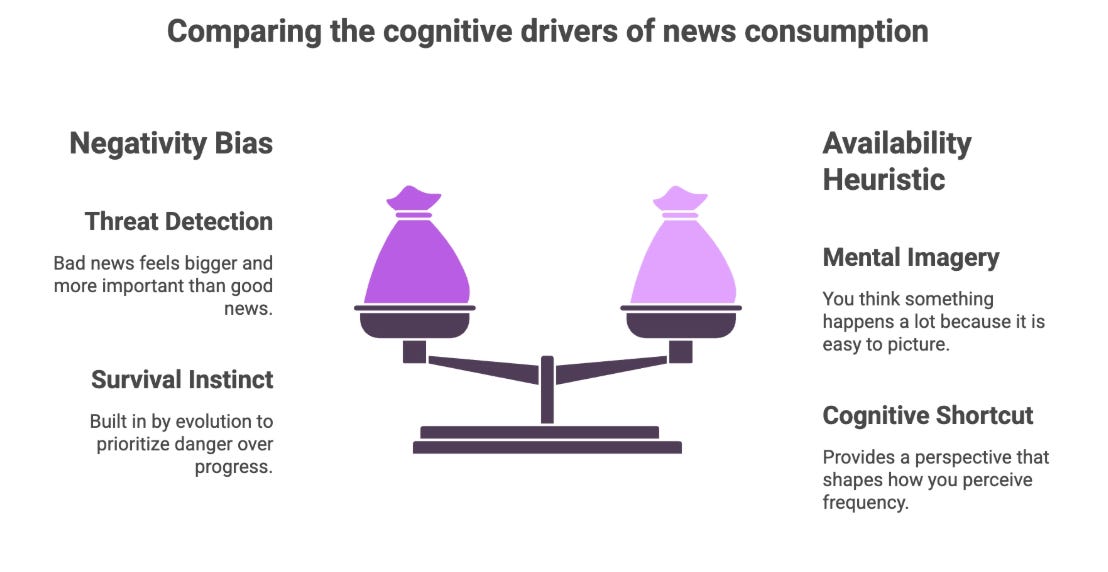
Here’s the uncomfortable bit, before I get to the comfortable bit: you’re biased-not just a little, but deep down. It’s built in by evolution, wired to spot threats and miss progress. So am I.
That isn’t the same as being manipulated. A bias is just a vantage point: where you stand to look at the world from. Manipulation is someone else choosing that vantage point for you, and hoping you never notice.
The question is not if you have a bias. It’s whether you chose to pick it, or someone handed it to you through whatever app happens to be open on your phone.
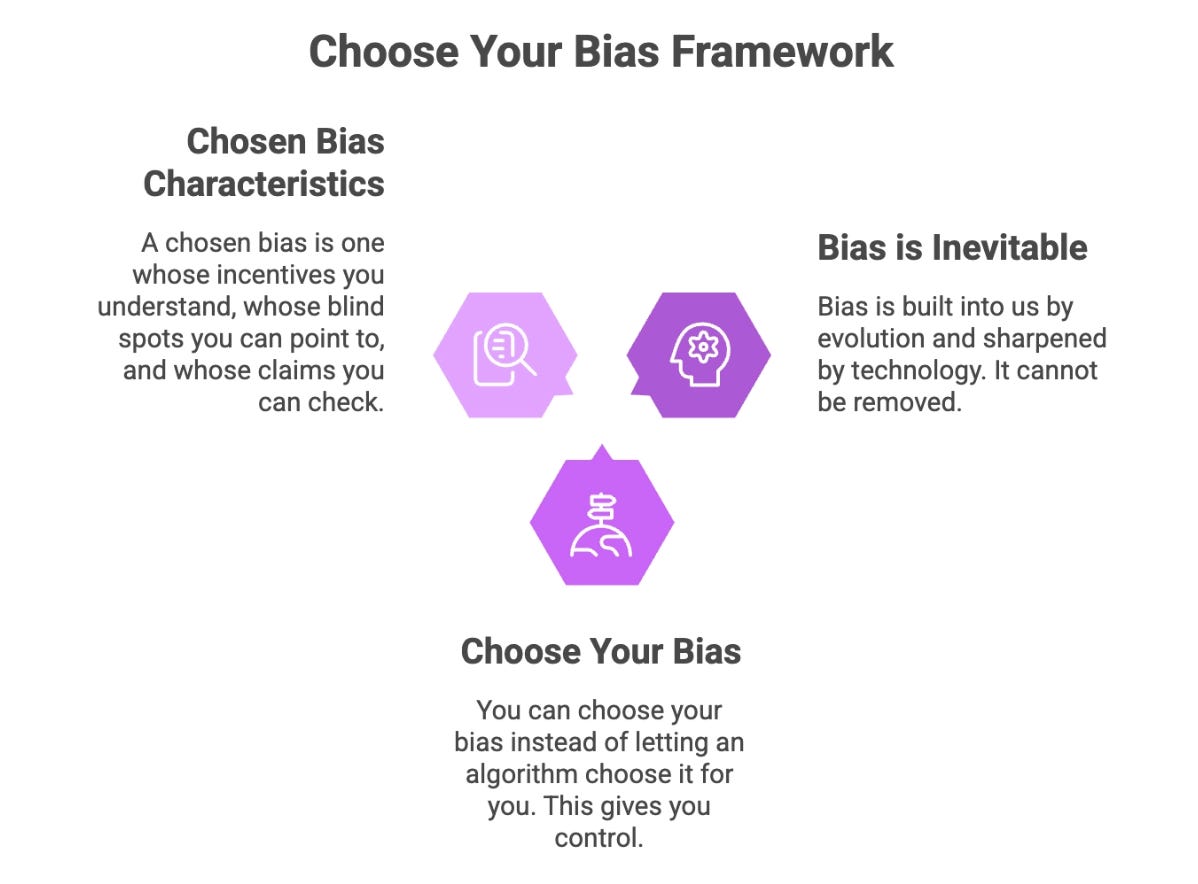
The Choose Your Bias Framework, defined
Everyone views the world through a bias, built into you by evolution and sharpened every day by whatever app is open on your phone. You cannot remove it. You can only choose it, on purpose, instead of letting an algorithm choose it for you.
A chosen bias isn’t the one that feels best. It’s the one whose incentives you understand, whose blind spots you can point to, and whose claims you can check.
The Model
People treat bias like dirt on a lens, something to wipe off until you’re seeing clearly. That’s the wrong picture. There’s no way to see the world without a lens at all. Every feed, every editor, every algorithm, even a friend who watches more news than you do, all of them are filters. They decide what you see and what you never hear about. So the real choice isn’t filter versus no filter. It’s a filter you pick on purpose, versus one that shows up by default and starts shaping you before you even notice.
What you feel about the world is the world, filtered once by what got reported, and filtered again by what got shared.
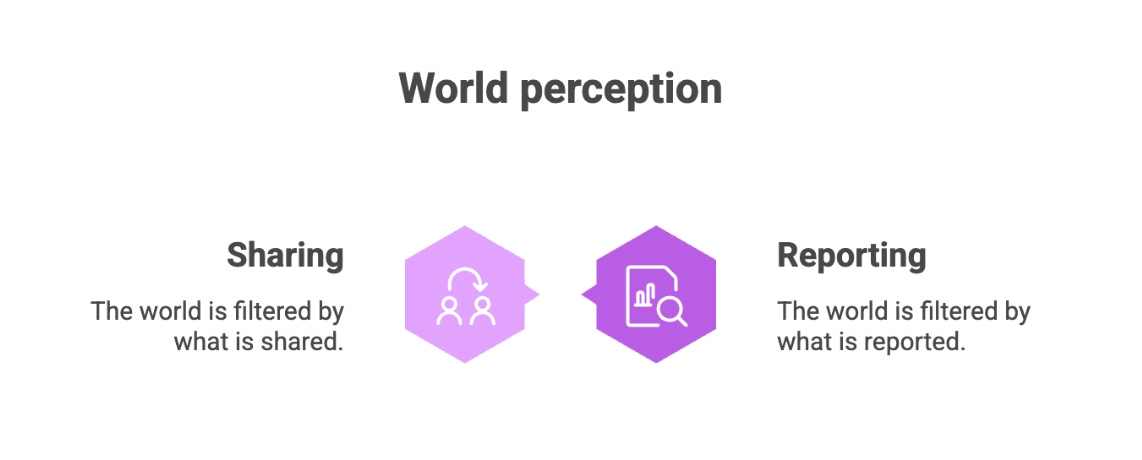
Two filters, stacked on top of each other. The first one is old and human. Journalists have always known bad news gets more attention than a quiet day, so bad news leads. The second one is new, and it runs on computers. Apps learned the same lesson and do it non-stop, automatically, all day. Outrage gets clicked. Fear gets shared. A billion people getting less poor? Nobody gets a notification for that.
Why Smart People Still Get This Wrong
The Purity Trap. Smart people often think that if they read widely enough, fact-check hard enough, and stay sceptical enough, they’ll land on a bias-free view. They won’t. Reading “everything” doesn’t remove your bias. It just means you’ve adopted the bias of whichever aggregator you trust most, without ever noticing you did it.
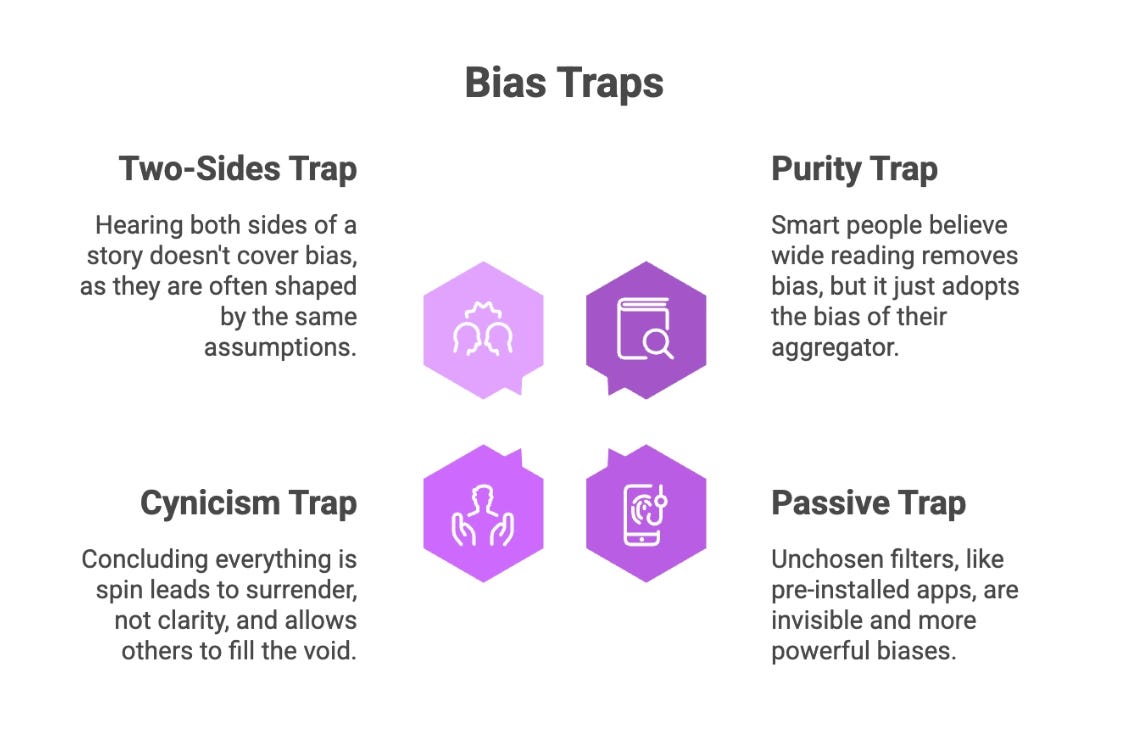
The Passive Trap. Hardly anyone chooses a filter on purpose. They inherit one: the app that came pre-installed, the group chat that sets the tone, the algorithm tuned to keep them scrolling. An unchosen bias isn’t neutral, it’s invisible, which makes it more powerful, not less.
The Cynicism Trap. Some people notice the first two traps, conclude that everything is spin, and decide nothing can be trusted. That is surrender dressed up as sophistication, not clarity. Refusing to choose a bias is still a choice, and it’s usually a bad one, because someone else fills that empty space for you, usually whoever is shouting loudest.
The Two-Sides Trap. Many people think they have covered their bias once they have heard both the Republican take and the Democrat take on a story. Take the Iran war: Republicans and Democrats in the US genuinely disagree about it. But stand back far enough and their two takes are standing almost shoulder to shoulder, shaped by the same domestic assumptions, the same allies, the same history taught in the same schools. Neither is anywhere near the perspective of someone living in Tehran, or Doha, or Tel Aviv. Two sides is one narrow slice of the full spectrum, not the whole of it, and most of the rest of that spectrum is not written in English.
The Diagnostic
Before you read another headline today, answer these three questions honestly.
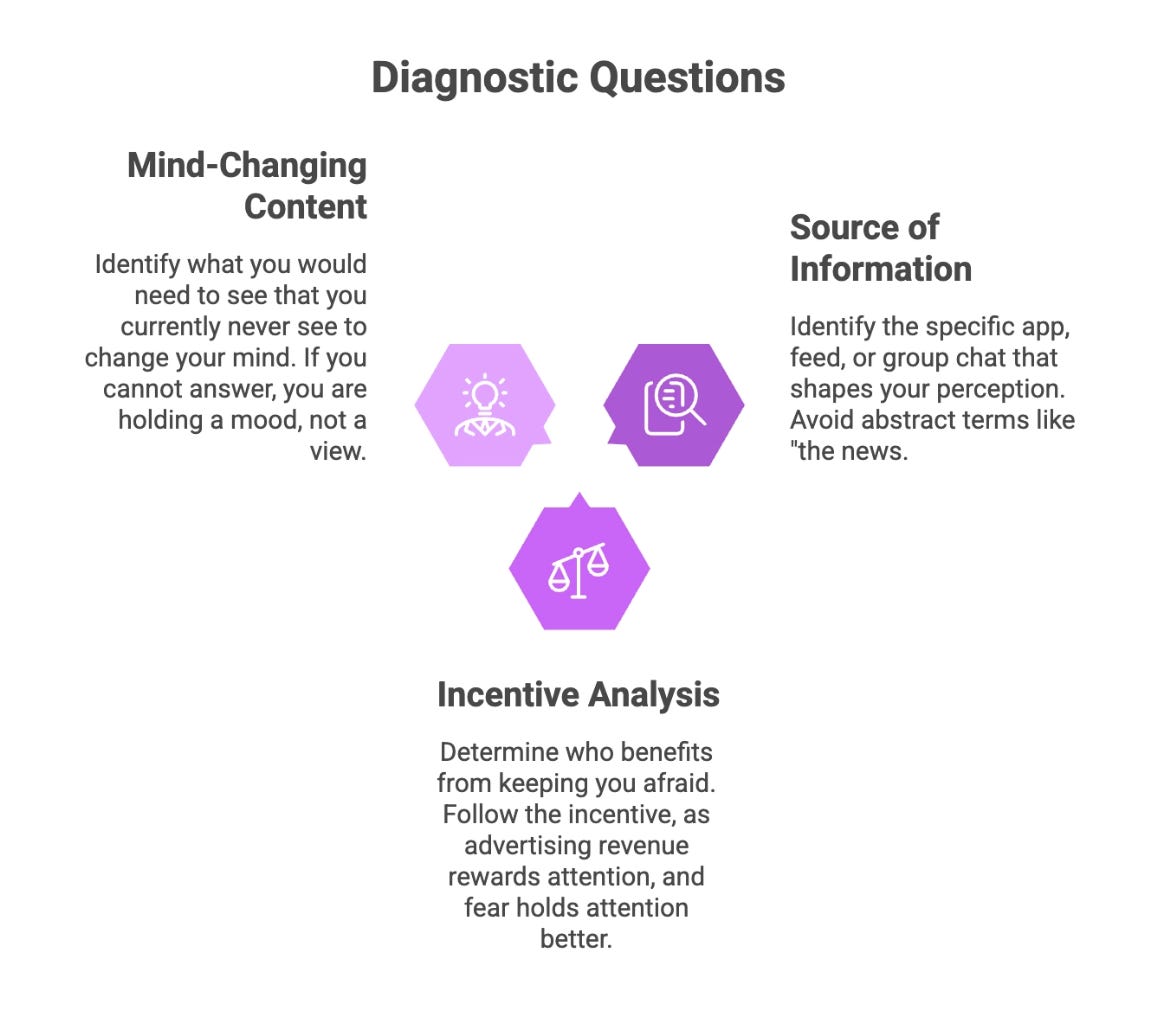
What actually shapes your sense of “how things are going”? Name the specific app, feed, or group chat. Not “the news” in the abstract. The actual source.
Who benefits when that source keeps you afraid? Follow the incentive. Advertising revenue rewards attention, and fear holds attention better than reassurance does. A feed does not need to lie to you to distort you. It only needs to show you the crash and skip the safe landings.
What would you have to see, that you currently never see, that would change your mind? If you cannot answer this one, you are not holding a view. You are holding a mood, and moods are the easiest thing in the world to manufacture.
Now the Maths
Here is what your feed almost certainly did not lead with this year.
In 1990, close to 38% of the world lived in extreme poverty. Today it’s under 10%. That’s more than a billion people who crossed that line in a single generation, and it happened slowly enough that people guess the opposite if you ask them.
Child mortality: about one in five children died before their fifth birthday in 1960. Today it is under one in twenty-five, the lowest rate in recorded history. Global life expectancy has risen from around 46 years in 1950 to over 73 today, and even a global pandemic only briefly dented that line before it kept climbing.
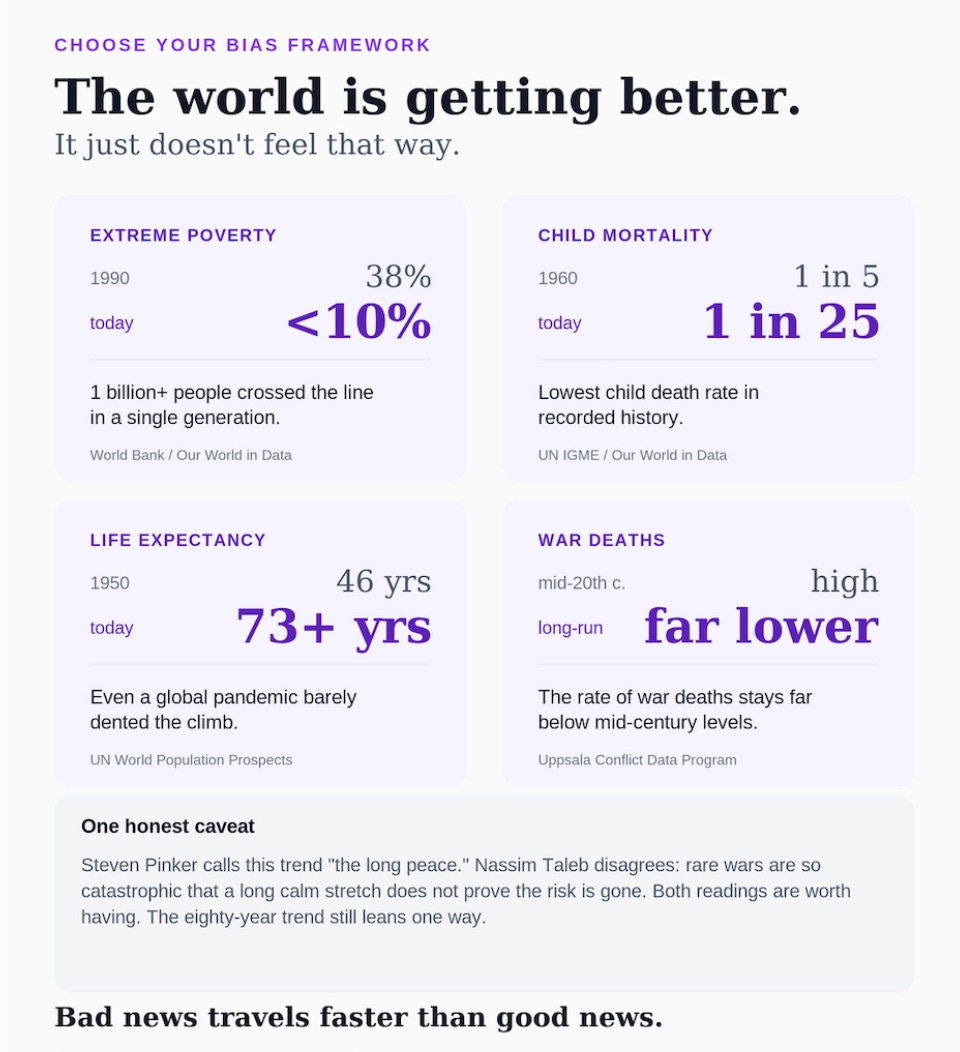
Sources: World Bank, Our World in Data, UN IGME, UN World Population Prospects, Uppsala Conflict Data Program (UCPD)
None of this erases what is genuinely happening in Ukraine, Gaza, and Sudan right now, and I am not going to pretend it does.
But the long numbers tell a different story than this week’s headlines do. The rate of deaths from war and conflict remains far below the levels of the mid-twentieth century, what the psychologist Steven Pinker calls the long peace. Today’s conflicts are real tragedies for the people living through them. They are not evidence that the world is becoming more violent. The evidence points the other way, and has for eighty years.
Not everyone agrees with that reading. Nassim Taleb points out that wars are rare, but the bad ones are so huge they can undo decades of quiet peace in one go, like one giant earthquake instead of years of gentle rain. A long calm stretch doesn’t prove the risk is gone. It might just mean the big one hasn’t hit yet. I lean toward the eighty-year trend, because eighty years is a long stretch of calm. But you should hear both sides, not just mine.
That is the macro picture. Here is the same pattern at street level.
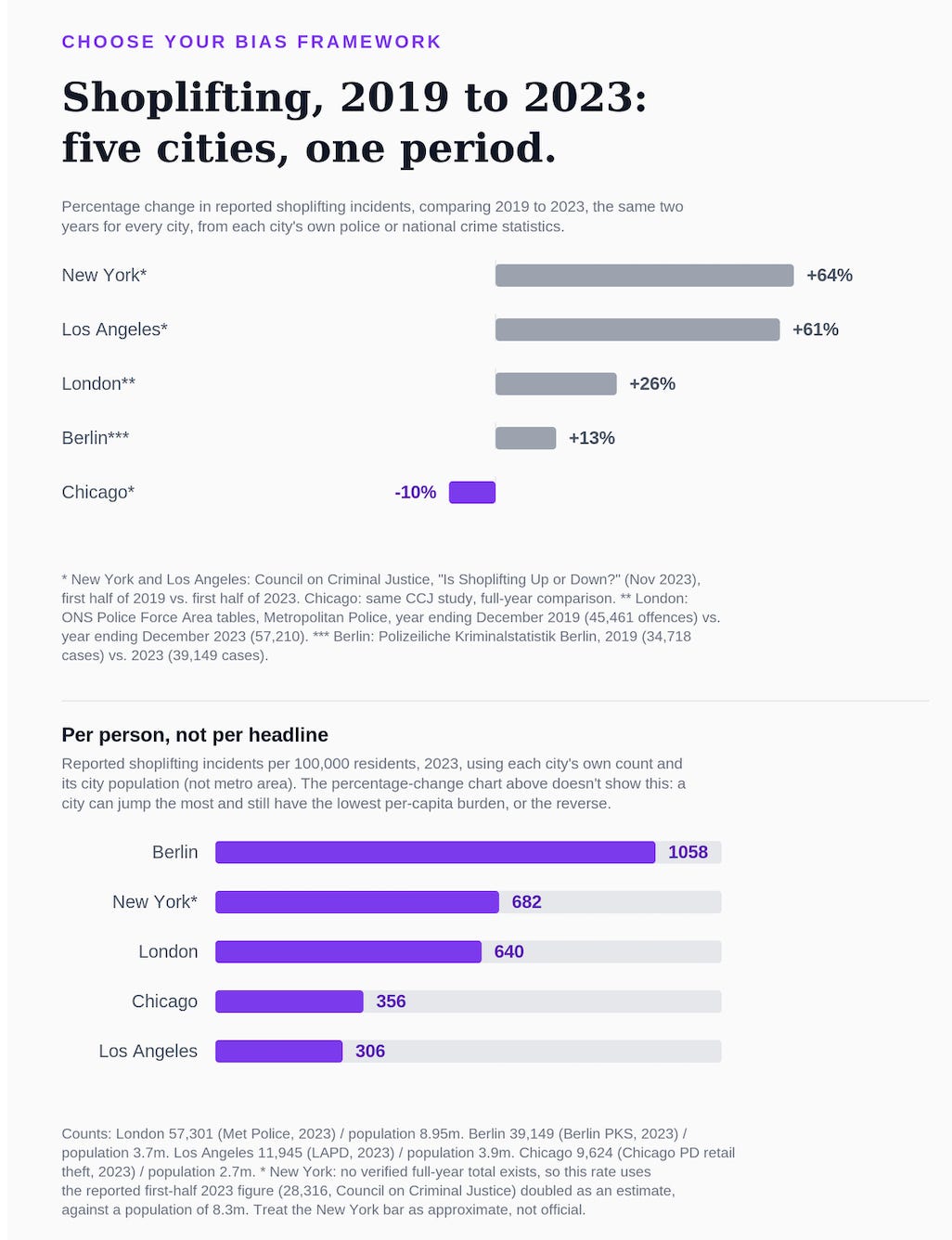
Take London, since it’s the example everyone seems to have an opinion on right now. Overall recorded crime rose 2.6% last year, and shoplifting is up 26% between 2019 and 2023. Also true, and almost never shared: homicide in London is at its lowest level since monthly records began, down close to 60% since 2003, and burglary is falling too. London’s murder rate now sits at 1.1 per 100,000 people. New York’s is 4.6. Chicago’s is 21.8. London comes out safer than Paris, Berlin, Toronto, Mumbai, Delhi, San Francisco, and Moscow too, full comparison in the chart below.
London is safer than almost every major city people compare it to, including the ones whose leaders like to call it dangerous.
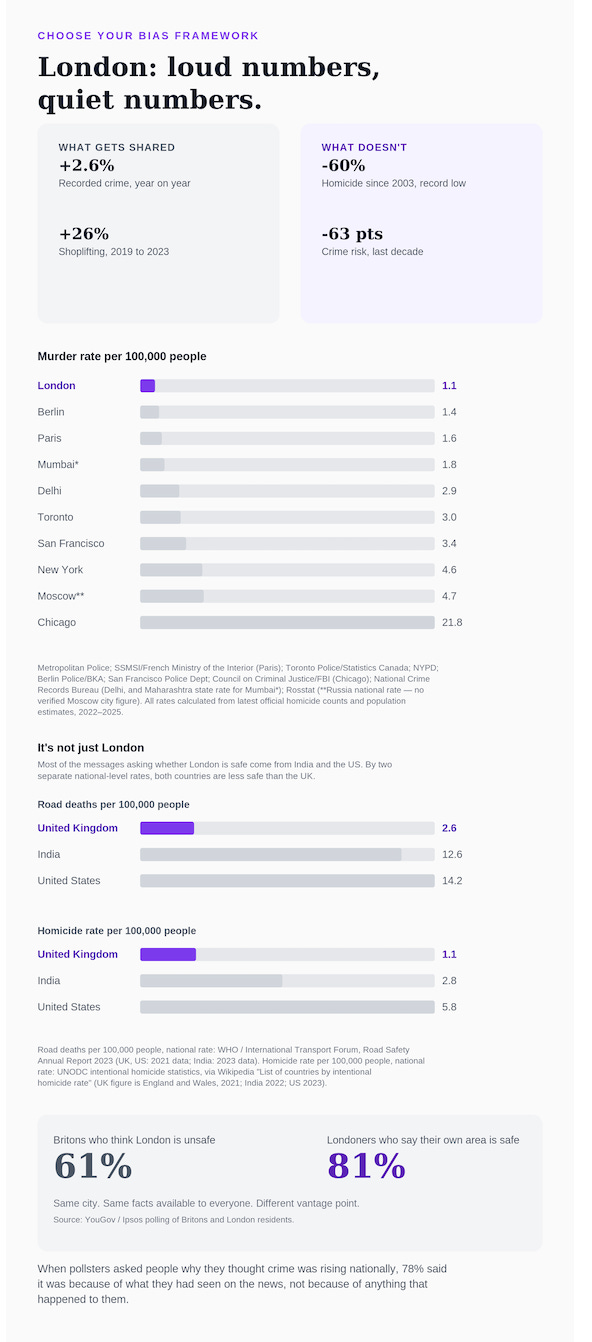
Sources for the 78% figure: Ipsos “Politically Correct Britain?” Tracker 2025-2026
And it isn't only a city-level story. Most of the messages I get asking if London is safe come from concerned friends in India or the US, and both countries are less safe than the UK on two separate national measures, not just one city's murder rate.
Road deaths run at 2.6 per 100,000 people in the UK. In India it's 12.6. In the US it's 14.2. The national homicide rate is 1.1 per 100,000 in England and Wales. In India it's 2.8. In the US it's 5.8.
London isn't the exception here, it's the number everyone else should be benchmarking and striving to emulate.
Ask Britons in general whether London is safe, and 61% say no. Everyone seems to have heard about a shoplifting incident in the news. Ask the people who actually live tin London, and 63% say yes, and 81% say their own neighbourhood is safe. Same city, same facts available to everyone, and a completely different answer depending on whether you’re inside the data or inside the headlines.
When pollsters asked people why they thought crime was rising nationally, 78% said it was because of what they’d seen on the news, not because of anything that had happened to them.
There’s a name for this: mean world syndrome, the finding that people who take in a lot of fear-driven news end up believing the world is far more dangerous than it really is. London isn’t an exception to that, it’s the textbook case.
Both sets of numbers are real. Only one of them is shared.
I wrote about a version of this in the Risk Framework. The slow, decades-long improvement in the world is what I called a Grey Rhino there: a huge, obvious thing bearing down on us that everyone still manages to ignore, because it never shows up as one dramatic moment. A stabbing is one moment. A billion people escaping poverty is not. So nobody posts about the poverty number. Everybody posts about the knife.
Applications
Your own mental health. If you feel like the world is ending and you can’t say why, the honest answer is often: “because my filter (which I never chose) profits from that feeling.” That’s fixable. It isn’t a character flaw.
Parenting and mentoring. Anxious teenagers are not irrational. They are running the same negativity bias you are, on a feed engineered even harder for engagement than yours. Naming the mechanism to them does more good than telling them to worry less.
Hiring and leadership. A team that only reads the bad news about its market will make cautious decisions that feel prudent and are actually just frightened. Choosing a wider filter is a business decision, not just a wellbeing one.
Investing and risk. Markets driven only by headline fear miss the slow gains that make patient positions pay off. This is the other half of the Alpha Engine: look past the panic to what’s actually building underneath it.
Civic life. Voting, donating, and organising all get distorted when the baseline assumption is “everything is getting worse and nothing works.” Some things are getting worse. Plenty is getting better. You make better decisions when you can tell the two apart.
Choosing the Filter on Purpose
So here’s the practical version of “choose your bias.” Stop trying for a filter-free view of the world. You can’t get one. Instead, pick a filter that shows you the crash and the safe landings side by side, in the same feed, labelled honestly enough that you can tell which is which.
I noticed this in my own life long before I thought about building anything. I get messages from friends and family in the US, the UK, India, and China about the same story in the same week, and the framing is barely recognisable as the same event. Everyone is absolutely certain, and everyone is reading one slice of the spectrum and calling it a holistic understanding.
I built Asgard News to solve that for myself first, before I ever thought about readers. I wanted one place where I could see what people were actually saying, in their own words and their own languages, before I decided what I thought.
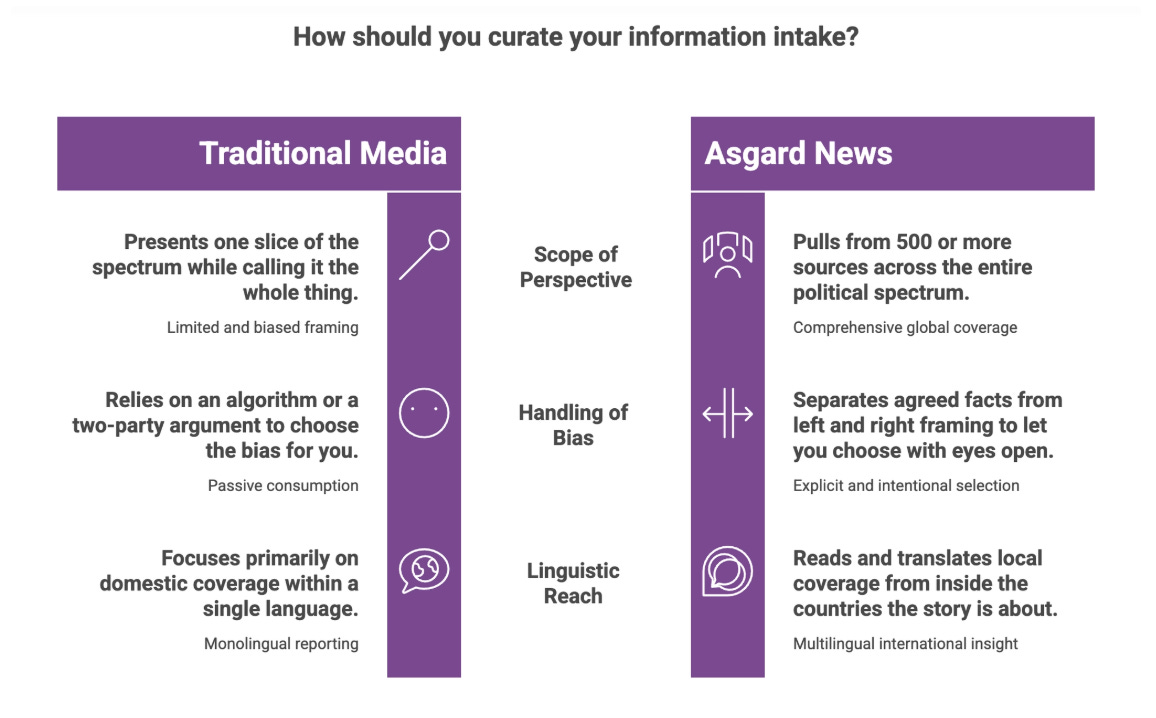
It pulls from over 500 sources across the entire political spectrum and geographies and puts them in one feed, then does the thing no single outlet will do for you: it separates the agreed facts from the left framing and the right framing, explicitly, so you can see where a story is genuinely contested and where it just looks that way.
And it does not stop at the English-language argument. It reads and translates local coverage from inside the countries a story is actually about: Iran, China, Korea, Japan, Pakistan, India, the US. That gets lined up next to the domestic coverage. So the view from Tehran or Beijing sits right in front of you alongside the view from Washington, not just the American left sitting next to the American right. You are still choosing a bias. You are choosing it with your eyes open instead of an algorithm, or a two-party argument, choosing it for you.
Inside Asgard News there is a daily AI hosted podcast called The Bright Side, which chronicles the ways in which our world is getting better on a compounding path, alongside the regular daily news briefing that covers everything else.
Its two hosts, Nova and Ravi, are AI podcasters, not real people, built for this exact job. Nova is twenty-four, doomscrolls at 2am like the rest of her generation, and is not remotely sold on optimism. Ravi is fifty-eight, has lived through three technology hype cycles, and reads fifty-year data for fun.
Every episode, Nova brings the actual fear people feel: about jobs, about rent, about her own future. Ravi does not talk her out of it with a pep talk, and he is no cheerleader either.
Tell him AI will make intelligence cheap and he is usually the one who points out the catch before Nova can: when something gets cheaper, people don’t use less of it, they use way more. So cheap intelligence might not mean less work for anyone. It might just mean intelligence running everywhere, all the time. He puts the real number on the table and stops.
When a feel-good story does not survive the evidence, he is the one who kills it. Neither of them wraps it up into a neat lesson. They just say the trade-off out loud and leave it with you: that’s the trade-off, you decide where you land. That is what an honestly chosen bias actually sounds like.
To illustrate the long term power of progress, here’s a special episode of the Bright Side on 4th of July 2026, - “America at 250” zooming from centuries down to single years to ask one plain question: over 250 years, did life actually get better, for whom, and by how much.
The Offer
I want more of you reading with a chosen filter instead of an inherited one. So every reader gets a free month of Asgard News Pro.
To get your access, go to
sign up, and send me the email address you used so I can upgrade you to Pro.
Then spend a day reading all sides to the news side by side, and decide for yourself which bias you want to keep.
Check out some more Frameworks on the Fast Frameworks Substack:
The Identity Migration Framework
The Thirty-Three Kilometre War
The Decision Framework: DECIDE
The Alpha Engine Framework for Venture & Angel Investing
Don’t Hire an Agency. Build a Memetic Engine - The memetic engine framework
Fast Frameworks AI Tools: Cortex
The Exponential AI Adoption Framework
Moltbook and the Entity AI Framework
May every sunset bring you peace!
Entity AI, swarms and the future of work (Asymmetric Podcast)
Fast Frameworks Podcast: Entity AI-Episode 8: Meaning, Mortality, and Machine Faith
Fast Frameworks Podcast: Entity AI - Episode 7: Living Inside the System
Fast Frameworks Podcast: Entity AI – Episode 5: The Self in the Age of Entity AI
Fast Frameworks Podcast: Entity AI – Episode 4: Risks, Rules & Revolutions
Fast Frameworks Podcast: Entity AI – Episode 3: The Builders and Their Blueprints
Fast Frameworks Podcast: Entity AI – Episode 2: The World of Entities
Fast Frameworks Podcast: Entity AI – Episode 1: The Age of Voices Has Begun
The Entity AI Framework [Part 1]
The Promotion Flywheel Framework
The Immortality Stack Framework
Frameworks for business growth
The AI implementation pyramid framework for business
A New Year Wish: eBook with consolidated Frameworks for Fulfilment
AI Giveaways Series Part 4: Meet Your AI Lawyer. Draft a contract in under a minute.
AI Giveaways Series Part 3: Create Sophisticated Presentations in Under 2 Minutes
AI Giveaways Series Part 2: Create Compelling Visuals from Text in 30 Seconds
AI Giveaways Series Part 1: Build a Website for Free in 90 Seconds
Business organisation frameworks
The delayed gratification framework for intelligent investing
The Fast Frameworks eBook+ Podcast: High-Impact Negotiation Frameworks Part 2-5
The Fast Frameworks eBook+ Podcast: High-Impact Negotiation Frameworks Part 1
Fast Frameworks: A.I. Tools - NotebookLM
The triple filter speech framework
High-Impact Negotiation Frameworks: 5/5 - pressure and unethical tactics
High-impact negotiation frameworks 4/5 - end-stage tactics
High-impact negotiation frameworks 3/5 - middle-stage tactics
High-impact negotiation frameworks 2/5 - early-stage tactics
High-impact negotiation frameworks 1/5 - Negotiating principles
Milestone 53 - reflections on completing 66% of the journey
The exponential growth framework
Fast Frameworks: A.I. Tools - Chatbots
Video: A.I. Frameworks by Aditya Sehgal
The job satisfaction framework
Fast Frameworks - A.I. Tools - Suno.AI
The Set Point Framework for Habit Change
The Plants Vs Buildings Framework
Spatial computing - a game changer with the Vision Pro
The ‘magic’ Framework for unfair advantage