

When US and Israeli strikes began hitting Iran on February 28th, the first question out of every analyst’s mouth was: what does this do to China?
China purchases roughly 90% of Iran’s oil exports. Nearly half of its seaborne crude transits the Strait of Hormuz. Its closest strategic partner was being bombed by its principal rival, and Beijing could do nothing about it. The conventional picture was a China caught badly exposed - diplomatically humiliated, energetically vulnerable, watching its supply lines burn.
The United States, meanwhile, had spent a decade becoming the world’s largest oil producer through the shale revolution. It had achieved energy independence. It was the country launching the strikes, not absorbing them.
Then the numbers came in. And everything flipped.
The Grey Rhino
In 2021, I wrote about four archetypes of risk. The one that makes sense of this war is the Grey Rhino.
You are on the African savannah. In the distance, a colossal rhino grazes. It is large, it is visible, you know exactly how fast it can run. It is not an ambush predator - it gives you every opportunity to move. The danger is not that the rhino is stealthy. The danger is that you get distracted, look at your phone, and by the time you look up again, it is already charging.
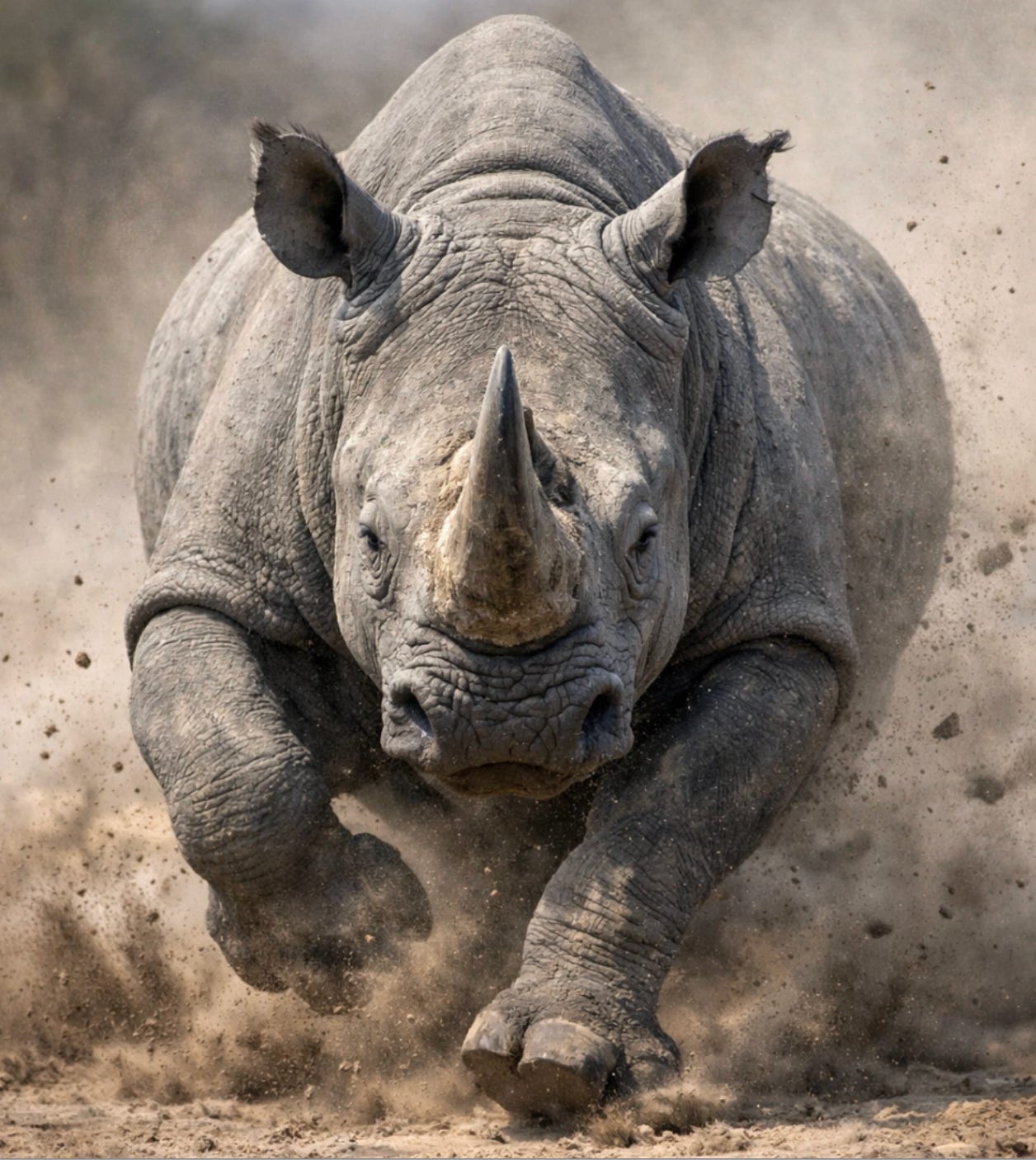
A Grey Rhino is a high-probability, high-impact threat that is entirely visible and almost entirely ignored. Not because it is hidden, but because acting on it requires paying a visible cost today for an invisible benefit tomorrow. That trade is psychologically brutal. Humans - and governments - are exceptionally bad at making it.
The Strait of Hormuz was a Grey Rhino. Every serious energy analyst knew that running a significant share of global oil supply through a 33-kilometre chokepoint between Iran and Oman was a structural vulnerability of the highest order. The geography was not going to change. The geopolitical logic of Iranian leverage over that chokepoint was not going to change. The question was always when, not whether, a crisis would arrive. And yet most countries continued running their economies through that single corridor year after year, because rerouting required investment that was expensive, slow, and politically unrewarding.
Two weeks into the war, we can see precisely who acted on the Grey Rhino and who did not.
The Bet That Did Not Look Like a Bet
Through the 2010s, China’s investment in renewable energy, electric vehicles, and grid infrastructure looked, from the outside, like industrial policy, pollution management, and climate signalling. It was all of those things. Underneath those rationales, it was also a deliberate response to a risk Chinese planners had mapped clearly: structural dependence on a chokepoint that, in any crisis, their adversary’s allies controlled.
Oil and gas supply 4% of China’s power mix. Across most major Asian economies, that figure runs between 40% and 50%. More than half of new cars sold in China are electric. Renewables met 80% of China’s new electricity demand growth in 2024. Oil shipments through the Strait of Hormuz account for approximately 6.6% of China’s total energy consumption. China entered this conflict holding 104 days of strategic crude reserves, rising to an estimated 140 to 180 days by year end.
The rhino charged. China was not standing in its path.
This is what acting on a Grey Rhino actually looks like. Not a single dramatic decision, but fifteen years of unglamorous infrastructure investment - each project individually justifiable on narrower grounds, collectively producing a resilience that only becomes fully visible when the crisis arrives. The cost was front-loaded and real. The benefit was back-loaded and invisible. Until now.
The benefit also turned out to be larger than the hedge alone. China did not just reduce its Hormuz exposure. It captured the manufacturing base for the global energy transition in the process. It now produces the dominant share of the world’s solar panels, lithium-ion batteries, and electric vehicle components, having invested a record $625 billion in renewable energy in 2024 - more than the rest of the world’s major economies combined. Every country now scrambling to reduce its own Hormuz exposure, which is most of them, will be buying Chinese technology to do it. The Grey Rhino response generated a Grey Rhino prize.
There was a third dividend nobody planned for. The air in Chinese cities is measurably cleaner than a decade ago. Coal power generation fell in 2025, the first annual decline in half a century, because renewable capacity expanded fast enough to absorb rising demand without it. One structural bet on energy independence delivered security, industrial dominance, and public health simultaneously. That is what happens when you act on the right risk early enough - the payoff compounds in directions you did not anticipate.
The Trap That Looked Like Dominance
The shale revolution was a genuine achievement. It made America energy independent in crude oil and gave Washington a geopolitical tool it had not previously held. It was also, by the logic of the risk framework, a response to the wrong risk.
Shale answered the question of whether America would run short of oil. It did not answer the question of whether oil itself was becoming a strategic liability. The Grey Rhino was not oil scarcity. It was oil dependency - the structural vulnerability of a global economy running on a fuel concentrated in unstable geographies, transited through military chokepoints, priced on markets that any regional conflict could detonate. The US, having achieved tactical energy independence, stopped looking at that rhino entirely.
The deeper error was statistical. Policymakers modelled Hormuz dependency as if the outcomes were normally distributed - occasional disruptions, manageable price spikes, diplomacy resolves it, back to normal. Gaussian thinking applied to a fat-tailed system. The actual distribution has a quiet, thin body - most years nothing catastrophic happens - and a tail that is not just fat but almost boundless. When a fat-tailed system fails, it does not fail a little. Currencies collapse, allies go into emergency rationing, oil crosses $100, a war has no exit. The downside is not worse than expected. It is a different order of magnitude from anything the model contained. Shale independence was so seductive precisely because it eliminated the thin-body risk - America’s own supply - while leaving full exposure to the tail. The US solved the small problem and declared the large one closed.
While China built the infrastructure for a post-oil economy, the United States cycled through energy policy with each administration. Obama invested in clean energy. The first Trump term reversed course. Biden reversed again. The second Trump term has reversed more aggressively than any predecessor, withdrawing clean energy incentives and pursuing fossil fuel dominance as explicit national strategy. No utility, grid operator, or manufacturer can make fifteen-year capital commitments in that environment. So they do not.
The manufacturing base for the energy transition - the batteries, the panels, the drivetrain components, the physical infrastructure of the post-oil economy - has migrated to China. The US won the current energy game and surrendered the structural position in the technologies that define the next one. It confused owning today’s market with owning tomorrow’s.
The cost of that confusion is now concrete. Oil above $100 damages the US economy through global price mechanisms even though no American crude transits Hormuz. The allies whose security commitments underpin US influence in the Indo-Pacific - Japan, South Korea, India - are absorbing the most acute pain from a conflict they had no part in starting. Every dollar those countries now spend accelerating their energy transitions will mostly flow to Chinese supply chains, because that is where the capacity lives. The US triggered the exact demand signal that cements China’s industrial advantage for the next decade.
The US went to the Middle East to project energy dominance. In doing so, it demonstrated what happens when you confuse tactical strength with structural resilience.
The League Table Nobody Wanted to Top
The war is generating a real-time ranking of which countries acted on their Grey Rhinos and which did not.
China sits at the top. Diplomatically embarrassed, commercially disrupted at the margins, but structurally insulated in ways no other major importer can match.
India sits in the middle, and the middle is genuinely uncomfortable. India imports more than 85% of its domestic oil needs. Half its crude transits Hormuz. It imports roughly 67% of its LPG requirements, and 90% of those shipments pass through the same chokepoint. The government has invoked emergency commodity legislation to ration cooking gas to 330 million households. Indian-flagged tankers slipped through the strait last week with their tracking transponders switched off to avoid Iranian targeting. New Delhi is negotiating with Tehran for permission to move its ships - asking a government it spent years distancing itself from under US pressure for safe passage to keep its restaurants open.
India’s renewable programme is real and accelerating - it dropped coal power generation in 2025 alongside China, the first simultaneous fall in half a century. But the direction of travel is not the same as the destination. India saw the Grey Rhino. It started moving. It has not moved fast enough, and this crisis is the invoice for that gap.
Japan and South Korea sit at the exposed end. Japan imports between 75% and 90% of its oil through Hormuz. South Korea sources roughly 60% of its crude the same way. Both entered this crisis with reserve levels measured in weeks. The Bank of Korea has activated a round-the-clock crisis task force. South Korea announced a $68 billion stabilisation fund. Japan is in a quieter panic. These are wealthy, technically sophisticated nations that watched the same Grey Rhino for decades and decided that reserves and diplomatic relationships were sufficient hedge. They were not.
Your Portfolio Has a Grey Rhino
Most investors manage risk tactically - diversifying across sectors, timing entries around current conditions, holding what performed well recently. That is Pesky Mosquito management: controlling individual exposures while the structural exposure underneath goes unexamined.
The Grey Rhino question for an investor is different. Not: what is the biggest risk in my portfolio right now? But: what structural shift is highly probable, high impact, and being widely ignored - and am I positioned on the right side of it before it arrives?
The clean energy transition was a visible Grey Rhino in 2021 when I wrote the original framework. It is a more urgent one now. A major military conflict has just demonstrated why every country on earth has urgent reason to reduce dependence on oil running through a single chokepoint. The policy response to this crisis will accelerate clean energy deployment in ways that voluntary climate commitments never could. The question for investors is not whether that deployment happens. It is whether you are positioned in the companies and geographies that will supply it.
The second Grey Rhino is the technology infrastructure question. The country or company that manufactures the components of the next energy system occupies the same structural position that oil exporters held in the twentieth century. China understood that and invested accordingly. Most Western investors are still treating Chinese clean energy dominance as a trade policy irritant rather than a structural reality about who owns the supply chains of the next fifty years. That is not a political position. It is a portfolio miscalculation.
The Rhino in Your Boardroom
The competitive version of this story is one most business leaders recognise immediately and act on almost never.
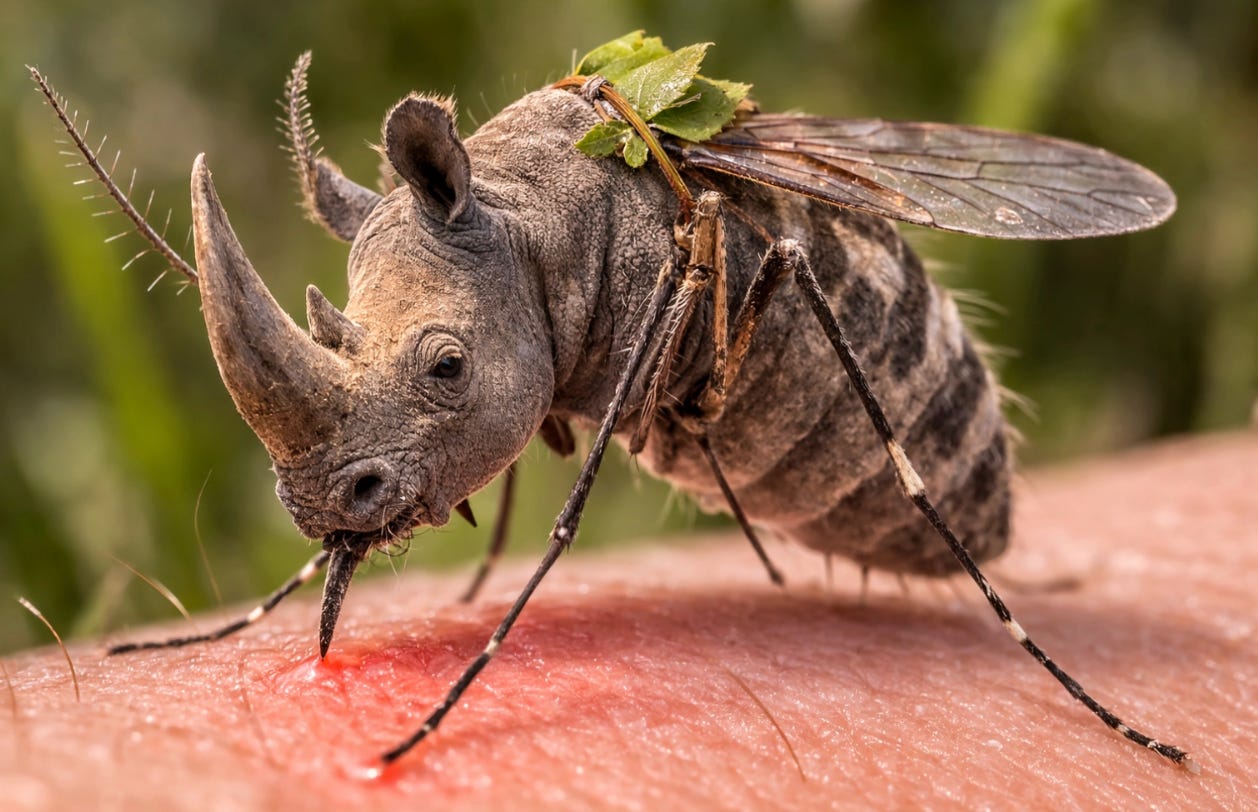
Large companies treat startups as Pesky Mosquitoes - individually irritating, manageable in isolation, unlikely to cause real damage. For a while, that assessment is correct. The startup is small, its product is rough, its market share is a rounding error. The mosquito is not worth the distraction.
The error is categorical, not factual. The dangerous startup is not a Pesky Mosquito at all. It is a Grey Rhino wearing Mosquito clothing.
Kodak invented the digital camera in 1975. It filed the patent, examined what digital photography would do to its film business, and put the technology in a drawer. The rhino was not just visible - it was sitting in their own laboratory. They chose the current market over the next one and paid for it with the company.
The structural pattern is always the same. The incumbent optimises for the current competitive environment. The challenger optimises for the next one. For years, optimising for the current environment looks correct - the numbers are real, the customers are real, the margins are real. Then the environment shifts, and the challenger’s long investment in a capability that looked unnecessary becomes the only capability that matters.
The Grey Rhino question for a business is not: who is our biggest competitor today? It is: what structural shift in our market is highly probable, high impact, and being treated as someone else’s problem - and is there a company, perhaps still small, that has been quietly building for that shift while we defend our current position?
There is almost always a company quietly building for the shift you have decided is someone else’s problem. The question is not whether it exists. It is how much of the 33 kilometres it has already closed.
The Rhino Is Already Charging
The country everyone assumed was screwed built the hedge. The country everyone assumed had it figured out built the trap.
The Strait of Hormuz will eventually reopen. Oil prices will stabilise. This war will end. What will not revert is the lesson this crisis is teaching, at enormous cost, to every government, investor, and business leader paying attention: structural resilience is built before the crisis, or it is not built at all.
Grey Rhinos do not disappear because you stop watching them. They just get closer.
The question worth sitting with today is not what your Grey Rhino is. You already know. The question is whether you are looking at your phone.
Sources
China’s energy position and Hormuz exposure
CNBC, 9 March 2026: China oil shock, Iran war, Hormuz energy transition - 4% power mix figure, EV penetration, 80% renewables share of new demand, 6.6% total energy consumption through Hormuz, 104-day reserves, OCBC analyst quotes
CleanTechnica, 13 March 2026: How China Is Avoiding the Straits of Hormuz Curse - coal power decline in 2025, economy redesigned around electricity
CNBC, 3 March 2026: Strait of Hormuz closure - which countries most impacted - 40% seaborne oil through Hormuz, LNG exposure data
OilPrice.com, January 2026: Five Key Trends Driving China’s 2026 Energy Strategy - $625 billion renewable investment figure
China’s geopolitical position
Middle East Institute, 5 March 2026: China in the Crossfire - Belt and Road Gulf exposure, strikes beginning February 28
Chatham House, February 2026: China is Playing the Long Game over Iran - China’s historical military non-intervention
CNN, 4 March 2026: Why has Beijing done very little? - 90% of Iran’s oil exports to China, rare earth export ban
Foreign Policy, 10 March 2026: US May Need China to Help Contain Iran War - China purchases 90% of Iran’s oil, one-third of Iran’s total trade
Chinese Foreign Ministry, 2 March 2026: Spokesperson Mao Ning Press Conference - official Chinese position on Hormuz
India
Bloomberg Opinion, 12 March 2026: Iran War Exposes India’s Vulnerability - LPG shortage, cooking gas crisis
Business Standard, 12 March 2026: India in talks with Iran for safe passage - transponders switched off, 28 vessels stranded, non-Hormuz sourcing rising to 70%, LPG production up 28%
CNBC, 2 March 2026: India hit by high oil prices - 85% import dependency, half of crude through Hormuz
CNBC, 10 March 2026: Iran war threatens LPG supply - 67% LPG imported, 90% of those through Hormuz
The Week India, 11 March 2026: The Hormuz Flashpoint - 2.5 to 2.7 million barrels per day through Hormuz, 330 million households on LPG
Japan and South Korea
Asia Energy Crisis analysis, March 2026: Asia Energy Crisis 2026 - Japan 75-90% Hormuz exposure, South Korea 60%, $68.3 billion stabilisation fund
Green Central Banking, 9 March 2026: Clean energy, not LNG, is Asia’s best hedge - Bank of Korea crisis task force, Singapore and Bangladesh exposure
Coal decline
Carbon Brief, January 2026, via CleanTechnica: China and India coal power generation fell simultaneously in 2025, first time in half a century
The Risk Framework
Aditya Sehgal, December 2021: The Risk Management Framework - Grey Rhino, Black Swan, Pesky Mosquito, Rare Panda archetypes
Check out some of my other Frameworks on the Fast Frameworks Substack:
The Decision Framework: DECIDE
The Alpha Engine Framework for Venture & Angel Investing
Don’t Hire an Agency. Build a Memetic Engine - The memetic engine framework
Fast Frameworks AI Tools: Cortex
The Exponential AI Adoption Framework
Moltbook and the Entity AI Framework
May every sunset bring you peace!
Entity AI, swarms and the future of work (Asymmetric Podcast)
Fast Frameworks Podcast: Entity AI-Episode 8: Meaning, Mortality, and Machine Faith
Fast Frameworks Podcast: Entity AI - Episode 7: Living Inside the System
Fast Frameworks Podcast: Entity AI – Episode 5: The Self in the Age of Entity AI
Fast Frameworks Podcast: Entity AI – Episode 4: Risks, Rules & Revolutions
Fast Frameworks Podcast: Entity AI – Episode 3: The Builders and Their Blueprints
Fast Frameworks Podcast: Entity AI – Episode 2: The World of Entities
Fast Frameworks Podcast: Entity AI – Episode 1: The Age of Voices Has Begun
The Entity AI Framework [Part 1]
The Promotion Flywheel Framework
The Immortality Stack Framework
Frameworks for business growth
The AI implementation pyramid framework for business
A New Year Wish: eBook with consolidated Frameworks for Fulfilment
AI Giveaways Series Part 4: Meet Your AI Lawyer. Draft a contract in under a minute.
AI Giveaways Series Part 3: Create Sophisticated Presentations in Under 2 Minutes
AI Giveaways Series Part 2: Create Compelling Visuals from Text in 30 Seconds
AI Giveaways Series Part 1: Build a Website for Free in 90 Seconds
Business organisation frameworks
The delayed gratification framework for intelligent investing
The Fast Frameworks eBook+ Podcast: High-Impact Negotiation Frameworks Part 2-5
The Fast Frameworks eBook+ Podcast: High-Impact Negotiation Frameworks Part 1
Fast Frameworks: A.I. Tools - NotebookLM
The triple filter speech framework
High-Impact Negotiation Frameworks: 5/5 - pressure and unethical tactics
High-impact negotiation frameworks 4/5 - end-stage tactics
High-impact negotiation frameworks 3/5 - middle-stage tactics
High-impact negotiation frameworks 2/5 - early-stage tactics
High-impact negotiation frameworks 1/5 - Negotiating principles
Milestone 53 - reflections on completing 66% of the journey
The exponential growth framework
Fast Frameworks: A.I. Tools - Chatbots
Video: A.I. Frameworks by Aditya Sehgal
The job satisfaction framework
Fast Frameworks - A.I. Tools - Suno.AI
The Set Point Framework for Habit Change
The Plants Vs Buildings Framework
Spatial computing - a game changer with the Vision Pro
The ‘magic’ Framework for unfair advantage