

The Ladder and Wall Framework is how I think about your progress and direction.
Capable people are good at climbing. Put a ladder in front of them and they will work out how to get up it. They climb roles, titles, pay bands, reputations. They climb expectations set by parents, managers, peers, and often by younger versions of themselves. The next rung is visible, the effort is familiar, and the climb feels productive. Momentum builds easily, which is why many people spend years climbing without stopping to ask where the ladder is actually taking them.

As time passes, the work keeps coming and the signals still look positive, but the range of future moves starts to narrow. Choices feel harder to make. From the outside it still looks like progress, so there is rarely a clear moment when you stop and reassess. You just keep going.
The real question is not whether you will succeed in the climb. If you are smart, disciplined, and driven, you probably will. The more important question is what the ladder is leaning against, and what sort of place you will arrive at when you reach the top.
In this framework, the ladder is what you are climbing. The wall is where that climb leads.
You can climb well, steadily, and for a long time, and still arrive somewhere you never consciously chose (and you dont’ like). That is the Ladder and Wall Trap.
Once you separate ladder from wall, the framework becomes practical. Four situations show up quickly, and most frustration around work and direction fits into one of them.
The Ladder-Wall Framework
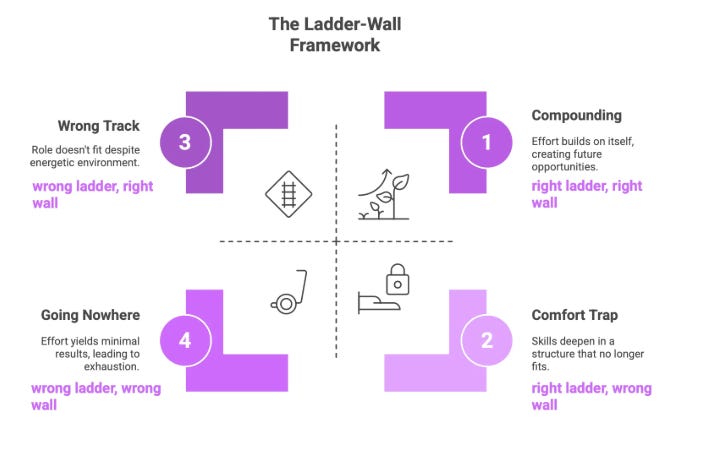
Right ladder, right wall: Compounding
Effort builds on itself. Progress creates options rather than closing them. The work you do today makes tomorrow easier, and your sense of self stays aligned with where you are heading.
Right ladder, wrong wall: Comfort Trap
You perform well inside a structure that no longer fits. Skills deepen, rewards continue, and leaving gets harder over time. What feels like stability slowly turns into constraint.
Wrong ladder, right wall: Wrong Track
The environment still has energy, but your role within it does not. You feel under-used. Motivation fades. Opportunity is nearby, but you are not positioned to take advantage of it.
Wrong ladder, wrong wall: Going Nowhere
Effort goes in without much coming back. Work expands, energy drops, and years pass without much changing underneath. People here are often busy and exhausted at the same time.
The point of the matrix is to help you see where you are while there is still room to move.
What ladders and walls are
The ladder is your role, your skill set, your craft, your function, or the path you are currently on. It is the thing you get better at through repetition and effort. It rewards discipline and persistence, and it gives feedback quickly through results, recognition, and progress.
The wall sits behind all of this. It is the larger structure you are climbing into. The industry. The organisation. The place. The phase of life. The general direction things are moving over time. When the wall fits what you want, climbing makes sense and tends to pay off. When the wall weakens or moves away from you, climbing harder only increases how dependent you are on it.
A simple way to hold the framework is this. A good ladder gets you up. A good wall tells you whether starting again from the bottom is worth it.
The platforms between ladders
Between ladders, there are platforms.
When a climb ends, you do not move directly from one ladder to the next. You step off onto a platform first. That platform might come after a promotion, finishing a degree, shipping a major product, selling a company, or deciding to move cities. Something has finished. Something else has not yet begun.
While you are climbing a ladder, attention is narrow and mostly upward. You focus on the next rung, the next test of competence, the next signal that you are progressing. Platforms change that. They give you distance. From a platform, you can see where you are, what the climb actually gave you, and what it did not. You are no longer scrambling for footing, but you are also not yet committed to the next ascent. This is where judgment becomes possible again.
Most people do not linger on platforms. They step straight onto the next ladder because momentum feels easier than stopping. Over time, this turns platforms into missed moments of choice rather than moments of orientation.
Life as a sequence of ladders
Life does not unfold as one long climb. It unfolds as a sequence of ladders, connected by platforms.
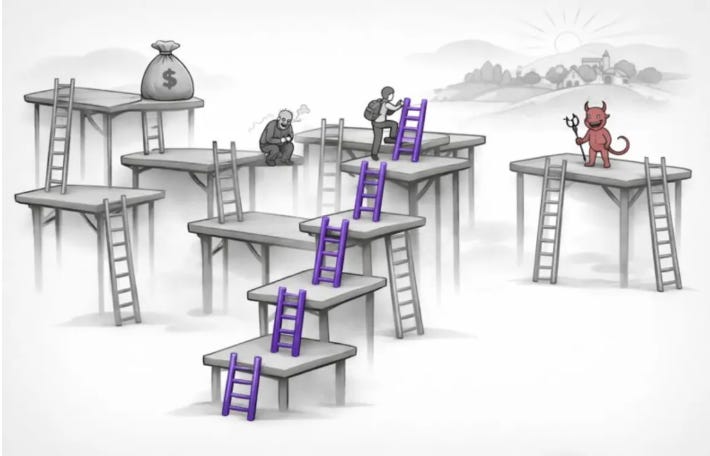
You climb one ladder, reach a platform, then choose the next ladder. Often the next ladder starts lower than where you just were. That drop is part of changing direction. It is how movement happens.
Most people recognise this pattern when they look back. At the end of school, confidence is high. At university, everything resets. The same thing happens when entering work, changing roles, or shifting paths entirely. Height resets, direction continues.
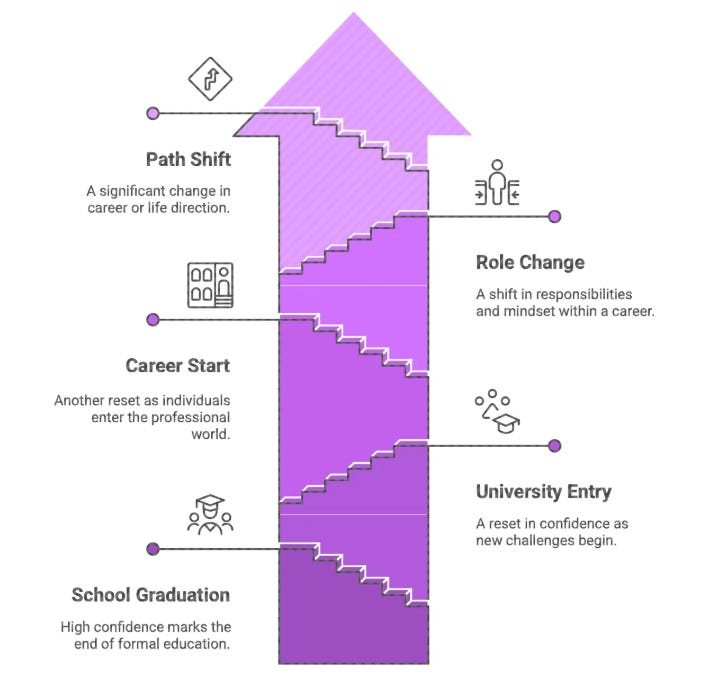
Each ladder calls for a different mindset. Early on, learning dominates. Later, you value execution and judgment more.
Platforms ask you for honesty. They are where direction gets set, whether deliberately or by default.
A quick check
You can use the framework without turning it into an exercise.
If you are successful at what you are doing over the next five years, who will that success turn you into?
If things go well on this path, will you be closer to the person you want to be, or just better at playing this role?
If you imagine yourself standing on the platform five years from now, would you choose to climb the same ladder again?
The answers tend to surface quickly.
The role of AI
AI does not change the fact that people climb ladders. It changes how quickly walls move. Industries that looked stable for decades can tilt in a few years. Skills that compounded reliably can stall suddenly. The trap becomes easier to fall into because the ladder still works while the wall shifts while you were distracted climbing the ladder.
AI can help you climb faster. It takes friction out of learning, execution, and coordination. Used well, it compresses effort and shortens the distance between rungs.
It can also help you see the wall more clearly. AI is good at pattern detection across markets, skills, and trajectories that are too large or slow-moving for any one person to track. It can surface shifts in demand, emerging adjacencies, and declining paths long before they become obvious in day-to-day work.
AI also reduces the cost of exploration. It makes it easier to simulate paths, test assumptions, and look sideways from a platform without committing years of effort. You can try ideas, roles, directions, and combinations cheaply before you choose what to climb next.
The combination changes how platforms work. Walls that once moved slowly can tilt mid-climb. Ladders that still feel stable can quickly lose relevance. Platforms matter more because they are where speed gives way to judgment. They are where you decide whether to keep climbing, change ladders, or change direction altogether.
AI is most valuable when it is used at the platform, not just on the ladder. It helps you decide what to climb next, not only how quickly you can climb.
Choosing what to climb
The most important question in this framework is not whether you can climb a ladder. If you are reading this substack post, its very likely that you are interested in self development and have the capability to climb any ladder.
The more interesting question is what the view will be like when you get to the top. Will it be your promised land?
If being higher on this ladder makes it harder to move toward the life you actually want, pay attention. You can finish the climb, step onto the platform, and then move sideways into a different sequence of ladders. Height gives way to direction. Familiarity gives way to trajectory. That shift reflects judgment.
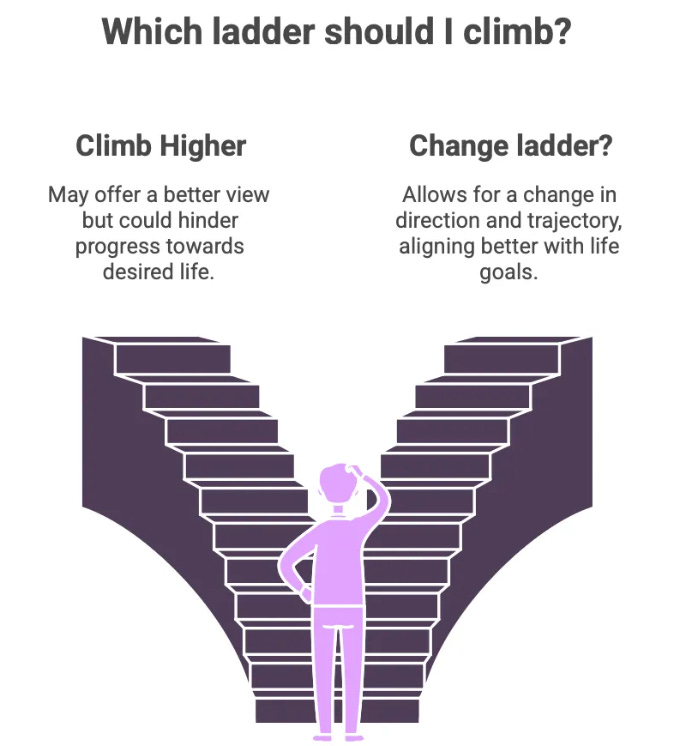
Smart people will always climb. What shapes the outcome is where the ladder is placed, what wall it leans against, and whether platforms are used deliberately.
Climb well. Take responsibility for what you are climbing into.
Direction compounds faster than effort.
Further reading (more frameworks that extend this narrative)
If you want to go deeper, these are the companion pieces that extend this idea in specific directions. The Magic Framework for Unfair Advantage explains why people get trapped optimising execution inside arenas where the underlying advantage is already decaying, which is the same structural error as climbing the right ladder against the wrong wall. The Exponential Growth Framework clarifies why compounding accelerates when mechanism and direction are aligned, which is what the “right ladder, right wall” quadrant looks like over time. The AI Jobs Framework maps how roles are shifting faster than industries, which is why “wrong ladder, right wall” is becoming more common. The Time-Mastery Framework shows how busyness can masquerade as progress and keep you climbing even when nothing is compounding, which is the engine of “wrong ladder, wrong wall.” Finally, the One Page Meeting Mastery Framework is a practical example of forcing platform-level clarity inside a system that otherwise rewards nonstop ladder-climbing.
Check out some of my other Frameworks on the Fast Frameworks Substack:
May every sunset bring you peace!
Entity AI, swarms and the future of work (Asymmetric Podcast)
Fast Frameworks Podcast: Entity AI-Episode 8: Meaning, Mortality, and Machine Faith
Fast Frameworks Podcast: Entity AI - Episode 7: Living Inside the System
Fast Frameworks Podcast: Entity AI – Episode 5: The Self in the Age of Entity AI
Fast Frameworks Podcast: Entity AI – Episode 4: Risks, Rules & Revolutions
Fast Frameworks Podcast: Entity AI – Episode 3: The Builders and Their Blueprints
Fast Frameworks Podcast: Entity AI – Episode 2: The World of Entities
Fast Frameworks Podcast: Entity AI – Episode 1: The Age of Voices Has Begun
The Entity AI Framework [Part 1]
The Promotion Flywheel Framework
The Immortality Stack Framework
Frameworks for business growth
The AI implementation pyramid framework for business
A New Year Wish: eBook with consolidated Frameworks for Fulfilment
AI Giveaways Series Part 4: Meet Your AI Lawyer. Draft a contract in under a minute.
AI Giveaways Series Part 3: Create Sophisticated Presentations in Under 2 Minutes
AI Giveaways Series Part 2: Create Compelling Visuals from Text in 30 Seconds
AI Giveaways Series Part 1: Build a Website for Free in 90 Seconds
Business organisation frameworks
The delayed gratification framework for intelligent investing
The Fast Frameworks eBook+ Podcast: High-Impact Negotiation Frameworks Part 2-5
The Fast Frameworks eBook+ Podcast: High-Impact Negotiation Frameworks Part 1
Fast Frameworks: A.I. Tools - NotebookLM
The triple filter speech framework
High-Impact Negotiation Frameworks: 5/5 - pressure and unethical tactics
High-impact negotiation frameworks 4/5 - end-stage tactics
High-impact negotiation frameworks 3/5 - middle-stage tactics
High-impact negotiation frameworks 2/5 - early-stage tactics
High-impact negotiation frameworks 1/5 - Negotiating principles
Milestone 53 - reflections on completing 66% of the journey
The exponential growth framework
Fast Frameworks: A.I. Tools - Chatbots
Video: A.I. Frameworks by Aditya Sehgal
The job satisfaction framework
Fast Frameworks - A.I. Tools - Suno.AI
The Set Point Framework for Habit Change
The Plants Vs Buildings Framework
Spatial computing - a game changer with the Vision Pro
The ‘magic’ Framework for unfair advantage
Excellent read! I practically re-lived different ladders and walls I climbed.
I already know what worked & what didn't at different stages... you just helped me understand why! thank you!!