

The Core Insight
Every brand wants to be culturally relevant. But few are built to move at the speed of culture.
For large brands, the cycle is glacial. A trend surfaces. It enters a weekly planning meeting. A brief is drafted. It goes to a retained agency. Rounds of feedback. Legal review. Compliance sign-off. The content ships two to four weeks after the moment it was responding to.
For smaller, more agile brands, the cycle compresses - but it’s still linear. Something trends on Monday. A creative brief gets written on Tuesday. It goes to a freelancer or small agency on Wednesday. Feedback loops through Thursday. Legal reviews on Friday. By the time it ships - the moment is gone.
In both cases, the architecture is the same: sequential, human-dependent, and slower than culture.
Culture doesn’t wait for approval cycles.
The brands that win aren’t the ones with the biggest budgets - they’re the ones with the fastest cultural reflexes.
Memes move in hours. Narratives shift in days. But underneath every meme that spreads is something deeper - what the Xeme Framework calls a xeme: the smallest transferable unit of learning created by a real-world test and embedded into a system. Memes are the cultural surface. Xemes are the intelligence underneath. The Memetic Engine doesn't just produce memes at scale - it generates xemes with every cycle, learning what works, what fails, and what's dangerous, and feeding that knowledge back into itself.
What if you could build a system that listens to culture in real time, generates thousands of creative variants automatically, filters them for legal and brand safety, simulates audience response using agents that model your actual consumers, micro-tests the best ones, and then amplifies only the winners?
That’s not a content calendar. That’s a Memetic Engine.
And when you build it as a swarm - it becomes a brand’s cultural nervous system.
From the Swarming Framework to the Memetic Engine
In the Swarming Framework, I laid out the architecture for building businesses as swarms - autonomous agents working in series, parallel, or hybrid configurations to create value without headcount.
The four levels: Agent > Swarm > Composite Swarm > Wrapper.
The Memetic Engine is the Swarming Framework applied to one of the most expensive, slowest, and most wasteful functions in business: content and creative production.
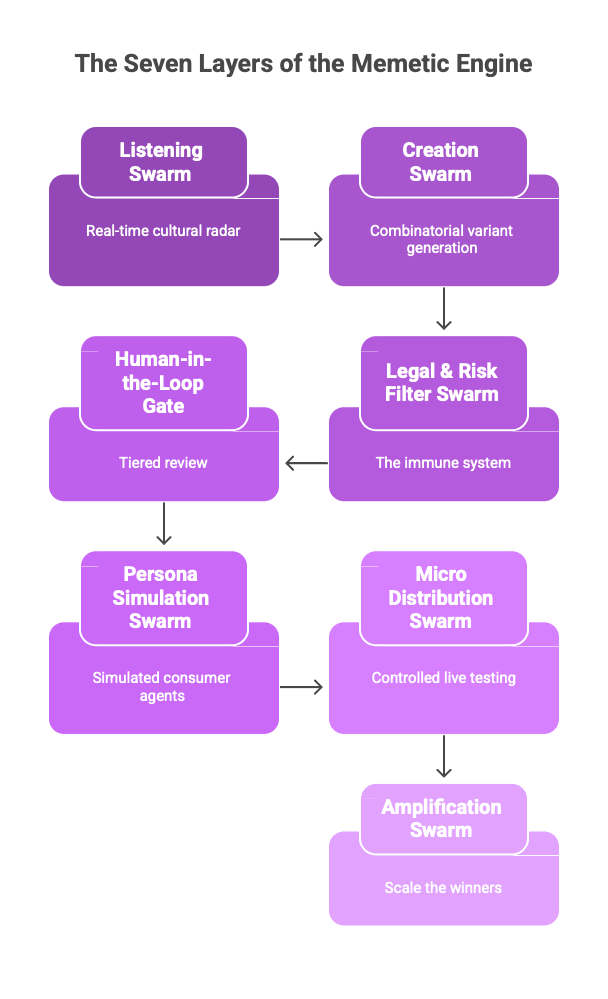
Instead of agencies, briefs, and campaign cycles, you deploy seven specialized swarm layers - each one autonomous, each one feeding the next - to produce culturally relevant content at machine speed.
A Swarming Cultural Operating System. Built to replace creative briefs, agency cycles, campaign planning delays, and reactive content production - with always-on, adaptive, performance-driven cultural output.
What the Memetic Engine Replaces
The traditional content pipeline looks something like this: a trend emerges, someone spots it, a brief gets written, a creative team ideates, legal reviews, revisions happen, and eventually something ships. That process takes days to weeks. The cultural moment it was responding to lasted hours.
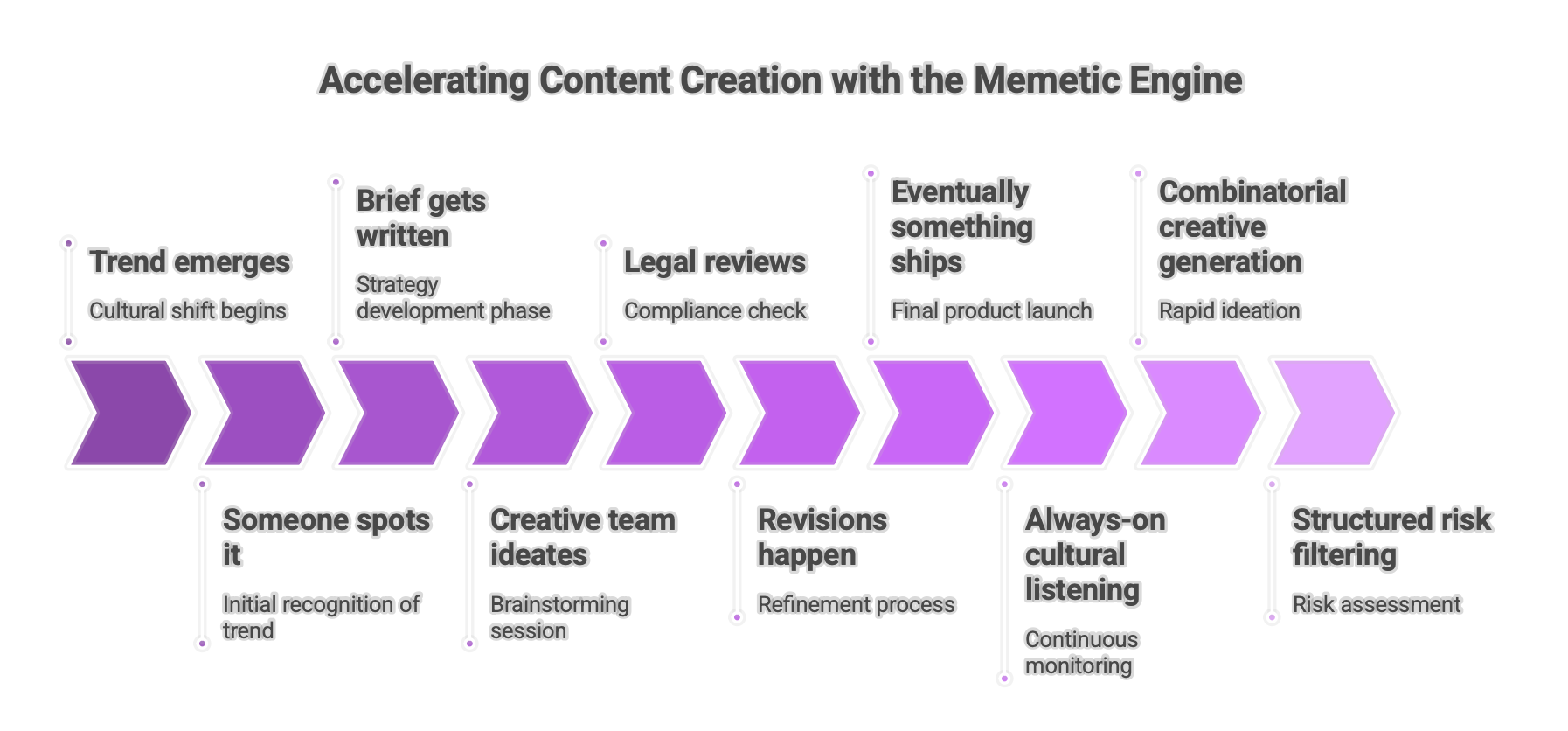
The Memetic Engine replaces this entire chain with always-on cultural listening, combinatorial creative generation, structured risk filtering, persona-based simulation, controlled micro-testing, iterative scaling, and KPI-driven amplification.
It requires only four inputs from the brand: brand guidelines, mandatories, risk constraints, and distribution access. Everything else is emergent from live culture.
One important clarification: the Memetic Engine is optimized for scroll-stopping image macros and short-form captions - the atomic unit of cultural content. Static memes, carousel cards, story frames. These are the units that move fastest, test cheapest, and compound hardest across platforms. The engine can also generate short-form video by injecting its creative output as prompts into video generation models like Seedance 2 or Kling - turning a winning meme concept into a 3-10 second clip without a production team. Longer-form content - articles, video essays, brand films - can be informed by what the engine learns, but they operate on a different cycle with different economics. The engine doesn’t try to replace the whole brand studio. It replaces the part of the studio that should have been a machine all along.
Meet VECTOR: The Demonstrator
Before diving into the architecture, meet VECTOR - the Velocity Engine for Cultural Trends, Outcomes & Rituals.
VECTOR is a Custom GPT I’ve built as a scaled-down demonstrator of the Memetic Engine. It simulates the core layers of the full system in a single conversational interface - listening to live culture via browsing, generating multi-variant creative across archetypes and tones, pre-screening for brand and legal safety, running persona-based evaluation, generating images, and offering iteration.
It supports four entry modes:
Build a meme - Guided creation with brand and audience inputs
Savage mode - Aggressive, high-contrast memes designed to provoke engagement
Surprise me - The engine picks the trend, the tone, and the format
Rainbow mode - Seven distinct meme variations across the full emotional and tonal spectrum
The sections that follow describe the full production-grade architecture that VECTOR demonstrates in miniature. Where VECTOR generates 2-7 memes per run, the full engine generates tens of thousands. Where VECTOR uses a single conversational interface, the full engine deploys seven autonomous swarm layers working in continuous parallel.
The Seven Layers of the Memetic Engine
The system operates as a composite swarm - seven specialized agent layers working in series, with parallel processing within each layer.
Layer 1 - The Listening Swarm
This is the engine’s sensory cortex. It continuously scans X, Reddit, TikTok, YouTube Shorts, news outlets, Google Trends, influencer accounts, and subculture clusters.
This isn’t social listening in the traditional sense - dashboards and weekly reports. This is a real-time cultural radar that feeds directly into creation.
Cadence: Real-time. Not weekly. Not daily. Not even hourly. The Listening Swarm operates as a continuous feed - scanning, scoring, and surfacing memetic vectors as they emerge, not after they’ve peaked.
Every vector is scored across six dimensions: emotional polarity, velocity, mutation elasticity, cross-platform diffusion, brand adjacency probability, and risk index.
The output: a live, ranked stream of the 10-20 strongest memetic vectors at any given moment - updating continuously.
Layer 2 - The Creation Swarm
For each trending vector identified by the Listening Swarm, the Creation Swarm generates structured variants at industrial scale. It works across six creative dimensions - the same ones VECTOR uses in its demonstrator form, but running at full combinatorial scale.
Archetypes define the structural logic of the meme. The engine uses seven: Contrast (two opposing realities side by side), Exaggeration (a truth pushed to its absurd extreme), Recognition (the “this is so me” moment), Escalation (tension that builds frame by frame), Inversion (the expected outcome flipped), and Absurdity (logic deliberately broken for comic effect).
Tones set the emotional register. Ten are supported: Relatable, Inspirational, Educational, Flex, Satirical, Absurd, Dark, Wholesome, Brutal, and Savage Mode.
Aggression controls the edge. Three levels: Low (brand-safe, warm, inclusive), Medium (edgy, provocative, designed to spark debate), and High (savage, confrontational, designed to polarize and amplify).
Tension Drivers are the psychological hooks that make a meme stick. The engine deploys six: Status Contrast (the gap between haves and have-nots), Identity Tension (who you are vs. who you project), Expectation Flip (the setup says one thing, the punchline says another), Cultural Contradiction (two truths that shouldn’t coexist but do), Scarcity Cue (urgency, exclusivity, FOMO), and Power Imbalance (the small vs. the big, the individual vs. the system).
Personas are not a fixed list. They are generated dynamically based on the brand’s target audience and the trend being addressed. The engine infers the right persona from brand context and trend data - or the user specifies their own.
Languages add the final multiplier. For a global brand, the engine generates natively in every target market language - not as translation, but as transcreation. A meme that works as dry sarcasm in English may need to land as absurdist humor in Japanese, as direct provocation in Brazilian Portuguese, or as aspirational storytelling in Hindi. The Creation Swarm generates language-native variants from the start - not English-first with translation bolted on.
Now the math.
Take a mid-size deployment: 7 archetypes x 10 tones x 3 aggression levels x 6 tension drivers x 5 personas x 5 languages.
That’s 31,500 possible permutations per trend.
Not every combination is valid. A Wholesome tone at High aggression gets pruned. An Educational tone with Absurdity archetype may not serve a luxury brand. Constraint-based pruning eliminates contradictions and brand-unsafe pairings.
But even after pruning, the engine generates 2,000-5,000 structured variants per trend. Across 10-20 live trends running simultaneously, that’s 20,000-100,000 candidate memes in play at any given time.
Here’s what that looks like in practice. Say a trending vector emerges - a CEO’s tone-deaf post gets ratio’d on X. The engine might generate:
A Contrast archetype in Satirical tone for a Gen Z Meme Native at High aggression in English, using Power Imbalance as the tension driver: “POV: your CEO just discovered LinkedIn. Shareholders discovered the exit.”
An Inversion archetype in Relatable tone for a Corporate Insider at Medium aggression in Spanish, using Identity Tension: the public face vs. the Slack DMs.
An Exaggeration archetype in Dark tone for a Side-Hustle Operator at High aggression in Hindi, using Status Contrast: the corner office vs. the food court.
An Absurdity archetype in Wholesome tone for an Aspirational Student at Low aggression in Arabic, using Expectation Flip: what you think the CEO meeting is about vs. what it’s actually about.
And thousands more. Each one structurally distinct. Each one targeted to a specific persona, tone, and cultural register.
Only the top 25% survive. Every variant must pass four filters: a compression test (can it be understood in 12 words or fewer?), a scroll-stop test (does it register in 1.5 seconds?), a cultural specificity check (is it rooted in something real and current, not generic?), and a visual simplicity constraint (can it be rendered as a single, clean image?).
The rest are killed.
Layer 3 - The Legal & Risk Filter Swarm
Speed without safety is recklessness. This layer is the engine’s immune system.
Before any output reaches distribution, it passes through five filters: a defamation guard (no unverified claims about real individuals, no fabricated allegations), a protected class filter (no targeting based on protected attributes), a political sensitivity classifier (flagging election cycles and geopolitical volatility), a brand safety matrix (enforcing brand red zones and checking for value contradictions), and platform compliance mapping (alignment with Instagram, TikTok, X, and YouTube rules).
If anything gets flagged, the system doesn’t just kill it - it auto-rewrites into symbolic abstraction, downgrades aggression, or routes to human review. The engine is designed to be intentionally aggressive but controlled.
The philosophy: Attack narratives, not identities. Parody rhetoric, not protected traits. Symbolize risk instead of asserting wrongdoing. Aggression is stylistic, not defamatory.
Layer 4 - The Human-in-the-Loop Gate
Not everything should be fully autonomous. The engine uses a tiered review system that preserves velocity while controlling legal exposure.
Tier 1 - Low Risk: Auto-approve. The system has enough confidence and the content falls within well-established brand guardrails.
Tier 2 - Medium Risk: Human sign-off before scaling. A brand manager reviews and approves within a target latency of under 30 minutes.
Tier 3 - High Risk: Mandatory human approval. This covers elections, regulated industries, and anything that touches geopolitical sensitivity.
The key insight: you don’t slow everything down to the speed of your most cautious scenario. You tier the review so that 80% of content flows fast while 20% gets appropriate scrutiny.
Layer 5 - The Persona Simulation Swarm
Before a single piece of content reaches a real human, the engine runs it through simulated consumer agents.
The key word is “simulated consumer agents” - not fixed archetypes. The Persona Simulation Swarm spins up custom agents modelled on the brand’s actual target consumer segments.
If you’re a luxury streetwear brand, your persona agents might be the Hype-Obsessed Reseller, the Quiet-Luxury Minimalist, and the Culture-Adjacent Professional. If you’re a fintech, they might be the First-Time Investor, the Crypto-Native Degen, and the Risk-Averse Saver. If you’re a fast food chain, they might be the Late-Night Craving Student, the Budget-Conscious Family, and the Irony-Pilled Food Blogger.
The engine builds these persona agents from the brand’s own customer data, CRM segments, and audience research - or infers them from publicly available brand positioning if no proprietary data is provided.
But personas don’t have to stop at 3-5 segments. When you have 20,000-100,000 candidate memes in play, you can micro-target into tens of thousands of micro-personas. The engine builds these by running a meta-analysis of Facebook and Google lookalike audiences - extracting behavioral clusters, interest overlaps, and engagement patterns that platform algorithms have already identified. Each lookalike cluster becomes its own persona agent. Instead of asking “will Gen Z like this?” you’re asking “will this specific sub-cluster of 22-year-old crypto-curious sneakerheads in Sao Paulo share this at 11pm on a Tuesday?” The meme inventory is large enough to match at that resolution.
Each persona agent scores every surviving meme variant for: likelihood to like, likelihood to share, comment potential, save potential, and offense risk.
VECTOR’s evaluation framework scores each meme across six dimensions: Clarity, Cut-through, Virality, Brand Imprint, Persona Resonance, and Risk Exposure. It then surfaces the strongest overall, the most viral, the most brand-building, the safest, and the most polarizing - along with trade-off insights and aggression/tone impact analysis.
The output is an Engagement Probability Index - calibrated to the people the brand actually wants to reach, not a generic audience model.
Layer 6 - The Micro Distribution Swarm
Surviving content gets deployed to 100-500 real users through micro paid boosts and controlled A/B accounts.
Because each meme variant is already tagged to a micro-persona, the Micro Distribution Swarm doesn’t just A/B test at random. It routes each variant to the specific lookalike cluster it was built for - matching creative to audience at a granularity that traditional campaign targeting can’t reach. This is where the volume of the Creation Swarm pays off: you need thousands of variants because you’re serving thousands of distinct audience slices.
The system measures 3-second hold rate, share rate, comment depth, save rate, CTR, and conversion signal. It promotes the top quartile and kills the bottom half.
This is where the swarm meets reality. No amount of simulation replaces actual human response - but by the time content reaches this layer, it’s already been through five rounds of selection. The micro-test is confirmation, not exploration.
This layer is also the one with real prerequisites. To micro-test at speed, you need: platform ad accounts with spend permissions across your target channels, tracking pixels and attribution plumbing installed and firing, a library of A/B test accounts or dark-post infrastructure, creative routing automation (so variants flow from generation to deployment without manual uploads), and a measurement stack that can read engagement signals within hours, not days. Without this plumbing, the engine stalls at Layer 5. This is the infrastructure moat - and the reason most brands can’t do this even if they understand the concept.
Layer 7 - The Amplification Swarm
Winners - and only winners - get scaled. They flow to brand channels, influencer networks, paid distribution, and owned media.
Amplification is a hybrid of human and digital. Influencers add authenticity. Paid adds reach. Owned channels add permanence. The combination creates the kind of cross-platform saturation that used to require a full agency team and a six-figure media buy.
And because the engine tracks performance at every layer, the amplification swarm feeds data back into Layer 1 - closing the loop, tuning the system, and making the next cycle smarter.
Every cycle makes the engine sharper. Every meme that wins teaches the next thousand what to look like.
Brand Drift and the Fingerprint Score
There’s a risk baked into any system that generates at scale off live culture: brand drift. If the engine optimizes purely for engagement, every brand starts sounding the same - chasing whatever gets rewarded by the algorithm this week. Edgy becomes the default. Nuance disappears. The brand voice dissolves into generic internet tone.
The control mechanism is what we call the Brand Fingerprint Score - a composite metric tracked over time that measures how closely the engine’s output matches the brand’s defined identity across tone distribution, archetype mix, aggression range, visual style, and vocabulary. If the Fingerprint Score drifts beyond a set threshold, the engine automatically reweights its creative parameters back toward the brand’s baseline. Think of it as a thermostat for brand identity - the engine can explore, but it can’t wander.
The Memory Layer
The engine claims to “get smarter.” But what does it actually learn?
The Memory Layer is where xemes are stored.
Every cycle writes to a persistent memory layer that stores five categories of knowledge: which archetype-tone-persona combinations drive the highest engagement for this specific brand, which topics and cultural vectors consistently trigger risk flags or legal review, which content formats fatigue fastest and need rotation, what the “brand-safe edge” looks like - the maximum aggression level that performs without triggering backlash, and which language-market combinations require the most transcreation distance from the English-language original.
This isn’t abstract “machine learning.” It’s a structured log of what worked, what didn’t, what was dangerous, and what was stale - updated every cycle and fed back into Layers 1, 2, and 5. The Memory Layer is what turns a content engine into a learning system.
The Performance Loop
The Memetic Engine isn’t art for art’s sake. It operates against explicit commercial KPIs, calibrated to brand scale. Each tier anchors to one primary metric - the thing that tier actually cares about most.
Small / Local Brand - Primary metric: Sales efficiency (ROAS) At this scale, every dollar of spend has to pull its weight. Target: 2.5x ROAS minimum. Reach: 10K-100K daily organic impressions. Engagement: 6-10%. Markets: 1-2 languages. The engine earns its keep by converting, not just reaching.
Medium Brand - Primary metric: Engagement rate Medium brands have enough reach to matter but not enough to waste. The engine’s job is to maximize the quality of every impression. Target: 5-9% engagement. Reach: 100K-500K daily organic impressions. ROAS: 3.0x minimum. Markets: 2-5 languages.
Large Brand - Primary metric: Safe reach at scale Large brands can generate volume - the challenge is doing it without brand safety incidents. The engine’s primary job is to maximize reach while keeping risk exposure near zero. Reach: 500K-5M daily organic impressions. Engagement: 4-8%. ROAS: 3.5x minimum. Markets: 5-15 languages.
Global Brand - Primary metric: Fatigue-managed frequency At global scale, the biggest threat is audience fatigue - the same message hitting the same users too many times, across too many markets, in too many formats. The engine’s primary job is to maintain optimal frequency (2.3-3.1 exposures per user) across 15-40+ languages while rotating creative fast enough that the audience never tunes out. Reach: 5M-50M+ daily organic impressions. Engagement: 3-7%. ROAS: 4.0x minimum.
These KPIs don’t just measure output - they feed back into tone weighting, archetype weighting, aggression calibration, and persona targeting. The engine self-calibrates toward whatever the business is optimizing for.
This is the difference between a content strategy and a content system. A strategy is a plan. A system is a machine that improves itself.
The Convergence
Three things have converged to make the Memetic Engine possible - and inevitable.
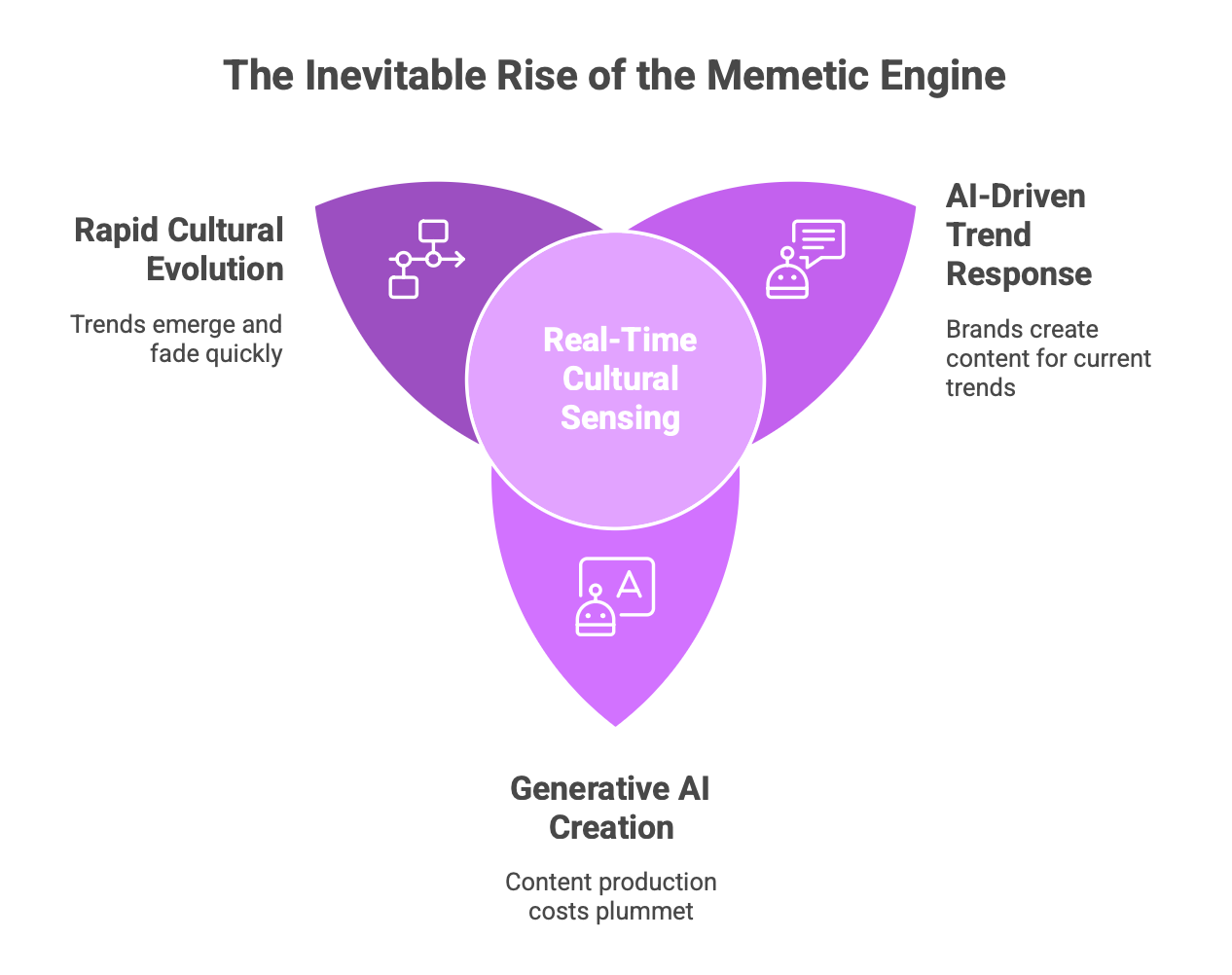
First, culture moves faster than organizations. The gap between when a trend peaks and when most brands respond has widened to the point where most branded content arrives after the cultural moment has passed. The traditional pipeline - brief, create, review, approve, publish - was designed for a world where news cycles lasted weeks. That world is gone.
Second, generative AI has collapsed the cost of creation to near zero. What used to require a designer, a copywriter, and a creative director can now be done by a well-prompted model in seconds. The constraint isn’t production anymore - it’s selection, safety, and distribution.
Third, the data infrastructure for real-time cultural sensing now exists. Between social APIs, trend aggregators, and sentiment models, it’s possible to build a listening system that processes cultural signals at machine speed. The raw material - live culture - is available to anyone who builds the right intake system.
Put these together and you get an engine that doesn’t just respond to culture. It rides inside culture - generating, testing, and amplifying in near-real-time.
The End State
Fully deployed, the Memetic Engine listens continuously, generates combinatorial creative, filters for legal risk, simulates audience response, micro-tests before scale, amplifies only winners, self-calibrates tone and aggression, and aligns to ROAS and reach goals - all without traditional creative agencies.
It doesn’t replace human creativity. It replaces the infrastructure around human creativity - the briefs, the approval chains, the media plans, the agency retainers, the campaign timelines that were built for a world that no longer exists.
A brand’s most expensive asset isn’t its creative. It’s the time between the insight and the output. The Memetic Engine compresses that gap to nearly zero.
It becomes what every brand needs but almost none have built: a cultural nervous system.
From the Swarming Framework
If you map the Memetic Engine back to the Swarming Framework, the structure is clear:
Agents: Each layer - listening, creation, filtering, simulation, distribution, amplification - is a specialized agent
Swarm: Within each layer, agents operate in parallel (thousands of variants, multiple personas, cross-platform scanning, multiple languages)
Composite Swarm: The seven layers together form a composite swarm - different agent types integrated in series, each feeding the next, the whole system learning from every cycle
Wrapper: The brand itself - its guidelines, its mandatories, its identity - is the wrapper that gives the swarm structure and direction
The swarm is the engine. The brand is the wrapper. Culture is the fuel.
#FastFrameworks #MemeticEngine #SwarmingFramework #CulturalOS #AIMarketing #MemeEngineering #AgentEconomy #CompositeSwarms #ContentAutomation #BrandStrategy #GenerativeAI #CulturalIntelligence #AICreative #AlwaysOnContent #MemeSwarming #CreativeVelocity #VECTOR #GPTBots #AIProductivity #ScaleWithoutAgencies #CulturalNervousSystem #DataDrivenCreative #ContentSwarm #RealTimeMarketing
If you found this post valuable, please share it with your networks.
In case you would like me to share a framework for a specific issue which is not covered here, or if you would like to share a framework of your own with the community, please comment below or send me a message
CustomGPT built by asgardlabs.ai.
Check out some of my other Frameworks on the Fast Frameworks Substack:
Fast Frameworks AI Tools: Cortex
The Exponential AI Adoption Framework
Moltbook and the Entity AI Framework
May every sunset bring you peace!
Entity AI, swarms and the future of work (Asymmetric Podcast)
Fast Frameworks Podcast: Entity AI-Episode 8: Meaning, Mortality, and Machine Faith
Fast Frameworks Podcast: Entity AI - Episode 7: Living Inside the System
Fast Frameworks Podcast: Entity AI – Episode 5: The Self in the Age of Entity AI
Fast Frameworks Podcast: Entity AI – Episode 4: Risks, Rules & Revolutions
Fast Frameworks Podcast: Entity AI – Episode 3: The Builders and Their Blueprints
Fast Frameworks Podcast: Entity AI – Episode 2: The World of Entities
Fast Frameworks Podcast: Entity AI – Episode 1: The Age of Voices Has Begun
The Entity AI Framework [Part 1]
The Promotion Flywheel Framework
The Immortality Stack Framework
Frameworks for business growth
The AI implementation pyramid framework for business
A New Year Wish: eBook with consolidated Frameworks for Fulfilment
AI Giveaways Series Part 4: Meet Your AI Lawyer. Draft a contract in under a minute.
AI Giveaways Series Part 3: Create Sophisticated Presentations in Under 2 Minutes
AI Giveaways Series Part 2: Create Compelling Visuals from Text in 30 Seconds
AI Giveaways Series Part 1: Build a Website for Free in 90 Seconds
Business organisation frameworks
The delayed gratification framework for intelligent investing
The Fast Frameworks eBook+ Podcast: High-Impact Negotiation Frameworks Part 2-5
The Fast Frameworks eBook+ Podcast: High-Impact Negotiation Frameworks Part 1
Fast Frameworks: A.I. Tools - NotebookLM
The triple filter speech framework
High-Impact Negotiation Frameworks: 5/5 - pressure and unethical tactics
High-impact negotiation frameworks 4/5 - end-stage tactics
High-impact negotiation frameworks 3/5 - middle-stage tactics
High-impact negotiation frameworks 2/5 - early-stage tactics
High-impact negotiation frameworks 1/5 - Negotiating principles
Milestone 53 - reflections on completing 66% of the journey
The exponential growth framework
Fast Frameworks: A.I. Tools - Chatbots
Video: A.I. Frameworks by Aditya Sehgal
The job satisfaction framework
Fast Frameworks - A.I. Tools - Suno.AI
The Set Point Framework for Habit Change
The Plants Vs Buildings Framework
Spatial computing - a game changer with the Vision Pro
The ‘magic’ Framework for unfair advantage
Will try this out Adi
Fantastic !