

There are two kinds of people at dinner parties. The ones who answer “what do you do?” with tasks they perform, and the ones who answer with problems they solve. The first group is about to have a very difficult decade.
The comfortable middle-class knowledge work that built careers for the last thirty years is being automated faster than anyone expected. ChatGPT can write the quarterly report. Claude can build the financial model. Midjourney can design the presentation. The question is not whether machines will change your job. The question is whether your sense of self can survive that change.
The Career Ladder: Four Levels of Identity
When someone asks what you do, your answer points to one of four things. Each represents a different relationship with automation. Each requires a different strategy for survival.
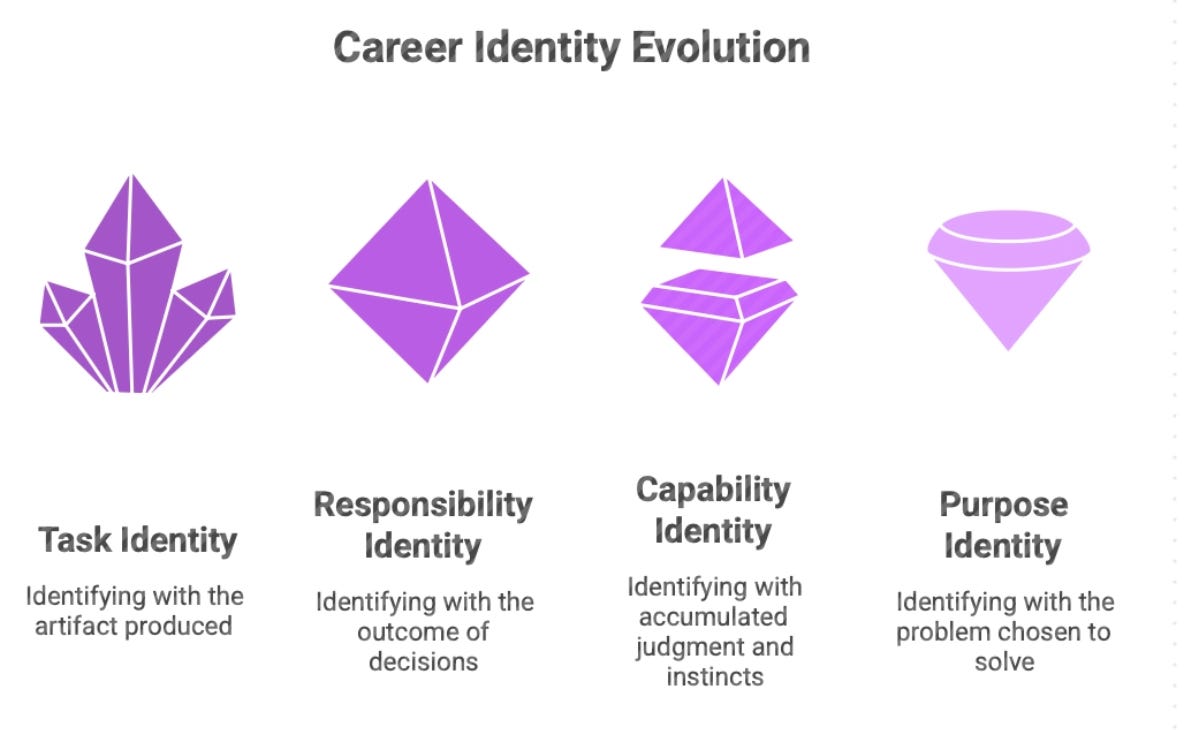
Level 1: Task Identity
“I write the quarterly report.”
You identify with the artifact. The spreadsheet, the presentation, the code, the design. When the thing you make is good, you feel good. When someone else can make it faster, you feel threatened.
Machines live here. They produce artifacts. If your identity is anchored at this level, you and machines are competing for the same work. You will lose that competition, and it will feel personal.
Sarah spent eight years as a marketing coordinator. She took pride in her email campaigns. She loved testing subject lines, setting up customer groups, tracking open rates. Then her company bought software that could test a hundred variations in the time it took her to write three. The campaigns got better. Sarah felt invisible. Her identity was the campaigns. When software could make them better, what was left of her?
In my AI-Jobs Framework, I mapped roles across two dimensions: how high the stakes are, and how repetitive or creative the work is. The roles at highest risk are repetitive, low-stakes tasks. These are task-identity roles almost by definition. The work is the artifact. The person is the pair of hands.
Level 2: Responsibility Identity
“I make sure we enter the right market.”
You identify with the outcome, not the artifact. You might still write the report, but the report serves a decision. You own whether that decision was right. You sleep well when the market entry succeeds and poorly when it fails.
Machines can write the report. They cannot own the consequence. There is no computer to blame when the strategy fails, no algorithm that loses reputation, no machine that lies awake wondering what it missed.
This is the first level where automation becomes a tool rather than a competitor. You use it to produce better artifacts faster, then stake your professional life on what those artifacts recommend.
This is the difference between being the architect and the bystander. Responsibility identity is what makes you the architect.
Level 3: Capability Identity
“I spot the patterns that change the strategy.”
You identify with accumulated judgment. The instincts you have built over years of making calls and watching what happened. The patterns you learned to see that others miss. The decisions you got right when the data was unclear.
Marcus runs revenue operations for a software company. He can look at a month’s worth of sales data and tell you which deals will close, which salespeople are burning out, and which market segment is about to shift. He cannot explain exactly how he knows. Fifteen years of watching sales cycles taught him to read signals that do not show up in any dashboard.
In my Xeme Framework, I introduced the idea of a xeme: the smallest piece of learning earned through real-world testing and built into how you work. Your capability identity is really the collection of xemes you carry. The decisions you got right and wrong. The patterns you spotted early. The instincts nobody taught you because they can only come from experience.
Machines can copy the outputs of judgment. They cannot copy the judgment itself. Your pattern recognition is yours. Your instincts come from choices you made and consequences you lived through. Those are not transferable to a machine, no matter how much data you feed it.
Level 4: Purpose Identity
“I help organisations make better decisions, even when it’s hard.”
You identify with the problem you chose to solve. Tools change, industries change, roles change. But the problem persists, and you persist with it. You could switch careers tomorrow without an identity crisis because your identity was never attached to any particular career.
The key word is “chose.” Purpose is not a direction someone gave you. It is a commitment you maintain when you could walk away. You wake up on a difficult Monday, consider quitting, and choose to keep going because the problem still matters to you.
Machines can be given a purpose. But they cannot choose one. They were never going to stop. They have no alternative they rejected, no cost they are paying, no Monday morning decision to keep going. The identity value of purpose comes from the fact that you could walk away and you do not.
In my Ladder and Wall Framework, I describe how your career has two parts: the ladder (your role, the thing you get better at) and the wall (the industry, the direction the ladder leans against). Purpose identity is what lets you change walls without losing yourself. If your purpose is “I help organisations make better decisions,” you can move from consulting to tech to education and your identity travels with you. Task identity cannot survive a wall change. Purpose identity does not even notice it.
How to Read the Ladder
Each level up fundamentally changes your relationship with automation. At the Task level, you find yourself competing directly with machines for the same work. Move to Responsibility, and those same machines become your assistants, helping you deliver better outcomes you own. At Capability level, automation amplifies your reach while your hard-earned judgment remains distinctly yours. And at Purpose level, machines become irrelevant to your identity entirely. You pick them up or put them down like any other tool.
Most people move between levels depending on the situation. You might operate at Capability level in your main role while staying at Task level for a side project. What matters is where your primary sense of self lives. That anchor determines whether automation strengthens or weakens your happiness.
The Migration Path
The movement is not a single jump. It is a series of shifts in what you feel responsible for.
Task to Responsibility: Stop identifying with the artifact. Start identifying with the outcome. Ask: “If this thing I make disappeared tomorrow, what would actually be lost?” If the answer is “the decision would be worse,” then the decision is your real work.
Responsibility to Capability: Stop identifying with any single outcome. Start identifying with patterns across outcomes. Ask: “What do I know now that I did not know five years ago, and how did I learn it?” That knowledge is your real asset.
Capability to Purpose: Stop identifying with your thinking. Start identifying with the problem you care about solving. Ask: “If I had to start over in a completely different industry, what problem would I still want to work on?” That problem is your purpose.
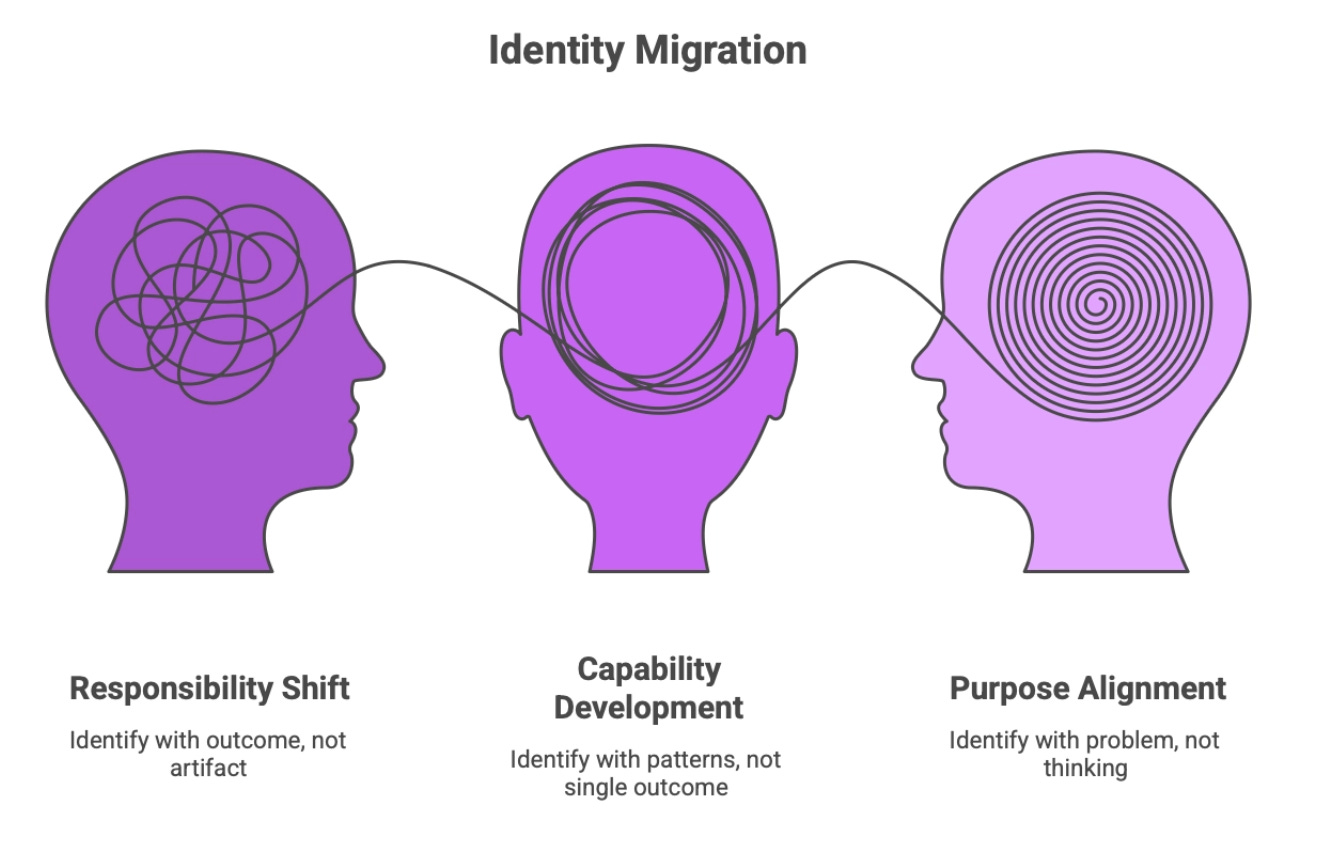
Each move takes time. The further your current role is from judgment-based work, the longer the migration. But every step up is permanent. Once you own an outcome, you do not go back to owning an artifact. Once you see patterns, you do not unsee them.
The Life Anchors: Three Sources Machines Cannot Touch
Career identity is not the whole story. Part of your sense of self lives in places machines cannot reach, no matter how advanced they get. These are your life anchors. They protect your happiness even if the career ladder gets disrupted entirely.
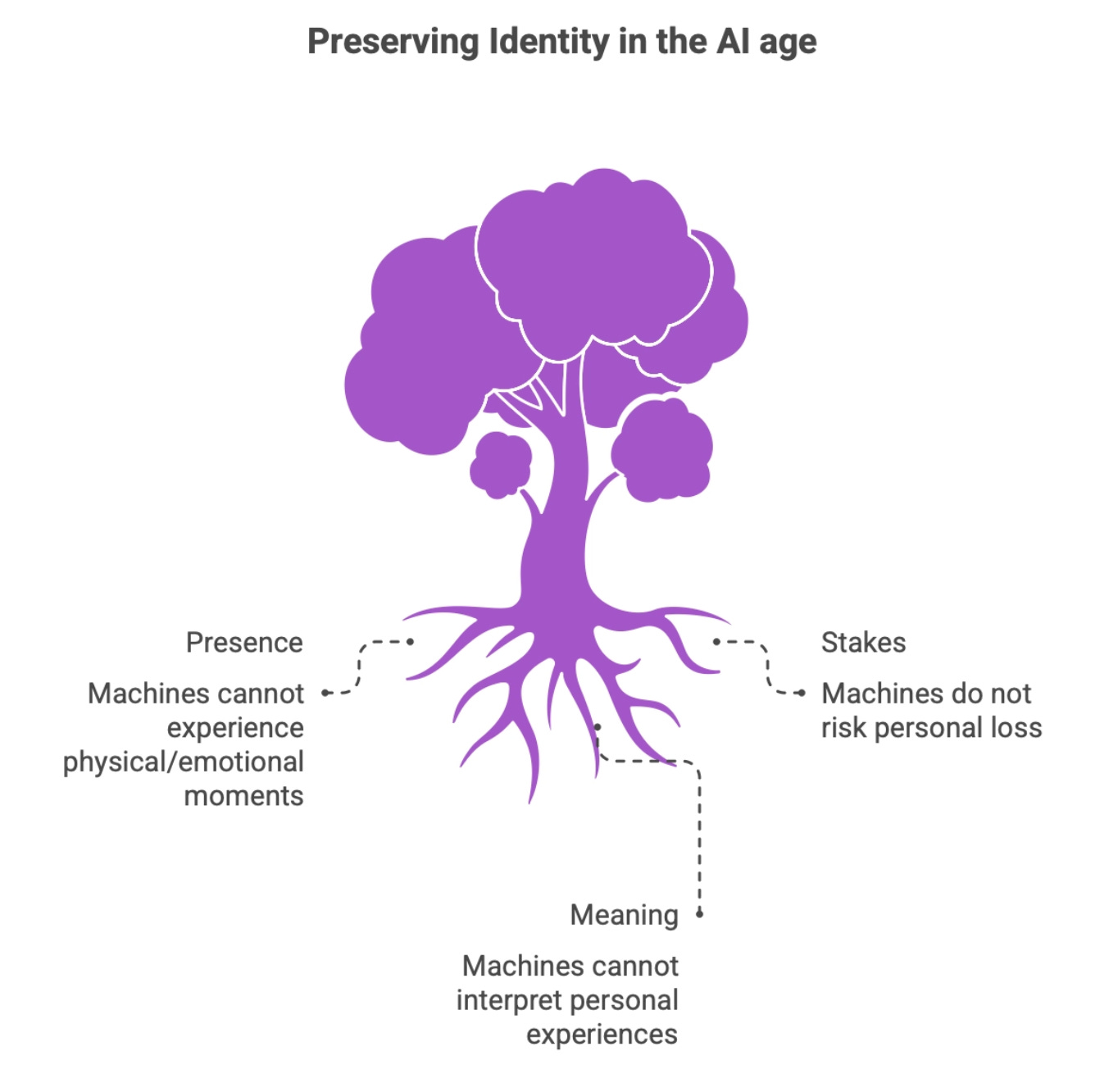
Presence: Being There
Every experience that requires you to show up physically, emotionally, completely. Saturday morning pancakes with your daughter, where you are the only one who knows she likes the burnt edges. Sitting with a friend whose marriage is falling apart and not trying to fix it, just being there. Running the last mile of a race when your legs feel like concrete.
Computers can process information about these moments. They cannot be in them. The value comes from the fact that you were there and it would not have been the same without you.
Stakes: Having Something to Lose
Every experience where the outcome is uncertain and the cost of failure is personal. Starting a business with your savings. Performing on stage when you might forget your lines. Telling your partner you are scared about money when you have always been the stable one.
Machines do not risk anything. They have no skin in the game. The identity value comes from choosing to do something when you could lose and it would matter to you.
Meaning: Choosing What It All Means
Making sense of what happened and deciding what it means for you. Computers can analyse patterns in your behaviour, but you decide whether your career pivot was brave or reckless. Whether your relationship challenges made you stronger or more guarded. Whether your failures were education or evidence.
The interpretation is yours. The story you tell yourself about your life is yours. Machines might offer data about your patterns, but the meaning you extract from that data lives where your identity lives.
The Thread: Kindness
In my original Happiness Framework, I wrote that kindness is the simplest and most powerful happiness hack. Be kind. It gives you achievement with almost zero expectations, and that combination drives a positive loop that lifts your entire happiness set-point.
In this framework, kindness plays an even deeper role. It works at every level of the career ladder and through every life anchor.
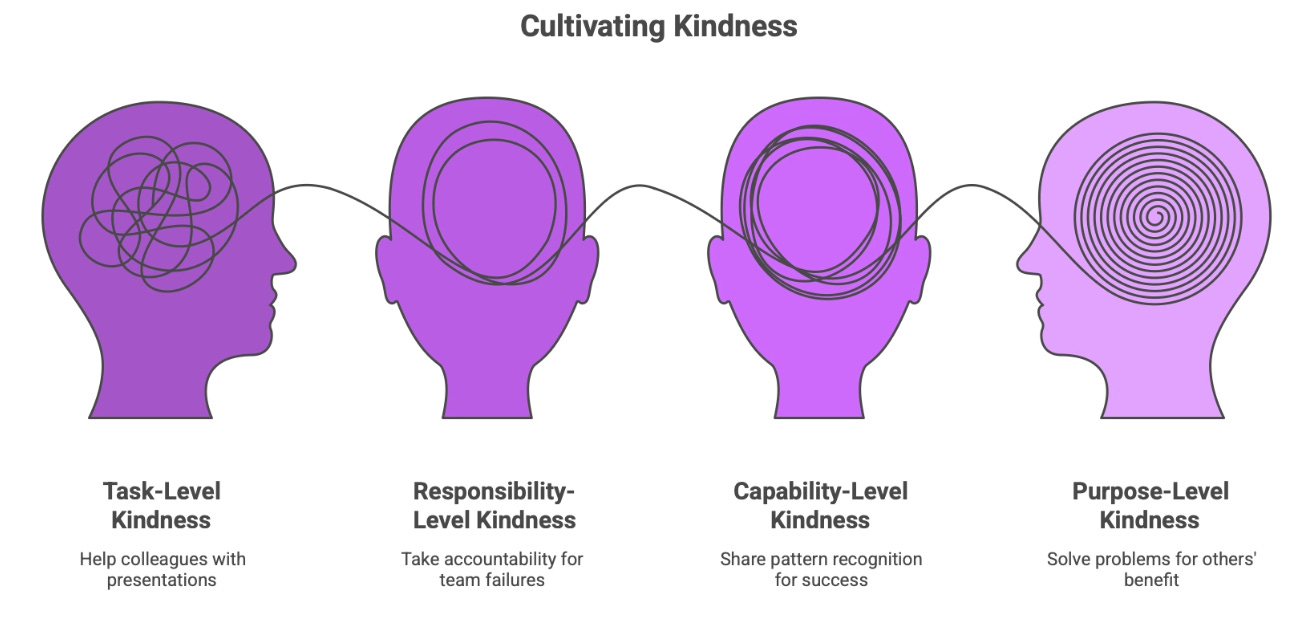
Task-level kindness: helping a colleague with their presentation when you did not have to. Responsibility-level kindness: taking accountability for a team failure even when it was not entirely your fault. Capability-level kindness: sharing pattern recognition that helps others succeed. Purpose-level kindness: choosing to solve problems that make other people’s lives better.
Kindness through presence: showing up for someone when you could have stayed home. Kindness through stakes: giving something up for someone else’s benefit. Kindness through meaning: helping others make sense of their struggles.
Kindness is the one move that builds identity regardless of where you are on any dimension. If you do nothing else, be kind. It works everywhere.
The Complete Framework
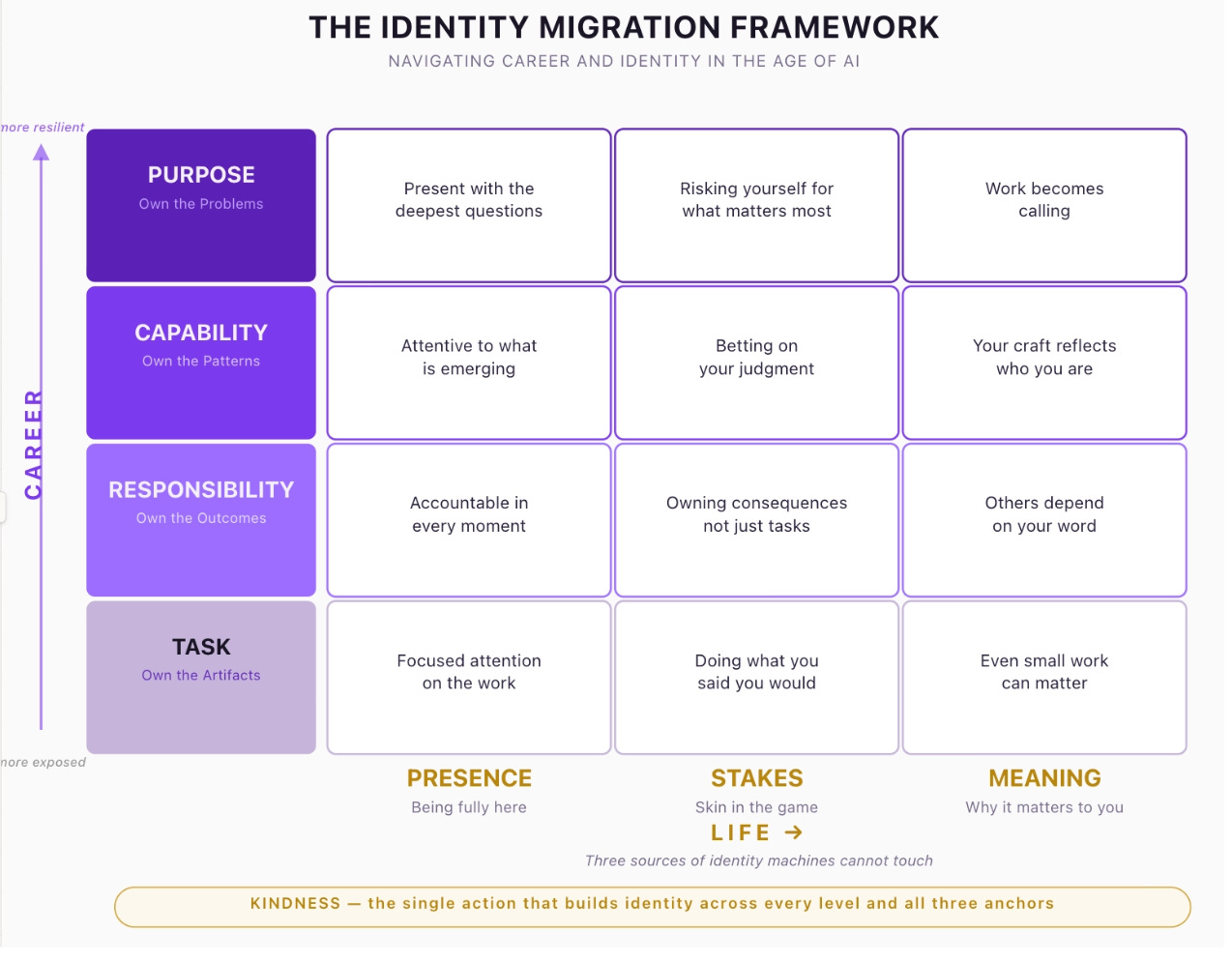
Vertical axis (career): Task → Responsibility → Capability → Purpose. Each level up makes automation more useful and less threatening to your identity. Move up by shifting what you feel you own: from artifacts, to outcomes, to patterns, to problems.
Horizontal axis (life): Presence, Stakes and Meaning. Three sources of identity machines cannot touch. Build all three while you have time.
Thread: Kindness. The single action that builds identity across every level and all three anchors.
A Migration Story
Elena spent twelve years as a financial analyst. She built complicated models, ran scenario analyses, created presentations that executive teams used to make billion-dollar decisions. She was good at her work. She identified completely with being good at it.
Then her company started using software that could build models faster than she could think through the assumptions. The recommendations got better. The executives still needed someone to translate machine output into human strategy, but Elena felt like a middleman in her own career.
The migration took eighteen months. First, she stopped caring whether she personally built the model and started caring whether the model led to good decisions. When a recommendation based on her analysis helped avoid a costly acquisition, she owned that win differently than she had owned her previous modeling accuracy.
Next, she began noticing patterns the software missed. The model would flag Company A as a good acquisition target, but Elena had seen three deals like this before and knew the cultural integration would fail. Her judgment became her differentiator, not her technical skill.
Finally, she realised what she actually cared about: helping companies spend money on things that matter. The industry became secondary. The tools became secondary. The problem became primary.
Today Elena runs strategy for a climate tech firm. She uses software for modeling. She owns the outcomes. She trusts her judgment. Her identity survived the transition because she moved it to higher ground before the flood.
Applications
Early career: If you are three years in and still identifying with deliverables, you are building toward a career that automation will hollow out. Start the migration now while you have time. Ask for ownership of outcomes, not just tasks.
Mid-career: This is where the fork matters most. Fifteen years of deepening task skills puts your identity in automation’s crosshairs. Move to responsibility level immediately. Ask your boss for accountability, not more work.
Leadership: Your job is to help your team migrate. Give people ownership of outcomes, not just deliverables. The leader who says “write me a report by Friday” anchors their team at task level. The leader who says “figure out whether we should enter this market and come back with a recommendation” pushes them toward responsibility.
Parenting: Children build identity the same way adults do. If everything is done for them (by parents or by machines), they stay at task level or below. Let them own outcomes. Let them fail. Let them experience presence, stakes, and meaning early and often. These are the raw materials of resilient identity.
Retirement: When the career ladder disappears, only the life anchors remain. People who retire with strong presence, stakes, and meaning transition well. People whose entire identity lived on the career ladder struggle, regardless of which level they reached. Build the horizontal anchors before you step off the vertical ladder.
The framework is simple. The migration is not. But the alternative (watching automation erode an identity you spent decades building) is worse.
Move your sense of self to higher ground. The flood is coming. The high ground is beautiful.
Check out some of my other Frameworks on the Fast Frameworks Substack:
The Thirty-Three Kilometre War
The Decision Framework: DECIDE
The Alpha Engine Framework for Venture & Angel Investing
Don’t Hire an Agency. Build a Memetic Engine - The memetic engine framework
Fast Frameworks AI Tools: Cortex
The Exponential AI Adoption Framework
Moltbook and the Entity AI Framework
May every sunset bring you peace!
Entity AI, swarms and the future of work (Asymmetric Podcast)
Fast Frameworks Podcast: Entity AI-Episode 8: Meaning, Mortality, and Machine Faith
Fast Frameworks Podcast: Entity AI - Episode 7: Living Inside the System
Fast Frameworks Podcast: Entity AI – Episode 5: The Self in the Age of Entity AI
Fast Frameworks Podcast: Entity AI – Episode 4: Risks, Rules & Revolutions
Fast Frameworks Podcast: Entity AI – Episode 3: The Builders and Their Blueprints
Fast Frameworks Podcast: Entity AI – Episode 2: The World of Entities
Fast Frameworks Podcast: Entity AI – Episode 1: The Age of Voices Has Begun
The Entity AI Framework [Part 1]
The Promotion Flywheel Framework
The Immortality Stack Framework
Frameworks for business growth
The AI implementation pyramid framework for business
A New Year Wish: eBook with consolidated Frameworks for Fulfilment
AI Giveaways Series Part 4: Meet Your AI Lawyer. Draft a contract in under a minute.
AI Giveaways Series Part 3: Create Sophisticated Presentations in Under 2 Minutes
AI Giveaways Series Part 2: Create Compelling Visuals from Text in 30 Seconds
AI Giveaways Series Part 1: Build a Website for Free in 90 Seconds
Business organisation frameworks
The delayed gratification framework for intelligent investing
The Fast Frameworks eBook+ Podcast: High-Impact Negotiation Frameworks Part 2-5
The Fast Frameworks eBook+ Podcast: High-Impact Negotiation Frameworks Part 1
Fast Frameworks: A.I. Tools - NotebookLM
The triple filter speech framework
High-Impact Negotiation Frameworks: 5/5 - pressure and unethical tactics
High-impact negotiation frameworks 4/5 - end-stage tactics
High-impact negotiation frameworks 3/5 - middle-stage tactics
High-impact negotiation frameworks 2/5 - early-stage tactics
High-impact negotiation frameworks 1/5 - Negotiating principles
Milestone 53 - reflections on completing 66% of the journey
The exponential growth framework
Fast Frameworks: A.I. Tools - Chatbots
Video: A.I. Frameworks by Aditya Sehgal
The job satisfaction framework
Fast Frameworks - A.I. Tools - Suno.AI
The Set Point Framework for Habit Change
The Plants Vs Buildings Framework
Spatial computing - a game changer with the Vision Pro
The ‘magic’ Framework for unfair advantage
Really good points - especially wrapping up with the kindness points - 100% fully agree.