

Try ARC (free Custom GPT): I built a GPT version of this framework so you can diagnose an audience, pick an arc, and draft the skeleton faster. It’s free for readers here, and your data is Private. Access it here: ARC — Audience × Resonance × Craft
Every founder I work with has the same problem. They know their numbers. They believe in their product. They have rehearsed the pitch. And they cannot get the room to care.
The data is right. The conviction is real. The story is wrong. Not wrong in a grammatical or stylistic sense. Wrong in a structural sense - the kind of wrong that no amount of rewriting will fix because the problem is not the words. It is the architecture underneath them.
The Model
ARC = Audience x Resonance x Craft
The relationship is multiplicative. If any layer is zero, the whole thing is zero. Beautiful writing aimed at the wrong audience fails. The right audience hearing the wrong arc shape feels manipulated or unconvinced. And the perfect arc told in the wrong format falls flat.
The Spine: Four Steps
If you remember nothing else, remember this:
1. Diagnose the audience. “They currently believe , and I need them to believe .”
2. Pick the arc. Match their state to one of seven shapes. (See the Fast Picker below.)
3. Build the skeleton. HOOK - TENSION - TURN - RESOLUTION - SHIFT. Start at the Turn.
4. Tune the craft. Match tone, evidence type, and format grammar to the medium.
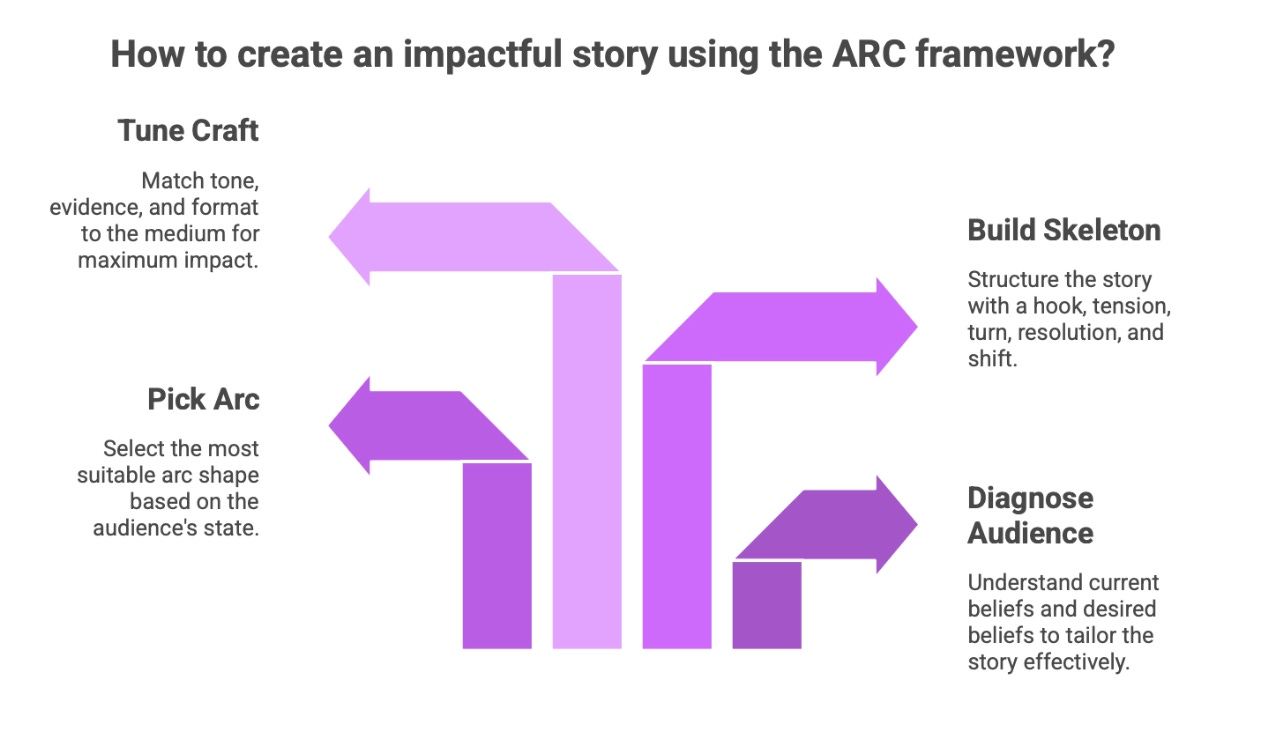
That is the whole method. Everything that follows is reference material for each step - go deep where you need to, skip what you already know.
The Cereal Box That Built a $75 Billion Company
In 2008, Brian Chesky and his co-founders pitched Airbnb to fifteen of Silicon Valley’s top venture capitalists. They had a working product, paying customers, and a clear market. Every single investor said no. The idea that strangers would pay to sleep in other strangers’ homes sounded absurd. The data was not enough. The deck was not enough. The logic was not enough.
Rejected by VCs, the founders turned to a stunt to survive. They designed custom cereal boxes - “Obama O’s” and “Cap’n McCains” - themed around the 2008 presidential election, and sold them for $40 each. They moved over a thousand boxes and made $30,000. Enough to keep the lights on. Nothing more.
Then they walked into Paul Graham’s office at Y Combinator. The pitch went the way the others had gone - Graham was sceptical. People living with strangers? Before he could leave, Chesky handed him a cereal box. Graham turned it over. Then he said something that changed the company’s trajectory: “If you can convince people to pay $40 for a $4 box of cereal, maybe you can convince strangers to live with each other.”
Y Combinator invested $20,000 for 6% of the company. That stake became worth over $4 billion.
The cereal box was not a business plan. It was a story - a physical object that proved something no slide deck could: these founders were resourceful enough, creative enough, and relentless enough to figure it out. The cereal box did not explain Airbnb. It made Paul Graham believe in the people building it. Fred Wilson, the VC who passed on Airbnb, kept a cereal box on his conference room credenza for years afterward as a reminder of what he missed.
Chesky’s first fifteen pitches had the right data. The cereal box had the right arc. In ARC terms: those pitches were strong on Craft (a good deck) but wrong on Resonance (a logical argument to an audience that needed to feel something visceral about the founders). The cereal box fixed the Resonance layer. Same company, same data, different arc.
Why Smart People Fail at Storytelling
I have sat through hundreds of pitches, brand presentations, and sales decks. The people giving them are almost always smart, prepared, and passionate. The stories they tell are almost always forgettable. Not because the people lack talent. Because they lack a diagnosis.
Most business stories fail for one of three reasons. Once you can name the pattern, you can fix it in an afternoon.
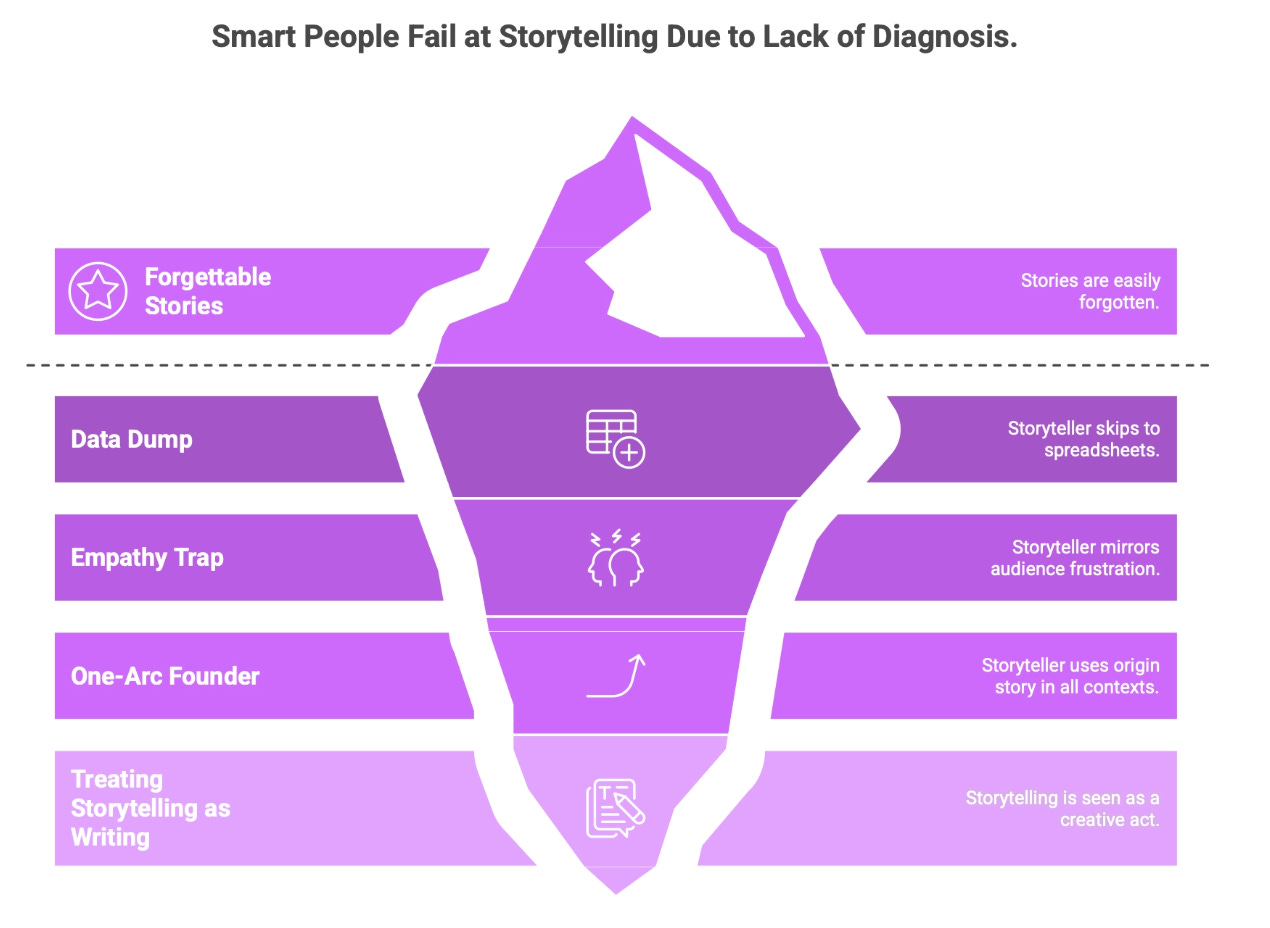
The Data Dump. The storyteller skips straight to a spreadsheet. The information is correct, comprehensive, and well-formatted. It is also forgettable. This is Chesky’s first fifteen pitches - strong data, no arc. They had every number right and still could not move a room.
The Empathy Trap. The storyteller understands who they are talking to and articulates the problem perfectly - but then never goes anywhere. They mirror the audience’s frustration without offering a turn. The audience feels understood and then... nothing. No new information, no reframe, no proof, no call to action. This is common in brand content that is “relatable” but forgettable. Empathy without a pivot is sympathy. Sympathy does not move people.
The One-Arc Founder. The storyteller has one story - usually an origin story - and tells it in every context. To investors, to customers, to employees, to media. The origin story is powerful in its right context. It is wrong for a sales conversation, wrong for a fundraise, and wrong for recruiting. Different audiences in different moments need different shapes.
I learned how expensive this last one is the hard way. A few years ago, I was advising a founder on her Series A pitch. She had a genuinely moving origin story - the kind that makes you lean in. I helped her build the entire deck around it. Origin arc, the full structure. The VCs listened politely and passed. Every single one. The feedback, when it came, was consistent: “Great founder. Not sure about the market.”
We had told the wrong story. These investors were not wondering about the founder. They were asking whether the market was big enough and moving fast enough. They needed a completely different story shape - one that said the game has changed, here is the structural gap, this founder is positioned to own it. We rebuilt the deck. Same company, same founder, same data. Different arc. She closed her round in three weeks. The origin story became a thirty-second aside in the founder slide. It was still beautiful. It was just no longer the load-bearing wall.
The question that kept nagging me after that: why do we keep getting this wrong? Why do smart people with the right data, the right product, and the right conviction keep failing to move the room?
The answer, I eventually realised, is that we treat storytelling as writing. As a creative act. Something you are either good at or you are not. But it is not writing. It is diagnosis. And diagnosis has a method.
Layer 1: Audience - The Story Before Your Story
A doctor who prescribes without examining the patient is negligent. A storyteller who writes without understanding the audience is guessing. The Audience layer is the examination.
Every person you are trying to reach is already mid-film. They have a plot running in their head - about their market, their career, their company, their problem. That plot has characters, a narrative, and an emotional register. Your story does not start on a blank page. It starts on a page that is already half-written. If you ignore what is already written, your story feels irrelevant. If you acknowledge it, your story feels like it was meant for them.
The Audience layer answers three questions:
What is their current narrative? An investor who believes AI is overhyped lives in a different story than one who believes AI is underinvested. A customer who thinks their current solution is “good enough” occupies different territory than one who is actively frustrated. Paul Graham’s narrative was: “This idea sounds crazy, and most crazy ideas fail.” Chesky could not win by arguing against that narrative. He had to sidestep it entirely - from “is this idea logical?” to “are these founders unstoppable?”
What frame are they already in? Every interaction has a psychological frame the audience brings with them. Oren Klaff identifies four: the Power frame (”convince me”), the Analyst frame (”show me the data”), the Time frame (”I have five minutes”), and the Intrigue frame (”tell me more”). If your audience is in an Analyst frame and you lead with emotion, it feels manipulative. If they are in an Intrigue frame and you lead with a spreadsheet, you kill the curiosity. This is their incoming frame - the state you are diagnosing. (What frame you set in response is a separate move. That is Frame Control, covered later.)
What is the desired shift? Every effective business story moves the audience from one belief to another. The shift must be specific enough to complete one sentence: “I want them to move from ____ to _____ . If either blank takes more than fifteen words, the shift is not specific enough. “I want them to be interested” is not a shift. “I want them to move from ‘this idea sounds crazy’ to ‘these founders will figure it out’” is a shift. “I want them to move from ‘we are fine’ to ‘we are exposed’” is a shift. If you cannot name it, you do not have a story. You have content.
In my Trust Framework, I describe trust as a fraction: credibility, reliability, and intimacy in the numerator, self-interest in the denominator. The desired shift often maps directly to one of those variables. A pitch deck shifts credibility. A customer story shifts reliability. A Belonging narrative shifts intimacy. And a story that feels manipulative - one where the audience senses the storyteller’s self-interest - collapses all three, because the denominator just got very large.
Before you write anything, complete this card. If you cannot fill every line, you are not ready to write. Go back to the beginning of this layer.
ARC Diagnosis Card
Audience: They currently believe:
Their frame: Power / Analyst / Time / Intrigue
Desired shift: from to
Arc: Skeleton:
Hook: ___
Tension: ___
Turn: ___
Resolution: ___
Shift: ___
Craft: Format / Length / Evidence type / CTA
One line per beat. If you cannot complete the Turn line in one sentence, the story does not have a hinge yet.
Layer 2: Resonance - The Seven Arc Shapes
A musician does not play random notes. She chooses a key. The key determines which notes create harmony and which create dissonance. The arc shape is the key of your story. It determines which emotional and strategic notes will resonate with your audience and which will feel wrong.
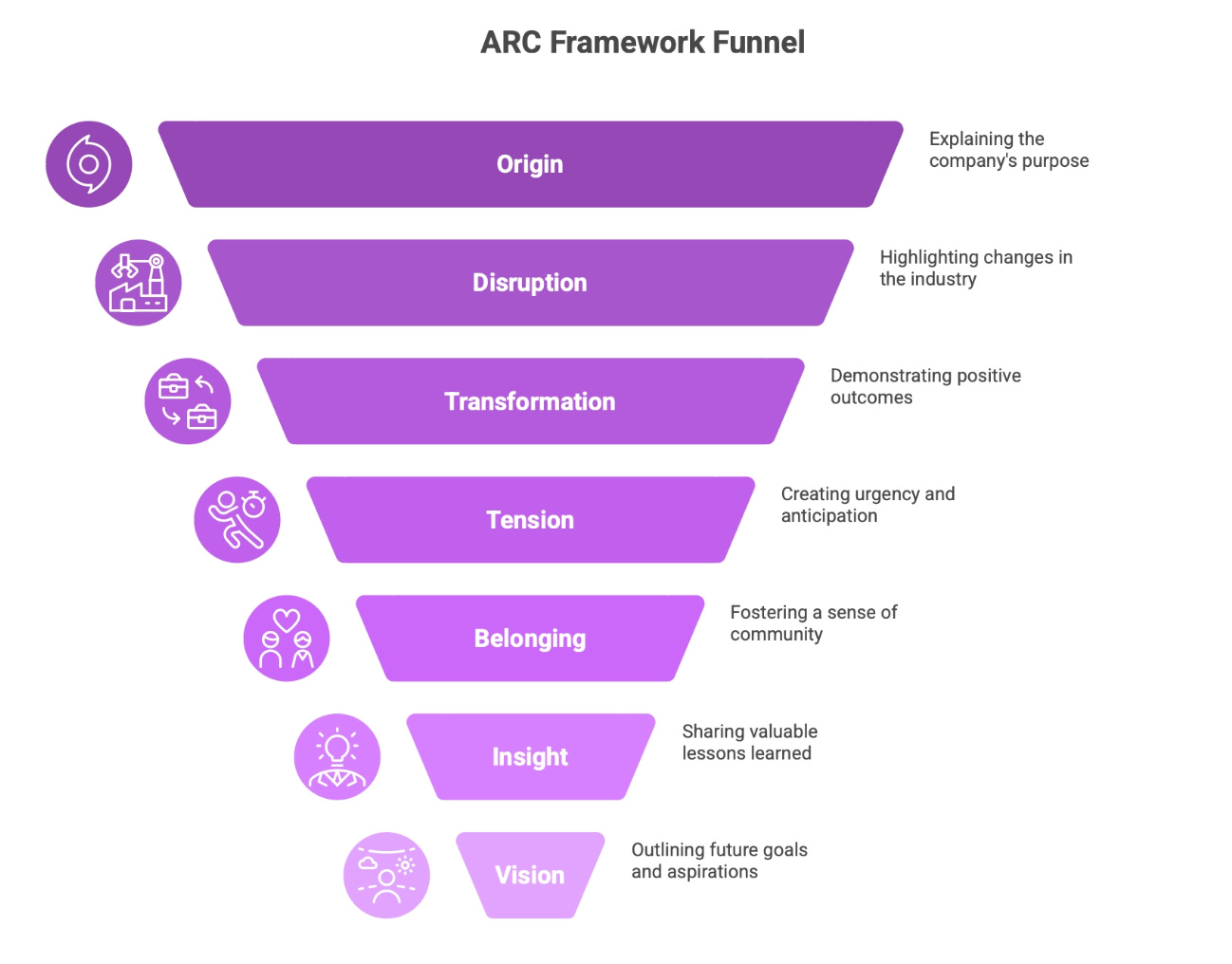
There are seven arc shapes, organised into three pairs and a standalone.
The Fast Picker
They need to know why you exist - use Origin. They need to feel the ground shifting - use Disruption. They need to see proof it works - use Transformation. They need to feel the clock ticking - use Tension. They need to feel they belong - use Belonging. They need to hear what you learned the hard way - use Insight. They need to see where you are going - use Vision.
When two arcs seem close: If they do not yet agree the world changed, lead with Disruption. If they agree but are not moving, lead with Tension. If they want evidence before they commit, lead with Transformation. If they are asking “why you?”, lead with Origin or Insight depending on whether the answer is your story or your scar.
Build stories tell the audience where you came from and where you are going: Origin (why this exists) and Vision(where we are building toward).
Proof stories show the audience what changed and what you learned: Transformation (what changed for someone) and Insight (what I learned the hard way).
Action stories create urgency and demand a response: Disruption (the game has changed) and Tension (the clock is ticking).
Belonging stands alone as the identity arc - it does not tell a story about an event. It tells the audience who they are.
Choosing the right one is not a creative decision. It is a diagnostic one. Match the arc to the audience’s narrative state and the desired shift you diagnosed in Layer 1, and the story almost writes itself. Get the match wrong and no amount of beautiful writing will save it.
Resonance has two checks, not one. The first is arc selection - did you pick the right shape for this audience and this shift? The second is Turn credibility - does the pivot moment earn its weight? You can pick the right arc and still fail Resonance if the Turn is weak. A Disruption arc where the “shift” is vague, or a Transformation arc where the “catalyst” is unconvincing, has the right shape but no hinge. When a story feels hollow despite being structurally correct, the Turn is almost always where it broke.
Arc 1: Origin - “Why This Exists”
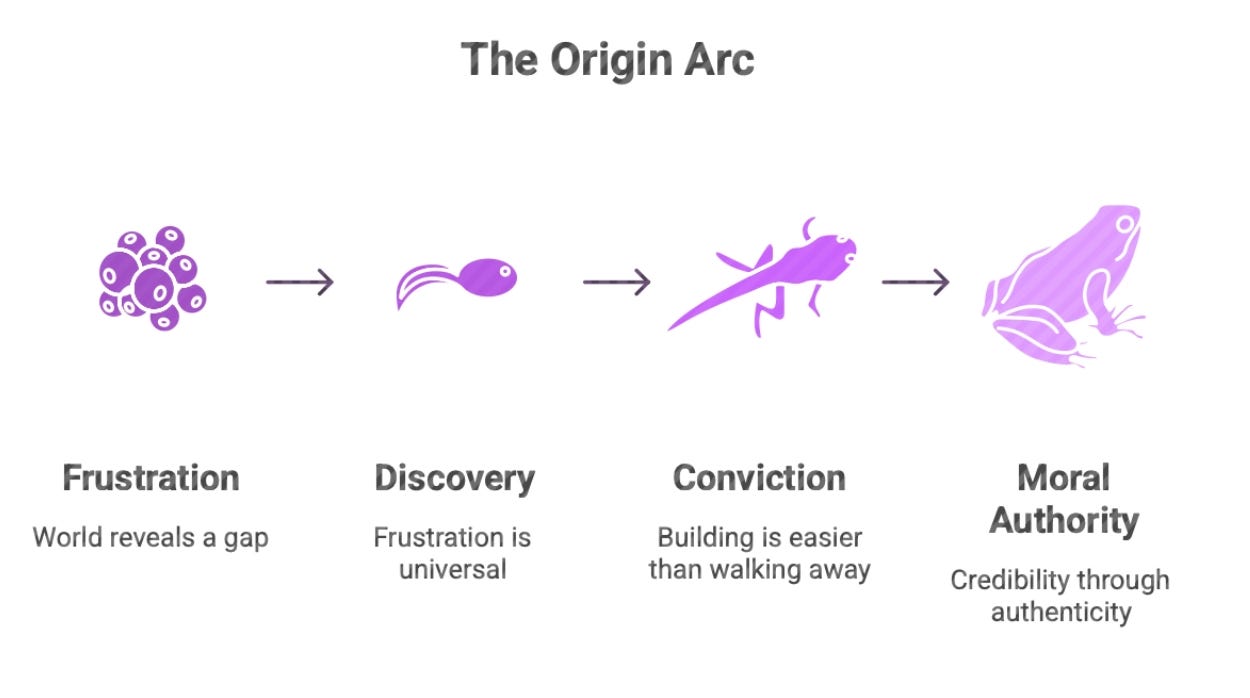
Dramatic engine: Dissatisfaction → Discovery → Conviction
Sara Blakely spent two years selling fax machines door to door. Every morning she put on trousers that did not fit right. She cut the feet off her pantyhose. That solved the problem, temporarily, badly. The frustration accumulated - not a eureka moment, but a slow boil. Two years of cutting pantyhose before she filed a patent. That is Spanx’s origin story. Not “visionary entrepreneur builds a billion-dollar company.” It is “a woman who was annoyed every single morning finally did something about it.”
The Origin arc tells the story of why something had to exist. The best origin stories do not start with the founder. They start with the frustration - a moment where the world revealed a gap that could not be ignored. The discovery is not a lightning bolt. It is a slow accumulation of evidence that the frustration is not personal but universal. And the conviction is the point where walking away became harder than building. That is where the audience leans in - not because the solution is clever, but because the pain is recognisable. The product is the proof. The problem is the story.
The frame this sets is Moral Authority. The storyteller earns credibility through the authenticity of the dissatisfaction, not through credentials.
Best for: Brand narratives, founder stories, “about us” pages, brand films, company culture documents, media interviews.
Example compressed: “Every performance review I ran as a manager felt like theatre. The employee knew the score before I said it. I knew the conversation would change nothing. After twelve years of running these rituals, I stopped asking how to make reviews better and started asking why we do them at all. That question became [company].”
Arc 2: Disruption - “The Game Has Changed”
Dramatic engine: Old World → Shift → New World → Who Wins
“In 2019, Indian D2C brands competed on price. In 2025, they compete on community. The brands that built audiences own their economics. The brands that bought traffic rent theirs. The game changed. Most have not caught up.”
That is a Disruption arc in six sentences. It does not mention a product. It does not mention a company. It names a shift in the world and forces the audience to ask: which side am I on?
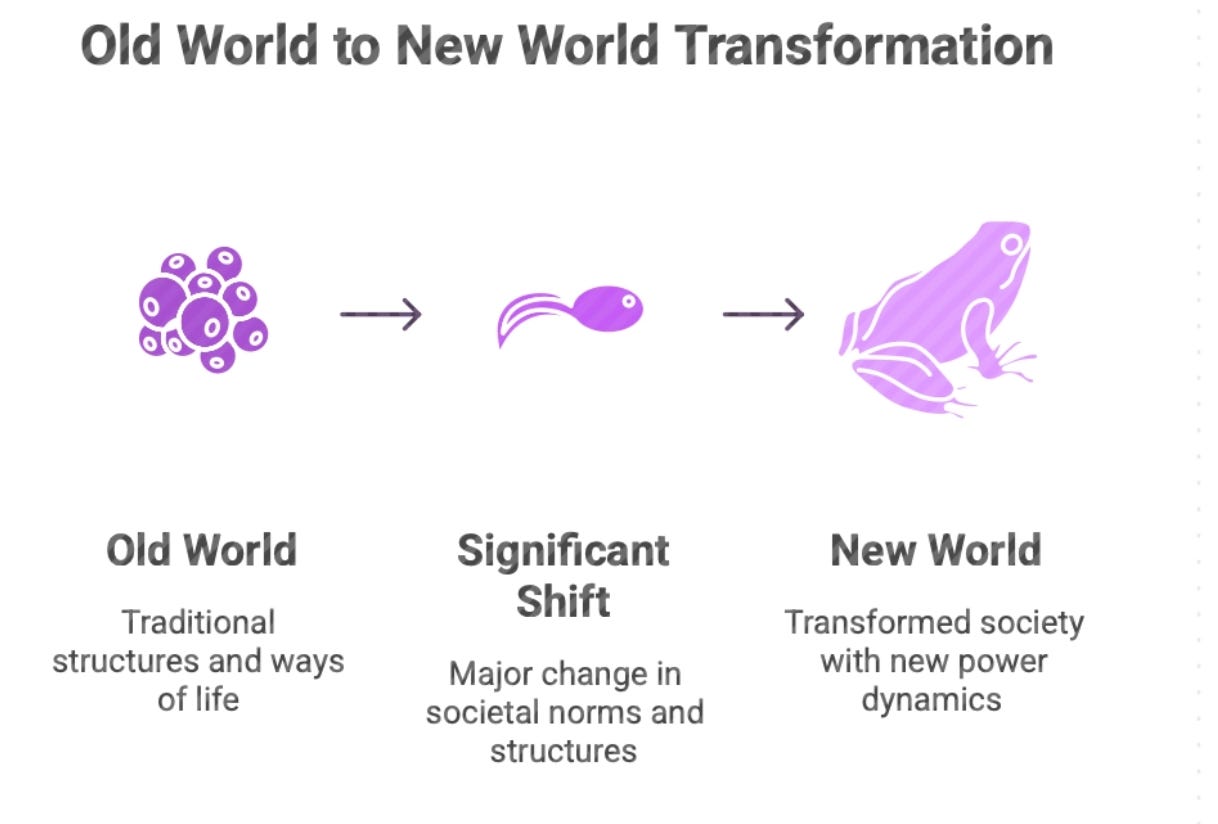
In 2007, Nokia had 50% global market share in mobile phones. By 2013 it had 3%. Nokia did not make bad phones. Nokia made phones for a world that no longer existed. The shift was not “smartphones arrived.” The shift was that the phone stopped being a communication device and became a computing platform. Every company that understood the shift thrived. Every company that saw it as incremental was consumed by it. In my Exponential Growth Framework, I describe the S-curve that governs this: lag phase, log phase, plateau, decline. Nokia was on the decline curve of one S and refused to jump to the next. The Disruption arc names that jump.
The Disruption arc is not about your company. It is about a change in the world that makes your company necessary. The dramatic engine runs on a single claim: the rules have changed, and most people have not noticed yet. Andy Raskin’s strategic narrative framework - the most influential sales deck structure of the last decade - lives entirely within this arc. His insight was that the best sales decks lead with market change, not product features.
The natural frame here is Prize. You are not asking for attention. You are revealing something the audience needs to know. You are not being evaluated. You are selecting who gets to participate.
Use it for pitch decks, investor narratives, category creation, thought leadership, product launches, keynotes, and fundraising. Anywhere you need the audience to feel the ground shifting under their feet.
Arc 3: Transformation - “What Changed”
Dramatic engine: Stuck → Struggle → Catalyst → New Reality
Kurt Vonnegut once drew the shapes of stories on a blackboard. His most universal shape was “Man in a Hole”: somebody gets into trouble, then gets out of it. He drew a line that dipped below the axis and climbed back above it. That shape - the dip and the climb - is the Transformation arc. The dip is essential. Without it, the story is a testimonial (”we loved the product”). With it, the story is a narrative (”we were drowning, we found this, and everything shifted”).
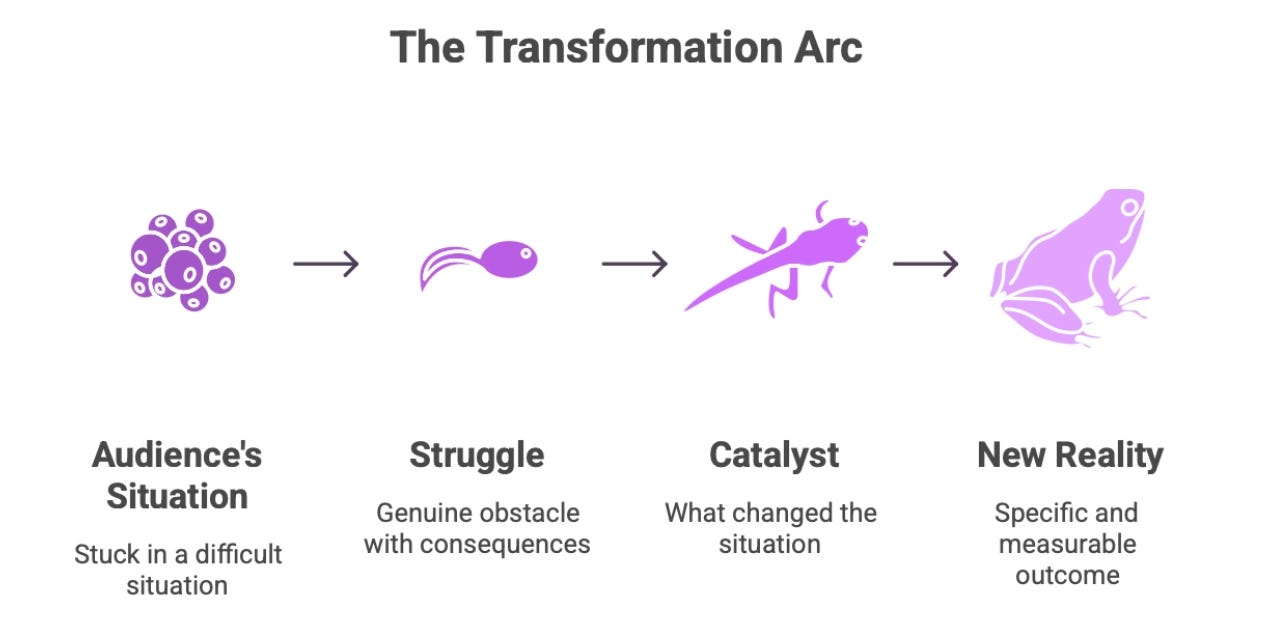
The Transformation arc is proof. It tells the story of someone who was in the audience’s situation and came out the other side. It does not ask the audience to believe a claim. It asks them to witness a journey. In my Pretotype Framework, I describe how to test whether something works before committing to building it. The Transformation arc is the narrative version of a pretotype - it lets your audience test the outcome in their imagination before committing to the purchase. The Struggle is not a minor inconvenience - it is a genuine obstacle with consequences. The Catalyst is what changed, but the emphasis is on the change, not the catalyst. And the New Reality is specific and measurable.
The frame is Intrigue. The audience stays because they need to know what happened next. The sale happens in the audience’s own mind, not in the narrative.
Best for: Case studies, customer stories, testimonials, sales conversations, demo narratives, before/after content.
Example compressed: “Priya’s supplement brand was spending 40% of revenue on paid ads and breaking even. Six months later, her repeat purchase rate hit 58% and her CAC dropped by half. What changed was not her product.”
Arc 4: Tension - “What Is At Stake”
Dramatic engine: Stakes → Escalation → Fork in the Road → Resolution Path
In 1962, JFK did not say “we should probably go to the moon at some point.” He said: “We choose to go to the moon in this decade.” The deadline was the story. Not the destination, not the technology, not the budget - the clock. That is the Tension arc. It creates urgency. It makes people act rather than consider.
Where the Disruption arc says “the game has changed” (intellectual urgency - I need to understand), the Tension arc says “the clock is ticking” (emotional urgency - I need to act now). The Escalation reveals the stakes are higher than initially understood. The Fork in the Road presents the choice: act or accept the consequences. And the Resolution Path shows that action is possible and achievable - but only if taken now.
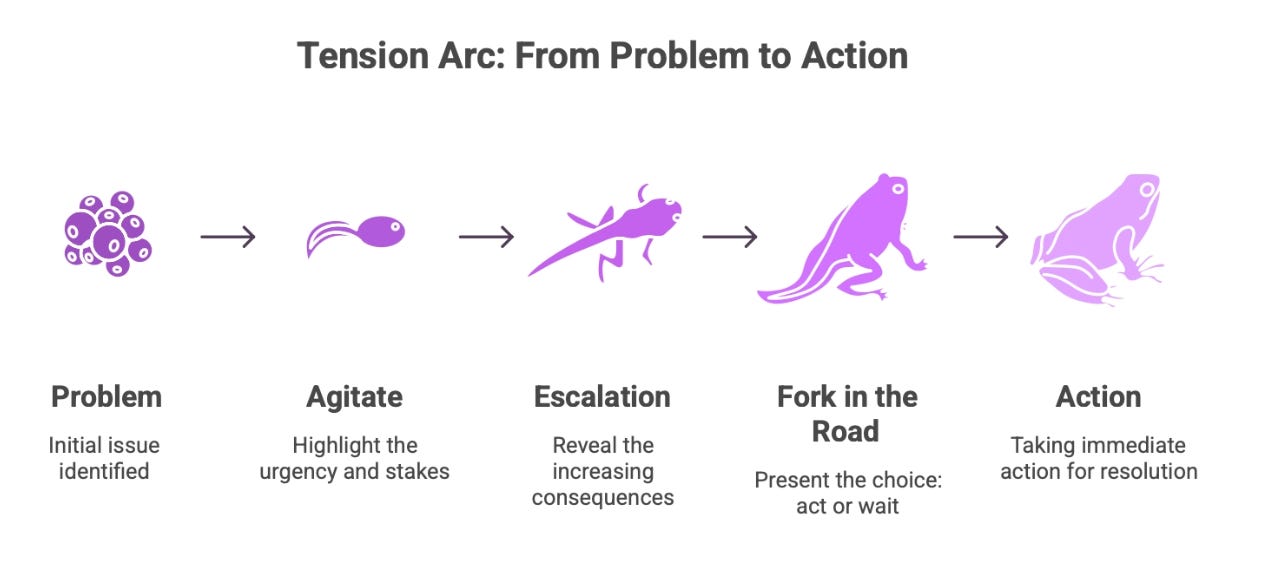
This arc draws on PAS (Problem-Agitate-Solve) but adds the Fork. PAS moves linearly from problem to solution. The Tension arc forces a choice, which is psychologically more activating than a recommendation. The audience feels not just that they have a problem, but that waiting has a cost.
The frame is Time/Scarcity. In my Risk Framework, I sort risks into four buckets: Grey Rhinos (high probability, high impact), Black Swans (low probability, high impact), Pesky Mosquitoes, and Rare Pandas. The Tension arc works best when the stakes are a Grey Rhino - obvious, high-impact, and approaching fast. The failure mode is manufacturing false urgency around a Pesky Mosquito, which destroys trust permanently. When the stakes are real, clarity about deadlines is not manipulation. It is a service.
Best for: Sales narratives, fundraising, calls to action, campaign launches, competitive displacement, crisis communication.
Example compressed: “Your three largest competitors migrated to headless commerce last quarter. Your site speed is 4.2 seconds. Theirs average 1.1. Every month you wait, you lose an estimated 12% of mobile conversions to them. The migration takes six weeks. The question is not whether to move. It is whether to move before or after peak season.”
Arc 5: Belonging - “Who We Are Together”
Dramatic engine: Isolation → Recognition → Tribe → Mission
In 1997, Apple was ninety days from bankruptcy. Steve Jobs did not launch a product campaign. He launched “Think Different.” The ad did not mention a single Apple product. It mentioned Einstein, Gandhi, Picasso, Lennon. The message was not “buy our computer.” It was “you are the kind of person who sees the world differently, and so are we.” Within two years, Apple’s stock had quadrupled. A membership card, not a sales pitch.
The Belonging arc does not sell a product. It sells an identity. Isolation is the feeling that you are the only person who sees this problem. Recognition is discovering others who share your worldview. Tribe is the group identity. Mission is the collective purpose that gives the tribe meaning beyond membership.
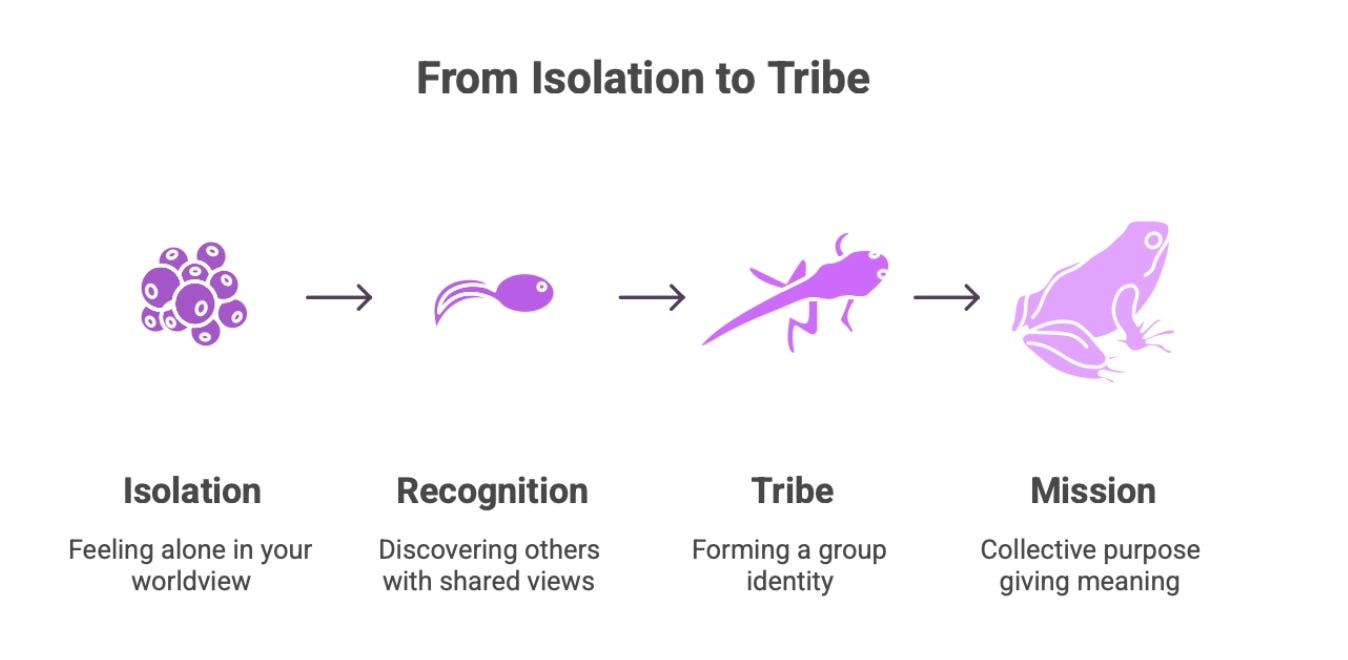
People do not comparison-shop their identity. They commit to it. In my Identity Migration Framework, I describe how professional identity climbs four rungs: from task to responsibility to capability to purpose. The Belonging arc speaks directly to purpose-level identity - it asks people to recognise themselves in a mission, not a product. This is why Belonging stories are selective by design - they deliberately exclude to strengthen the bond with those who remain. Patagonia did not sell jackets. It sold membership in a tribe that values the planet over profit. The product is a badge, not the point.
The frame is Identity. The audience is not being asked to buy. They are being asked to recognise themselves. Are you one of us?
Best for: Community building, brand identity, internal culture, employer branding, movement creation, loyalty programmes, recruiting.
Example compressed: “We do not hire people who want to work at a startup. We hire people who cannot stop thinking about why Indian supply chains are broken and believe they can fix it. If that sentence made you sit up, keep reading.”
Arc 6: Insight - “What I Learned the Hard Way”
Dramatic engine: Assumption → Experience → Rupture → Reframe
Howard Schultz visited Milan in 1983 and saw something that did not exist in America: a neighbourhood coffee bar where people lingered, talked, and treated coffee as an experience, not a commodity. He pitched the idea to Starbucks’ founders. They said no. The insight that coffee could be a “third place” was born not from market research but from standing in an Italian piazza watching people do something Americans did not know they wanted. The assumption (”coffee is a grocery product”) broke against experience. The reframe (”coffee is a place”) became a $100 billion company.
The Insight arc is the engine of thought leadership and personal brand. It requires vulnerability about what you got wrong. In my Xeme and Learning Framework, I call the smallest unit of real-world learning a xeme - something earned through testing, not reading. The Insight arc is a xeme told as a story. The audience trusts it precisely because it was paid for in experience, not borrowed from a textbook. Matthew Dicks calls the pivot the “five-second moment” - the instant understanding shifts. In the Insight arc, that moment is the Rupture. Everything else exists to set it up and pay it off.
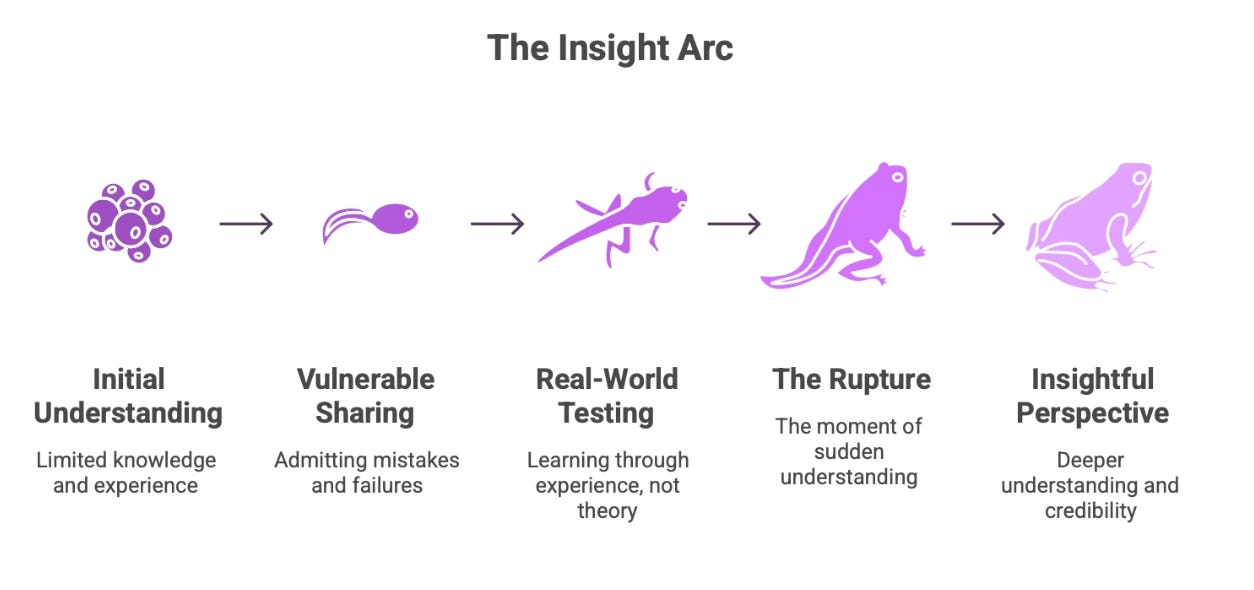
The storyteller is a fellow traveller, not an authority dispensing wisdom from above. A CEO sharing a failure teaches more than a CEO sharing a success, because the failure demonstrates judgment, not just outcomes. This is why the best LinkedIn content follows this pattern, and why the worst states principles without showing the price of learning them.
The frame is Intellectual Authority - but earned, not claimed. Credibility comes from the quality of the experience and the honesty of the admission.
Best for: LinkedIn posts, thought leadership, keynote speeches, podcast appearances, personal branding, blog posts, advisory contexts.
Example compressed: “For ten years I hired for skills. The best developer, the best marketer, the best operator. My teams were talented and miserable. Then I lost three A-players in one quarter and finally asked the question I had been avoiding: what if the problem is not them? It was not. The problem was that I built teams for output, not for trust. I now hire for one thing first: do I trust this person to tell me what I do not want to hear? Everything else can be taught.”
Arc 7: Vision - “Where We Are Building Toward”
Dramatic engine: Present Limitation → Imagined Future → The Path → The Invitation
In February 2014, Satya Nadella became CEO of a Microsoft that Wall Street had written off. Windows was declining, mobile had been lost to Apple and Google, and the company’s identity was anchored to a product era that was ending. Nadella’s first company-wide memo did not defend what Microsoft had been. It described what the world was becoming: “We live in a mobile-first and cloud-first world.” Six words that reframed a 39-year-old company. He did not have proof yet. Azure was small. Office 365 was early. But the vision was specific enough to be credible and ambitious enough to demand a choice - join or watch. Within a decade, Microsoft’s market capitalisation went from $300 billion to over $3 trillion.
The Vision arc tells the story of a future that does not exist yet and makes the audience want to build it. Where the Disruption arc says “the game has changed,” the Vision arc says “here is the game we are creating.” Disruption is reactive. Vision is generative - it brings something new into existence through the force of the narrative itself.
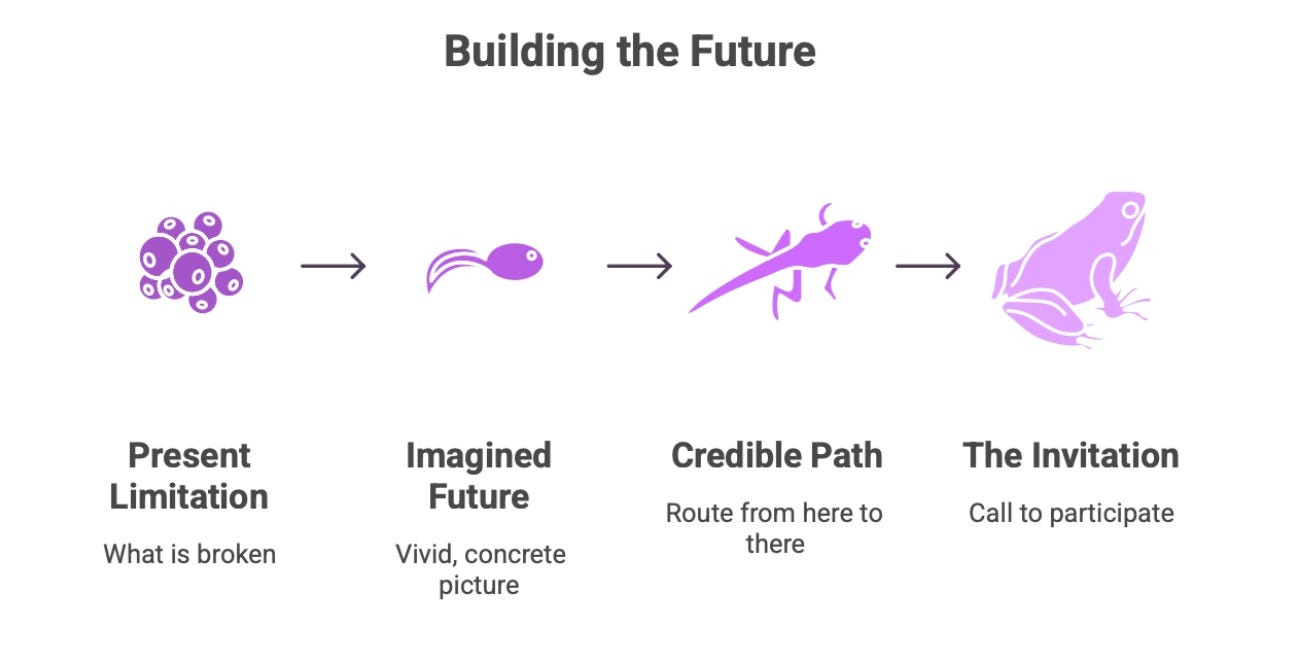
Present Limitation is an honest acknowledgement of what is broken. The Imagined Future is a vivid, concrete picture of what becomes possible. The Path is the credible route from here to there. And The Invitation is the call to participate - not as a customer, but as a builder. This arc sits on the knife-edge between inspiration and delusion. The difference is specificity. “We are going to change the world” is delusion. “We live in a mobile-first and cloud-first world” is vision - specific, directional, and testable.
The frame is Prize/Invitation. This is happening whether or not you join. But it will be better if you do.
Use it for mission statements, brand manifestos, internal rallying narratives, recruiting, long-term investor communication, and keynotes where you are defining a category rather than competing in one.
Example compressed: “In three years, the phrase ‘product returns’ will not mean sending something back. It will mean the product returns to the supply chain, is remanufactured, and ships again. We are building the infrastructure for that world. The question is not whether it happens. It is who builds it.”
The Universal Skeleton
Here is the part that makes the whole thing practical. Every arc shape, regardless of type, runs on the same five-beat skeleton. I call it the accordion because the same structure compresses into a tweet and expands into a keynote. The beats are:
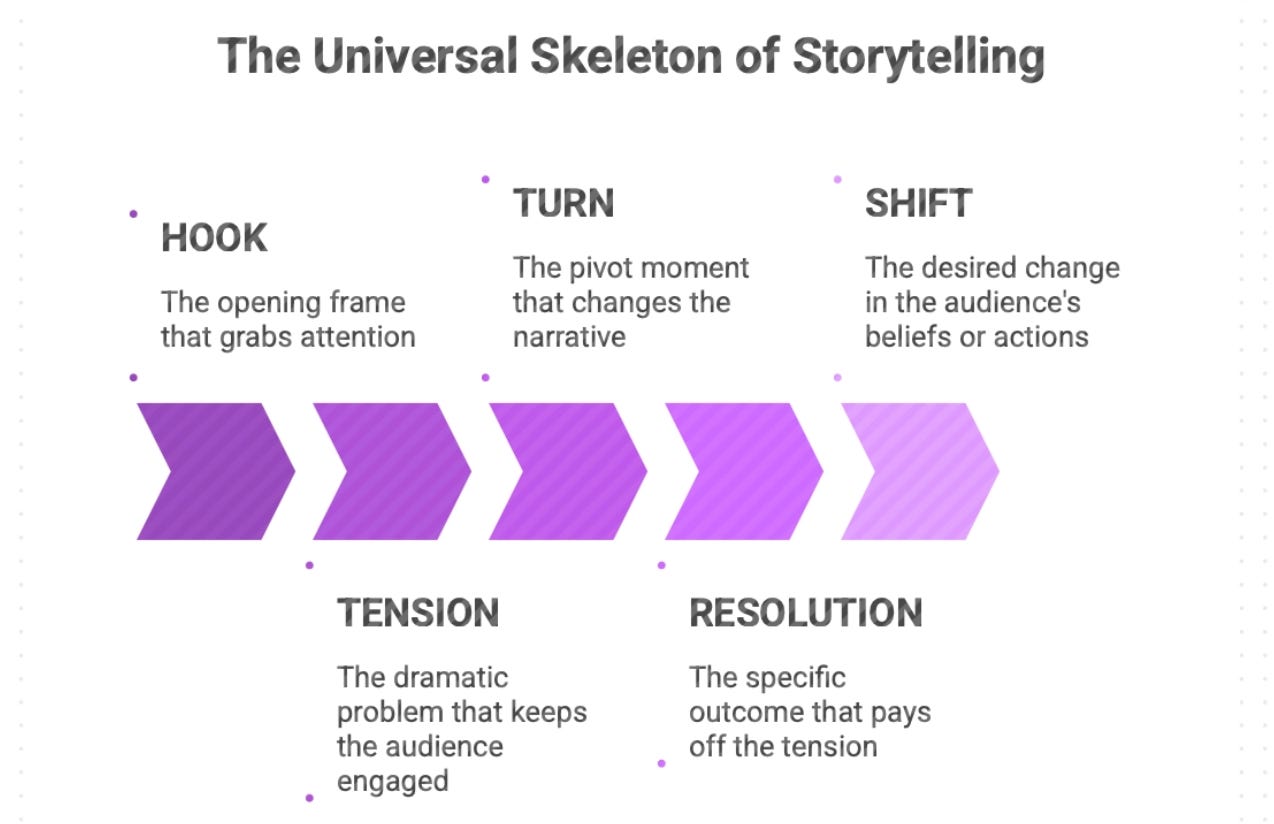
HOOK - The opening frame. Its only job is to stop the scroll, hold the gaze, or open the ear. Chesky’s Hook was a cereal box. Schultz’s Hook was an Italian piazza. A Hook works by creating a gap - between what the audience expects and what you deliver. “Revenue grew 30%” is not a hook. “We almost shut down in March” is. The gap creates a question, and the question creates attention.
TENSION - The dramatic problem. Without Tension, a story is an announcement. Tension comes from conflict, contradiction, stakes, uncertainty, or unresolved questions. The audience stays because they need to know how it resolves. In the Nokia example: “50% market share to 3% - what happened?” In the Spanx example: “Two years of cutting pantyhose - what did she do?” The moment Tension disappears, attention disappears with it.
TURN - The pivot moment. The non-negotiable core. The hinge that everything before builds toward and everything after pays off. In the Insight arc, the Turn is the Rupture. In the Transformation arc, the Turn is the Catalyst. In the Disruption arc, the Turn is the Shift. It occupies the smallest proportion of time or space but carries the greatest weight. It never gets cut, even in the shortest format.
RESOLUTION - What happened, what is possible, what changed. The Resolution pays off the Tension. It must be specific. “Things got better” is not a Resolution. “Repeat purchase rate went from 12% to 58% in six months” is. Chesky’s Resolution was Y Combinator’s investment - but it landed because the cereal box had already made Graham believe.
SHIFT - What the audience should now believe, feel, or do differently. The strategic delivery. The frame the audience leaves with. If the Shift lands, the story worked. If it does not, nothing else matters. The Shift connects back to the Audience layer: it is the desired change you diagnosed before you started writing.
The Accordion: Scaling the Skeleton
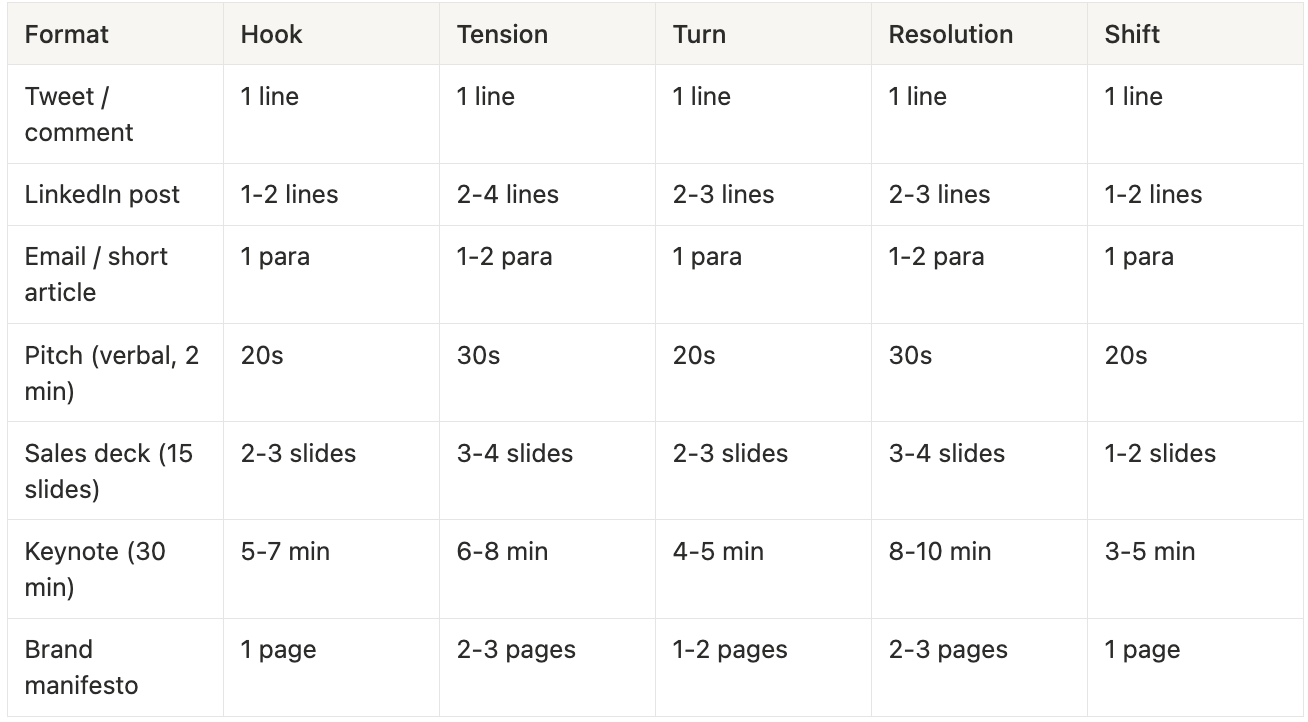
In longer formats, the Tension beat is built from two to four sub-stories that each escalate the stakes. The Resolution beat is built from two to three proof points that each compound the evidence. The Turn stays singular - one moment, one hinge.
Frame Control: The Frame You Set
The Audience layer diagnoses what frame the room is already in. Frame Control is the other half: what frame are you setting with your story?
Klaff’s observation is simple: in every interaction, there is a dominant frame and a subordinate frame, and the dominant absorbs the subordinate. Whoever sets the frame controls the interpretation. Each arc has a natural frame it sets:
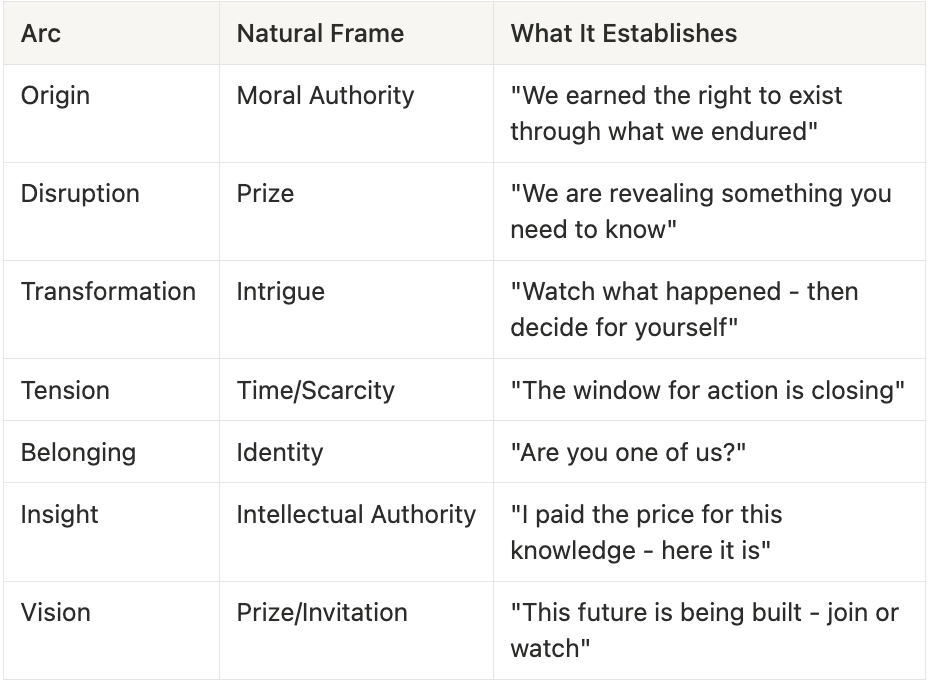
You can deliberately break frame for effect - a founder in a Prize frame who drops into Moral Authority (sharing a personal failure) deepens trust. But an accidental frame break - shifting from Prize to approval-seeking, from Authority to defensiveness - destroys the narrative. Before you speak, three questions: what frame am I setting, what frame are they in, and what frame break (if any) am I using on purpose?
Layer 3: Craft - The Right Story in the Right Clothes
A suit and a wetsuit both cover a human body. They solve completely different problems. The Craft layer puts the right story in the right clothes for the occasion.
Start with tone. Is the voice direct, warm, provocative, authoritative, or vulnerable? An investor in an Analyst frame needs authoritative tone. An employee hearing about a restructuring needs warm tone. Getting this wrong is like wearing a wetsuit to a board meeting.
Then pacing. A LinkedIn post moves fast - each beat is one to three sentences. A keynote moves slowly - each beat is five to ten minutes with room for sub-stories and pauses. A pitch that drags loses the room. A manifesto that rushes feels shallow.
Evidence type matters more than most people think. What counts as proof in the Resolution beat depends entirely on who is listening. Investors want data and comparisons. Customers want testimonials and before/after. Internal audiences want shared experiences and named individuals. Thought leadership audiences want personal experience and counterintuitive data. Chesky used a cereal box as evidence. If he had opened with a spreadsheet, the same information would have landed differently.
Dan Roam’s visual thinking framework is useful here for visual structure. If the story is about “how much,” use a chart. If it is about “where,” use a map. If it is about “how,” use a flowchart. The question is whether the story needs visual support at all, and what kind.
Finally, every format has its own grammar. Here are the ones that trip people up most often:
LinkedIn posts: Hook before the fold line (first two lines visible before “see more”). One idea per post. The Turn should land within the first 100 words. End with a Shift that provokes a comment, not a like. Short paragraphs - one to two sentences each. Prefer prose over bullets unless bullets genuinely reduce cognitive load.
Pitch decks: One claim per slide, narrative flow across the sequence. Title lines should read as a complete story if you read them in order. Never put the Turn on the same slide as the Tension - give the pivot its own slide. Evidence goes in the Resolution slides, not scattered throughout.
Sales emails: Subject line is the Hook, first sentence is the Tension, body is Turn and Resolution, CTA is the Shift. Under 200 words total. If the email works without the subject line, the subject line is wrong.
Keynotes: The Hook is the first 90 seconds - the room decides whether to listen or check their phone. Tension is built through two to four sub-stories that escalate. The Turn is a single moment, delivered slowly. Pause before and after it. Resolution uses the room - eye contact, repetition, questions.
Brand manifestos: Must work read aloud. If a sentence cannot be spoken in one breath, it is too long. Short declarative sentences. The rhythm matters as much as the content.
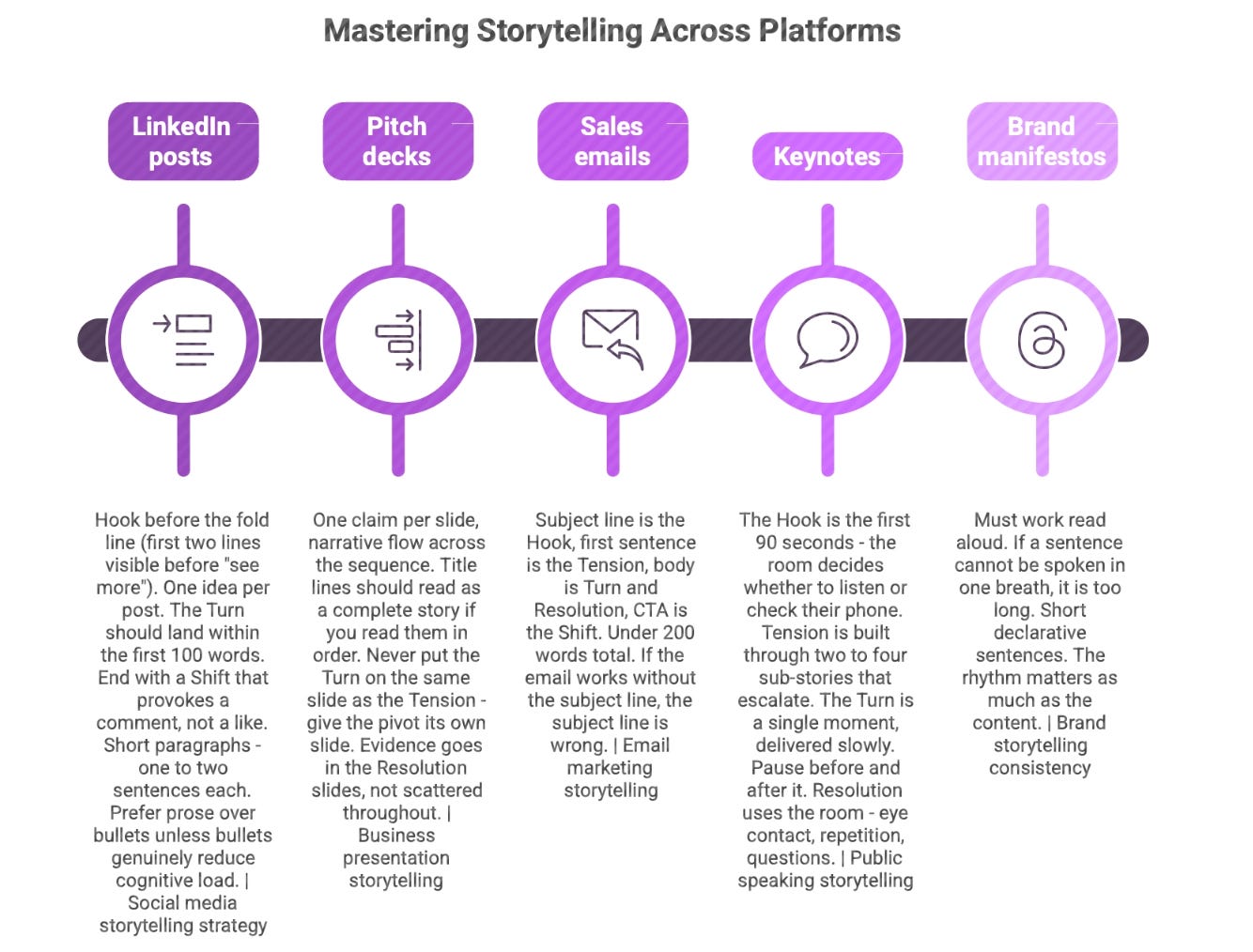
Violating the format grammar distracts from the story, no matter how good the arc is.
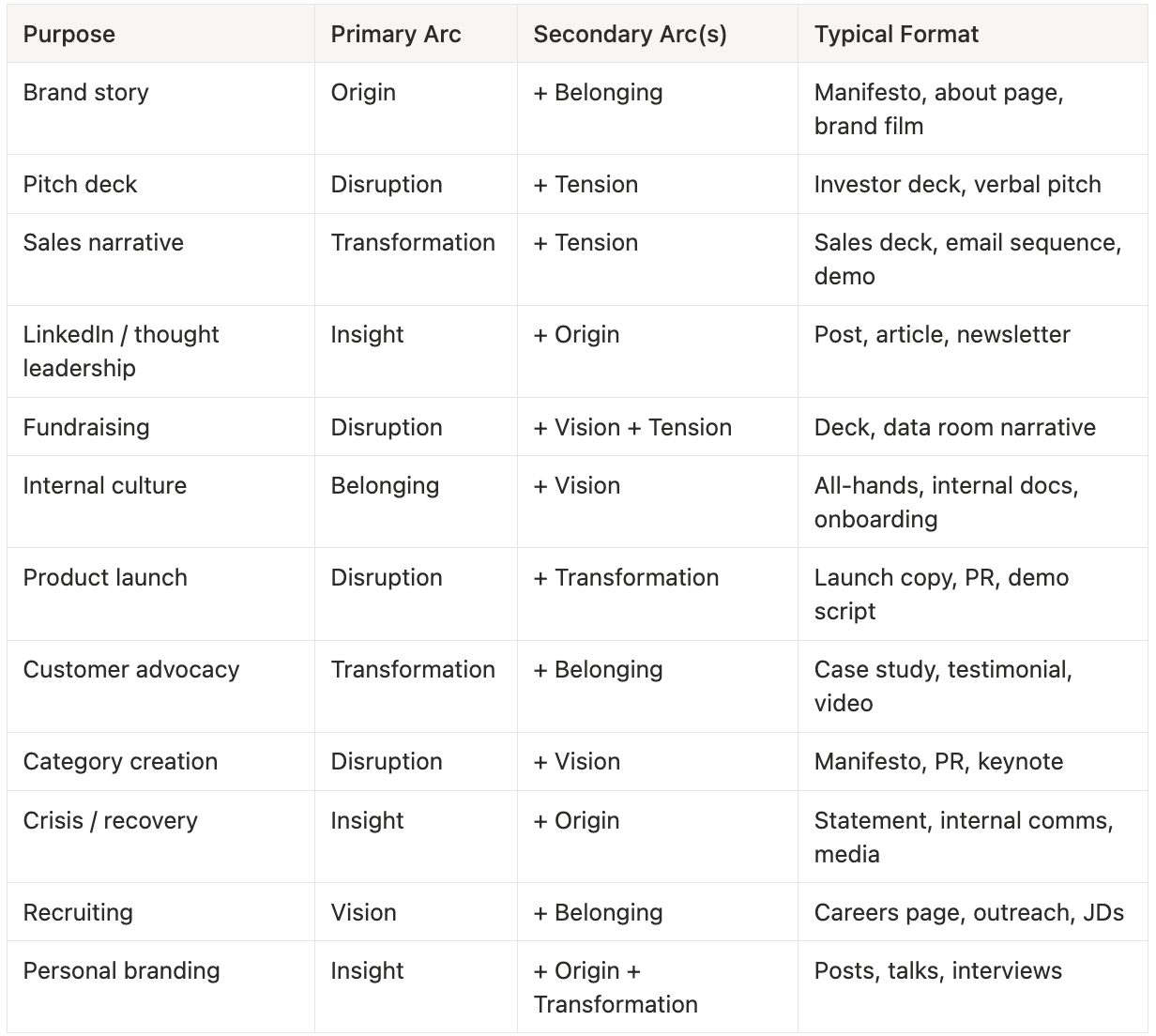
Arc-to-Purpose Mapping
Every business storytelling challenge has a natural arc shape. The primary arc carries the narrative structure. Secondary arcs provide texture - like a musician playing in one key but borrowing chords from another.
ARC in Practice: One Story, Three Layers
Tables are useful. Seeing the tool used is better. Let me walk through a complete diagnosis from scratch.
A D2C founder I know is preparing to raise a Series A. Her product works. Her repeat purchase rate is strong. Her unit economics are solid. She needs 50 crore to scale distribution. She has a deck. The deck is not working.
Layer 1: Audience. The investors she is targeting are institutional VCs who have seen 200 D2C pitches this year. Their current narrative: “D2C is a crowded, low-margin game. Most of these companies will not survive CAC inflation.” Their frame: Analyst, leaning sceptical. I asked her to complete the sentence: “I want them to move from —-____ to ____ . Her first attempt: “I want them to see we are a great company.” That is not a shift. That is a hope. Her second attempt: “I want them to move from ‘D2C is a crowded commodity game’ to ‘there is a structural shift in how Indian consumers buy, and this team has the data to prove they are on the right side of it.’” That is a shift.
Layer 2: Resonance. The arc-to-purpose mapping says fundraising = Disruption + Vision + Tension. Her instinct was to lead with Origin - how she started the company, why she cares. That is the One-Arc Founder anti-pattern. Her origin story is moving. It is also the wrong arc for a room full of Analyst-frame VCs who want to know about the market, not the founder.
Primary arc: Disruption. The dramatic engine: Old World (D2C brands compete on price and paid traffic) → Shift (the move to community-led, repeat-purchase economics) → New World (brands that own their audience own their margins) → Who Wins (this company, because of her specific moat in community infrastructure). Secondary arc: Tension for the close - the window to build this position is narrowing as two incumbents are moving into the space.
Layer 3: Craft. Format: 15-slide investor deck. Tone: authoritative, data-forward - matching the Analyst frame. Evidence type: comparisons and metrics - not testimonials, not personal anecdotes.
The skeleton maps to the slides:
Slides 1-3 (HOOK): “In 2019, the average Indian D2C brand spent 38% of revenue on paid acquisition. In 2025, the top 10 spend 11%. What changed?”
Slides 4-6 (TENSION): The market split. Brands that built owned audiences versus brands that rented traffic. Show the divergence in unit economics. Escalate: the gap is widening every quarter.
Slides 7-8 (TURN): The structural shift - community-led commerce is not a tactic, it is a new category. Name it. Define it. Show why it is irreversible. This is where the Disruption arc earns its weight.
Slides 9-12 (RESOLUTION): Her company’s data. Repeat purchase rate, CAC trend, LTV:CAC ratio, community engagement metrics, the moat, the team, the financials. Data is the evidence type that matches the Analyst frame.
Slides 13-15 (SHIFT): “The question is not whether Indian D2C moves to community-led economics. It is who builds the infrastructure for it. We are raising 50 crore to do that. Here is what we do with it.”
That is ARC applied. Three layers, diagnosed in sequence, executed in the skeleton. The same founder with the same data could have told an Origin story (how she started), a Transformation story (a customer journey), or a Belonging story (join the movement). All would have been true. Only the Disruption arc matches this audience’s frame and creates the specific shift needed to close the round.
She closed in four weeks.
How AI Changes Storytelling
I used AI to help write parts of a brand narrative last year. The output was clean, professional, and structurally sound. I sent it to the founder. She read it and said: “This is fine. It sounds like everyone.” She was right. It was a perfect Data Dump - comprehensive, well-formatted, forgettable. I had outsourced Layer 3 to AI without doing Layers 1 and 2 myself first. The machine produced Craft without Audience or Resonance, and I did not catch it because the writing looked finished.
That experience crystallised something I had been noticing everywhere. AI makes it trivially easy to produce content and almost impossible to produce stories. The distinction matters more now than it ever has.
Before AI, bad storytelling was rate-limited by effort. Writing a pitch deck took weeks. Producing a brand film took months. The effort itself forced a minimum level of thought about audience and structure, because nobody wanted to waste that much time on something that would not land. AI removed the effort. A founder can generate a pitch deck in twenty minutes, a LinkedIn post in thirty seconds, a brand narrative in an afternoon. The constraint that used to force thinking has evaporated. What remains is volume without arc - content that looks professional and says nothing.
The result is a world drowning in Data Dumps. AI’s default output is the Data Dump anti-pattern: comprehensive, well-formatted, forgettable. It produces Craft without Audience or Resonance. It does not know who is reading. It does not know what they believe. It cannot diagnose a frame. It has no theory of what shift is needed. It skips the first two layers entirely and goes straight to production. This is Chesky’s first fifteen pitches at industrial scale.
The danger is subtler than “AI writes badly.” AI writes competently. That is the problem. Competent writing without a story arc is worse than bad writing with one, because it looks finished. It passes the eye test. Nobody flags it for revision. It ships, and it lands with a dull thud that nobody can quite explain. “The deck was fine,” the founder says. “They just didn’t get it.” They got it. There was nothing to get.
Where AI helps is Layer 3 - Craft. Once you have diagnosed the audience, chosen the arc, built the skeleton, and defined the shift, AI accelerates execution dramatically. Drafting, formatting, adapting the same arc across multiple formats, generating variations for testing - these are rotation tasks, and AI compresses rotation time. In my Compounding Framework, I argue that the person who rotates fastest learns fastest. AI makes the rotation faster. But rotation without direction is just spinning.
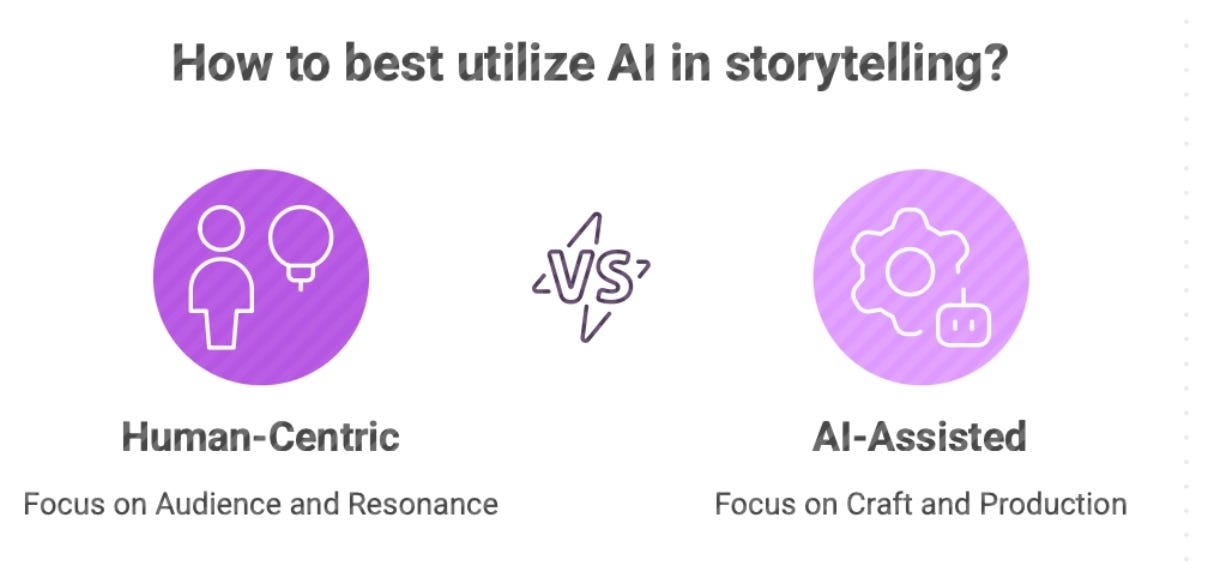
The rule is simple: do Layers 1 and 2 with your brain. Do Layer 3 with whatever tools make you faster. The thinking is yours. The production can be assisted. If you reverse that - letting AI think and doing the production yourself - you get beautiful content that moves nobody.
The Arc of This Article
The first draft of this framework was a Data Dump. Seven arcs listed in order, formula at the top, diagnostics at the bottom. It read like a textbook. I was doing the exact thing the framework warns against: skipping Audience and Resonance and going straight to Craft.
So I diagnosed it. Audience: people sceptical that another framework will change anything. Desired shift: “storytelling is a creative skill” to “storytelling is a diagnostic system I can use on Monday.” Arc: Insight. That is why the failure stories sit right after the model - you get the tool, then you feel the problem it solves.
If the arc worked, you feel it. If it did not, you now have the diagnostic to tell me which layer I got wrong.
Fifteen investors heard Airbnb’s pitch deck and said no. Paul Graham saw a cereal box and said yes. The difference was not the data. It was the arc.
Use ARC as a GPT
If you want help applying this in real time, I built a GPT called ARC for readers of this Substack. It’s free for now and your data is completely private. Try it and tell me what you think.
ARC — Audience × Resonance × Craft
If you found this post valuable, please share it with your networks.
In case you would like me to share a framework for a specific issue which is not covered here, or if you would like to share a framework of your own with the community, please comment below or send me a message
CustomGPT built by asgardlabs.ai.
Check out some of my other Frameworks on the Fast Frameworks Substack:
The Decision Framework: DECIDE
The Alpha Engine Framework for Venture & Angel Investing
Don’t Hire an Agency. Build a Memetic Engine - The memetic engine framework
Fast Frameworks AI Tools: Cortex
The Exponential AI Adoption Framework
Moltbook and the Entity AI Framework
May every sunset bring you peace!
Entity AI, swarms and the future of work (Asymmetric Podcast)
Fast Frameworks Podcast: Entity AI-Episode 8: Meaning, Mortality, and Machine Faith
Fast Frameworks Podcast: Entity AI - Episode 7: Living Inside the System
Fast Frameworks Podcast: Entity AI – Episode 5: The Self in the Age of Entity AI
Fast Frameworks Podcast: Entity AI – Episode 4: Risks, Rules & Revolutions
Fast Frameworks Podcast: Entity AI – Episode 3: The Builders and Their Blueprints
Fast Frameworks Podcast: Entity AI – Episode 2: The World of Entities
Fast Frameworks Podcast: Entity AI – Episode 1: The Age of Voices Has Begun
The Entity AI Framework [Part 1]
The Promotion Flywheel Framework
The Immortality Stack Framework
Frameworks for business growth
The AI implementation pyramid framework for business
A New Year Wish: eBook with consolidated Frameworks for Fulfilment
AI Giveaways Series Part 4: Meet Your AI Lawyer. Draft a contract in under a minute.
AI Giveaways Series Part 3: Create Sophisticated Presentations in Under 2 Minutes
AI Giveaways Series Part 2: Create Compelling Visuals from Text in 30 Seconds
AI Giveaways Series Part 1: Build a Website for Free in 90 Seconds
Business organisation frameworks
The delayed gratification framework for intelligent investing
The Fast Frameworks eBook+ Podcast: High-Impact Negotiation Frameworks Part 2-5
The Fast Frameworks eBook+ Podcast: High-Impact Negotiation Frameworks Part 1
Fast Frameworks: A.I. Tools - NotebookLM
The triple filter speech framework
High-Impact Negotiation Frameworks: 5/5 - pressure and unethical tactics
High-impact negotiation frameworks 4/5 - end-stage tactics
High-impact negotiation frameworks 3/5 - middle-stage tactics
High-impact negotiation frameworks 2/5 - early-stage tactics
High-impact negotiation frameworks 1/5 - Negotiating principles
Milestone 53 - reflections on completing 66% of the journey
The exponential growth framework
Fast Frameworks: A.I. Tools - Chatbots
Video: A.I. Frameworks by Aditya Sehgal
The job satisfaction framework
Fast Frameworks - A.I. Tools - Suno.AI
The Set Point Framework for Habit Change
The Plants Vs Buildings Framework
Spatial computing - a game changer with the Vision Pro
The ‘magic’ Framework for unfair advantage