

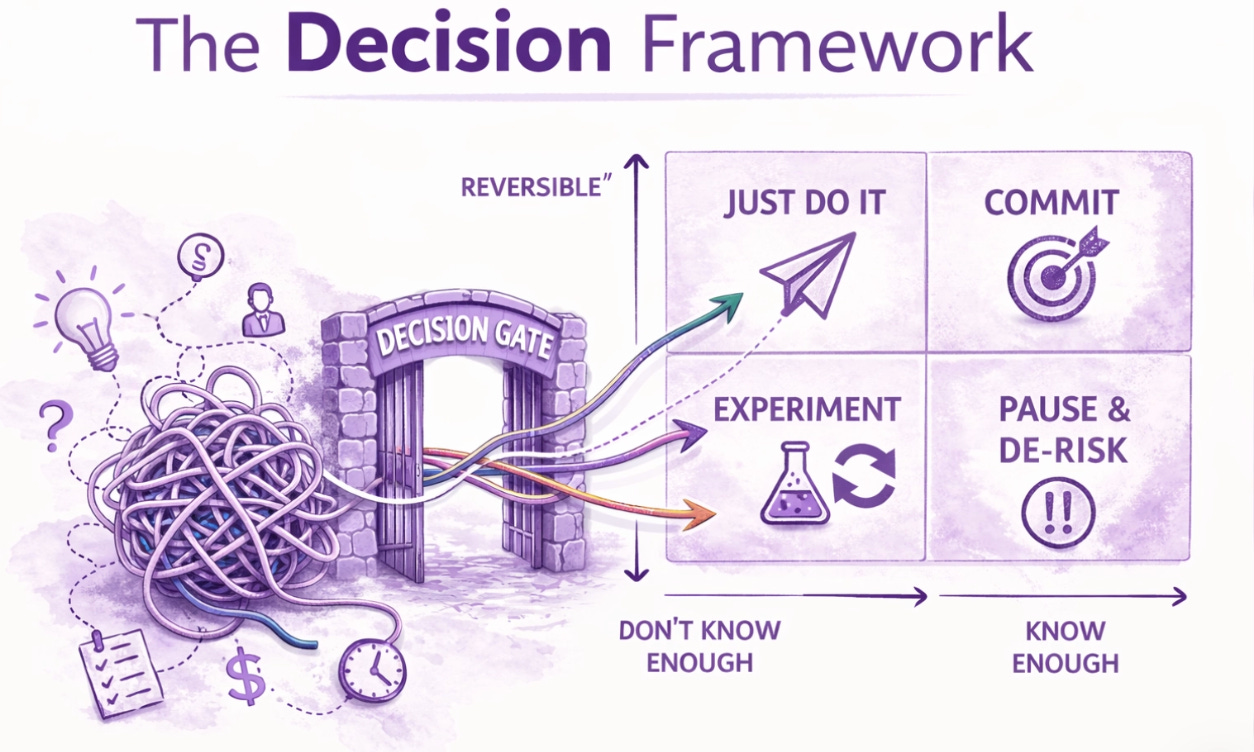
Most people do not have a decision problem. They have a sorting problem. They give the same mental energy to choosing a restaurant as they give to choosing a career move. Then they wonder why they feel exhausted by Tuesday and paralysed by Friday.
AI makes the sorting problem worse. Every new tool brings more options, more notifications, more “would you like to...” prompts. The number of small decisions hitting you every day has doubled, and most of them do not mater at all.
The fix is not “think harder.” It is knowing which decisions deserve thinking at all, and then using the right method for each one. This framework gives you a gate and a grid. The gate keeps most decisions out. The grid tells you what to do with the ones that get through. At the end of this article, you will find a free custom GPT called DECIDE that walks you through the whole process with your own decision.
How It Works
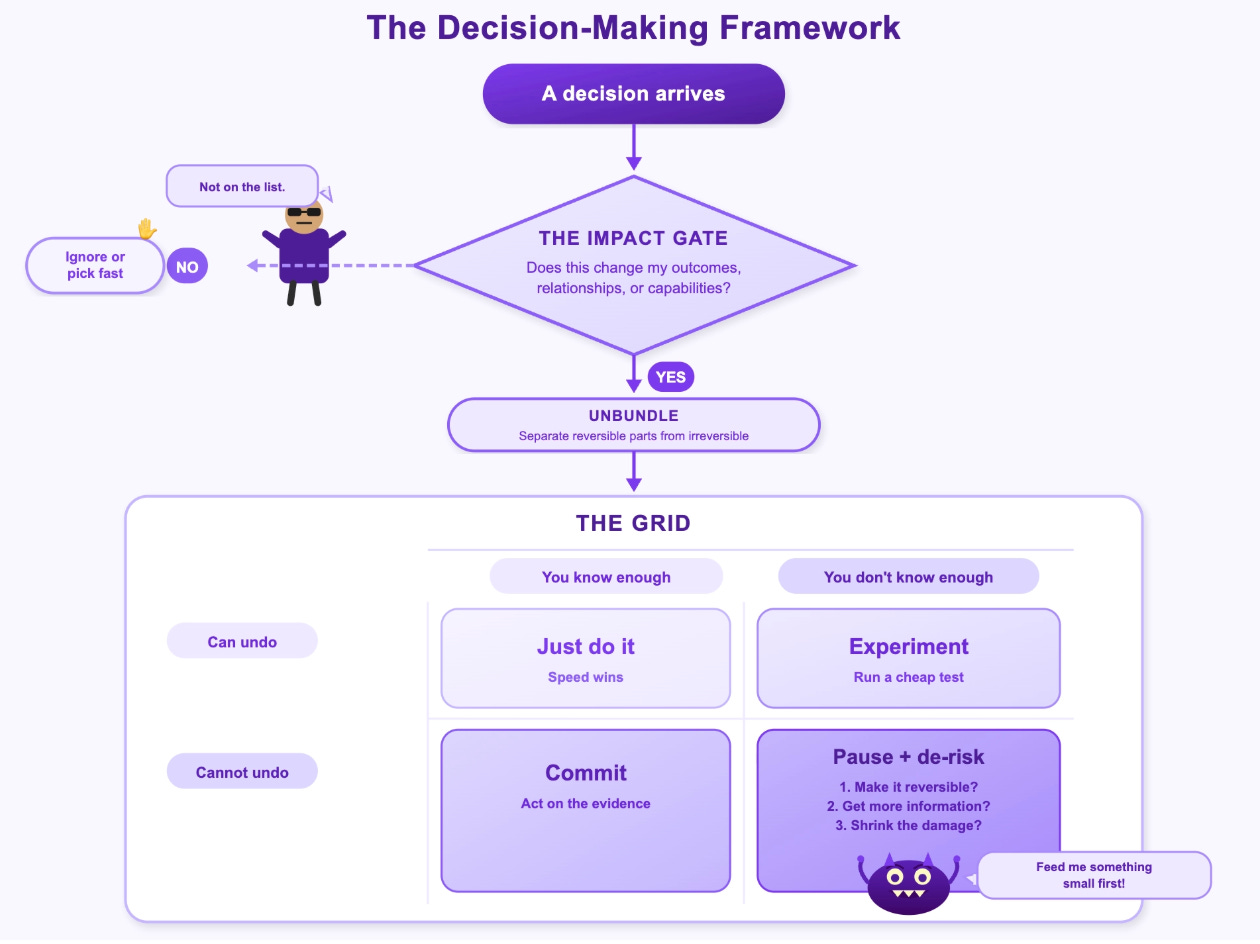
Every decision hits the gate first. The gate asks one question: does this decision change my outcomes, my relationships, or my capabilities? If the answer is no, do not deliberate. Ignore it or pick in under sixty seconds. If the answer is yes, it passes through to the grid.
The grid asks two questions. Can you undo this? And do you know enough? That gives you four boxes:

That is the whole system. Now let us go deeper on each part.
The Impact Gate
The gate is there because most decisions do not deserve your attention.
If it does not need your involvement at all, let it sort itself out or let someone else handle it. If it does need an action from you but none of the three (outcomes, relationships, capabilities) are at stake, pick fast and move on.
The third one (capabilities) matters more than people think. Choosing to let AI write all your emails does not change today’s outcome much. But it erodes a capability you used to have. Some small decisions are bigger than they look, not because of what happens today, but because of what they let atrophy. The gate catches those.
This is the idea behind my Time Mastery Framework. In that framework, I argued that you cannot manage time, only priorities. The system protects your first two hours of the day for your single biggest goal and batches everything else: email gets scanned in thirty-minute windows, meetings need an agenda and a purpose, and only 10% of emails deserve a reply. That system works because underneath it is a decision filter. It sorts the trivial from the meaningful before you waste energy on the wrong pile.
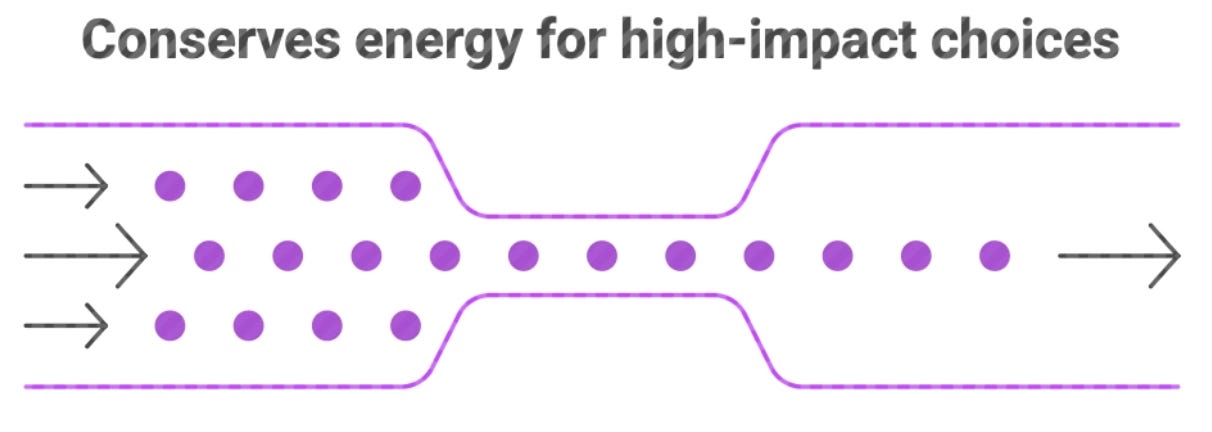
AI makes this gate more important than ever. AI tools throw a blizzard of micro-choices at you: which prompt to use, which suggestion to accept, which of five AI-generated options to pick. None of them matter much on their own, but together they drain the energy you need for the decisions that actually shape your career and life. Treat the gate like a bouncer. Most decisions do not get in.
Before You Use the Grid
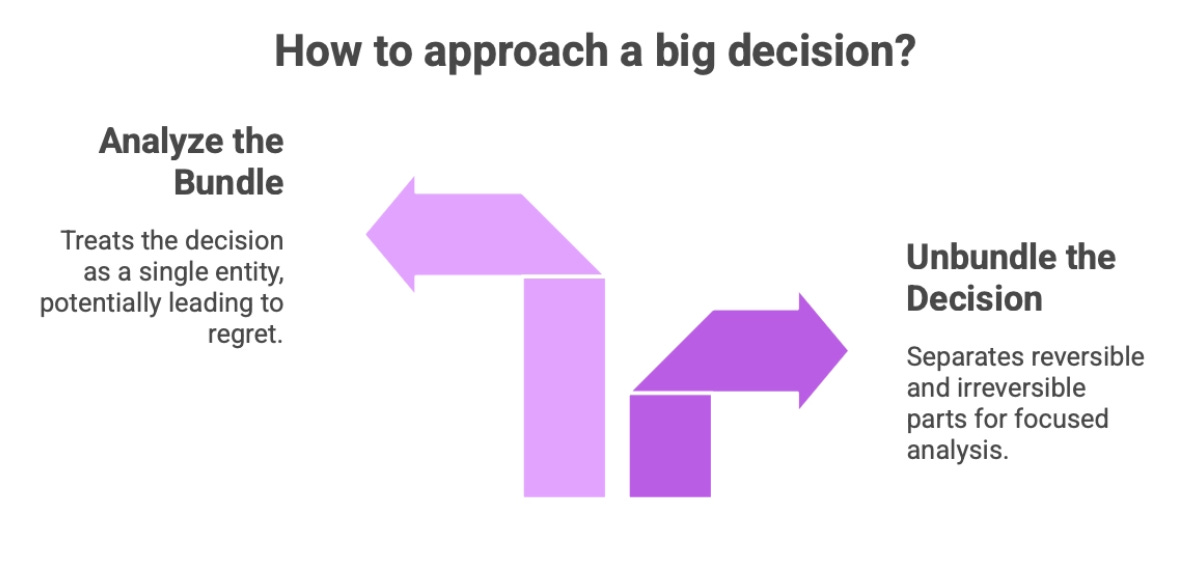
Most decisions are bundles. Leaving a job feels irreversible. But “leaving a job” is actually several decisions bundled together: when to leave, whether to negotiate a return option, how much runway to save, what to do next. Some parts of that bundle you can undo. Some you cannot. The most useful thing you can do with any big decision is unbundle it first. Separate the parts you can reverse from the parts you cannot. Then use the grid on each part, not the whole bundle.
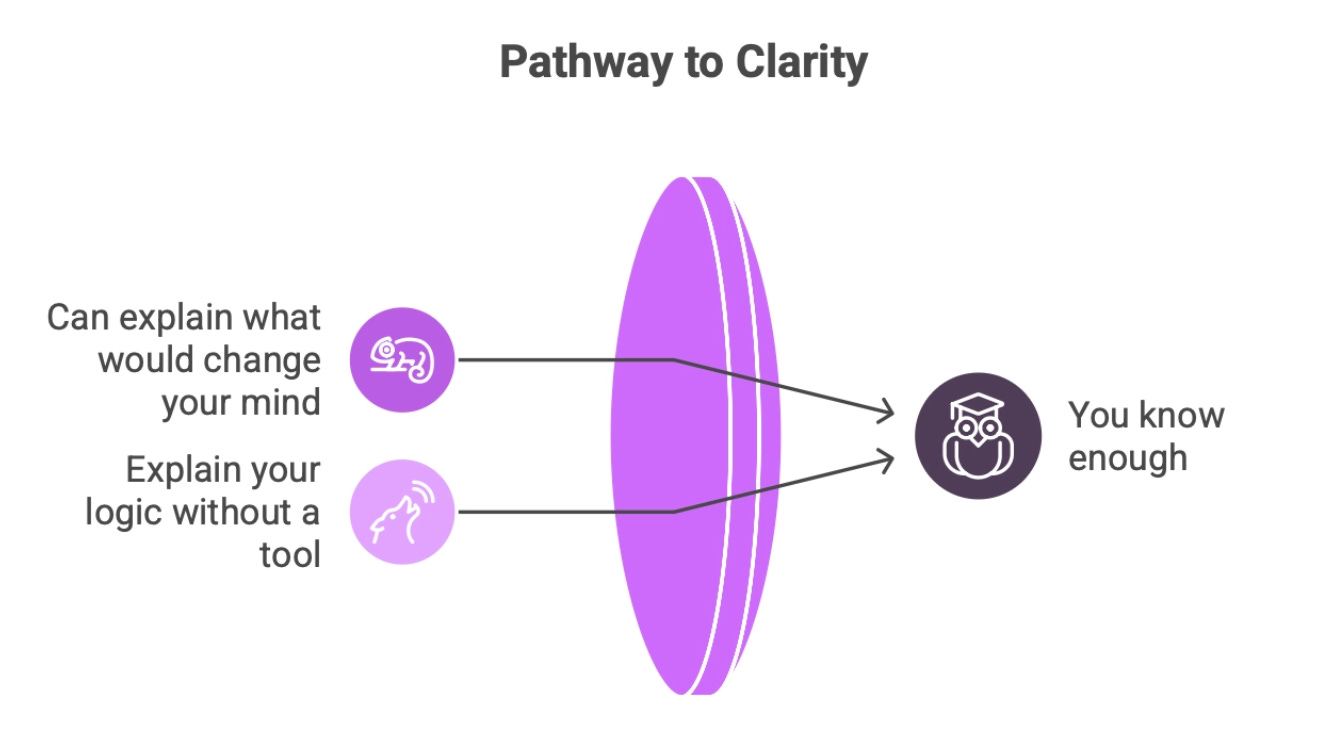
And on information: people are bad at knowing when they know enough. AI makes this worse because it gives you confident-sounding material very fast. One test cuts through the noise: you know enough when you can say what would change your mind, and you could explain that logic without leaning on a tool. If you cannot name the thing that would make you choose differently, you have not actually thought about the decision. And if your explanation starts with "the AI told me," you have information but not understanding. Those are not the same thing.
Where emotions fit: This framework does not ask you to ignore how you feel. It asks you to separate what you feel from what you know. Fear is useful data - it often points at the irreversible parts of a decision you haven’t fully examined. Excitement is useful too - it can signal that you care about the outcome, which means it passes the Impact Gate. The grid does not replace instinct. It gives your instinct something structured to push against. If your gut says “don’t do this” and the grid says “commit,” that tension is worth investigating. Run the pre-mortem. If your gut says “go” and the grid says “pause,” ask yourself whether you are excited about the opportunity or just tired of waiting. Emotions are inputs. They are not the grid.
The Four Boxes
Reversible + You Know Enough: Just do it.
You understand what is going on and you can change course if you are wrong. Speed wins. Most daily work decisions live here: which vendor to trial, which design to test, which meeting format to try. The mistake people make is treating these like they are permanent. They schedule three rounds of review for something they could reverse in an afternoon.
Example: you are choosing between two project management tools. Both have free trials. You have read the reviews. Just pick one and start. If it does not work after two weeks, switch.
Reversible + You Don’t Know Enough: Experiment.
You are in the dark, but the cost of being wrong is small. This is the most underused box. Instead of researching endlessly or asking five more people for their opinion, run a cheap test.
In my Pretotype Framework, I describe a set of techniques for exactly this. A pretotype is not a prototype. A prototype asks “can we build it?” A pretotype asks “should we build it at all?” The idea is to test whether anyone actually cares before you put in real money and time. Put up a fake landing page and see if people click. Deliver the service by hand before you build the software. Run the experiment in one small market before you roll it out everywhere. The goal is not a polished product. The goal is a real answer from real people: did anyone show up, and did they come back?
AI can help you run faster experiments and look at results in hours instead of weeks. The danger is using AI to read about the problem instead of testing it. Going through ten AI-generated reports about whether daily standups work is not an experiment. Trying daily standups for two weeks is.
Example: you are not sure whether your team would benefit from daily standups or weekly syncs. Do not survey them. Do not ask ChatGPT. Try daily standups for two weeks. If it is awful, stop. You have your answer and it cost you nothing permanent.
Irreversible + You Know Enough: Commit.
The evidence is clear and the door only opens once. This is where careful thinking pays off, but only if you actually close the loop and act. The trap here is not recklessness. It is delay. People sit on clear evidence because the decision feels heavy.
Example: you have a job offer with better pay, a role you want, and a company you have looked into properly. Your current company has told you there is no promotion path for two years. The information is as good as it gets. Commit.
Irreversible + You Don’t Know Enough: Pause and de-risk.
The most dangerous box. You cannot undo it and you are guessing. This is where the worst decisions happen, because people either freeze completely or rush because the uncertainty feels unbearable.
The answer is not “decide faster.” It is three questions, in order:
Can you make it reversible? Sign a shorter lease. Negotiate a trial period. Break the deal into stages.
Can you get more information? Talk to three people who have done it. Run the numbers one more time. Ask the question you have been avoiding.
Can you shrink the damage if it goes wrong? Put in a smaller amount. Pilot in one market before going everywhere.
Each question is trying to move you out of this box and into a safer one. Make it reversible and you are in the top row. Get real information and you are in the right column. Shrink the damage and you have turned one big bet into a smaller experiment. The goal is always the same: do not stay here if you can help it.
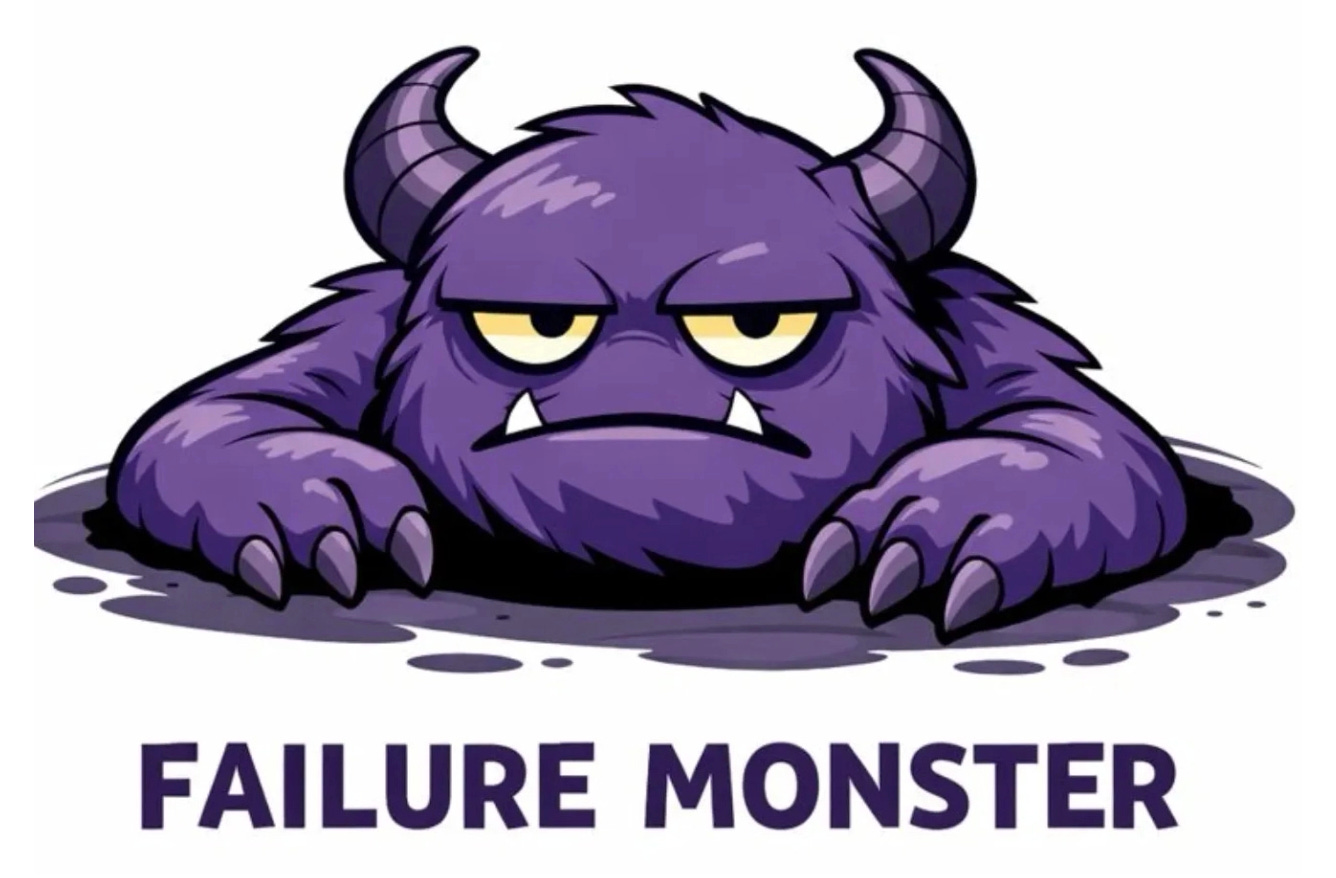
Think of failure as a monster that lives underground. Its job is to eat bad ideas. You are going to meet it eventually. The only question is what you feed it. A cheap experiment from the box above? It eats that and you walk away. A full launch built on guesswork? It eats the budget, the team, the time, and your reputation. AI lets you build bigger, more polished things faster, which means when the monster bites, the meal is bigger too. Feed it something small first.
If the answer to all three questions is no, run a pre-mortem. Assume the decision failed badly. Work backwards. What went wrong? You will see risks you missed because you were too close.
Example: you are thinking about leaving a stable job to start a company, but you have no customers, no co-founder, and no savings that last longer than four months. Before you leap: can you consult part-time first to test the idea? Can you line up three paying customers before you quit? Can you negotiate a six-month break instead of a resignation? Each question moves you toward a better box.
When Timing Puts Pressure on the Grid
The grid tells you the right method. But timing pushes you out of it.
Ask one question: is the clock external or structural?
An external clock is a deadline someone else set. A negotiation that closes Friday. A job offer that expires in 48 hours. A deal with competing bidders. Someone hands you a timer and says decide.
A structural clock is the world moving without you. In my Exponential Growth Framework, I describe how every market, technology, and career follows an S-curve. During the slow crawl at the start, the temptation is to bail. But if the evidence says the basics are sound, you are in the “commit” box, not the “pause” box. Giving up during the crawl is treating a commit decision like an experiment that failed.
During the steep climb, the opposite happens. The market is moving, competitors are grabbing ground, and overthinking puts you back into “pause” when you should be in “just do it.” AI is speeding up S-curves across every industry, which means the steep part arrives sooner and does not last as long.
The advice changes depending on which clock is ticking:
External clock: push back, negotiate more time, or shrink the part you cannot undo. Sign the letter of intent but add conditions. Accept the job but negotiate a trial period. The goal is to buy yourself room to be in the right box.
Structural clock: move, but keep what you can reversible. The world will not wait for your analysis. Make the smallest irreversible bet you can, learn from it fast, and adjust. This is where pretotyping and the experiment box earn their keep.
Both clocks do the same thing: they push you toward committing with less information than you want. The framework does not pretend that pressure disappears. It makes you see clearly whether you are choosing to act or being pushed into it.
When Other People Are Involved
Timing changes which box you are in. Other people change how you work inside it.
A decision that only affects you needs clarity. The same decision affecting a team needs clarity and buy-in. Same box, different work.
A solo decision in the danger box: run a pre-mortem in your own head. A team decision in the danger box: run the pre-mortem with the people who will live with the outcome. Not because they are smarter than you, but because they see risks you do not, and because if it goes wrong, trust is the second casualty after the outcome itself.
A useful rule: if the decision cannot be undone and affects more than just you, the people affected should be in the room before you commit. Not to vote. To stress-test.
Applications
Career: Map your next three decisions onto the grid. Most of them are probably reversible. The one that is not (leaving a job, moving city, starting a company) deserves the full bottom-right treatment: three questions, pre-mortem, and an honest look at what you actually know versus what you are assuming. But before you run the grid, check the wall. In my Ladder and Wall Framework, I describe how most ambitious people do not fail because they cannot climb. They fail because they never chose the wall. The grid tells you how to decide. The wall tells you whether the decision is pointed in the right direction at all. A flawless commit to the wrong career is worse than a messy experiment in the right one. And ask yourself where you sit on the S-curve. If you are in the slow crawl of a new role or industry, patience might be the right call. If the curve is climbing and you are standing still, speed matters more than getting it perfect.
Leadership: Teach your team the four boxes. Most organisations move slowly because they treat reversible decisions as if they were irreversible. If your team needs three sign-offs to change a slide deck, you have a sorting problem. Push reversible decisions down and fast. Save the careful work for the irreversible ones. And watch for AI-generated false confidence: when someone says “I looked into this thoroughly” and means “I asked ChatGPT,” ask them: what would change your mind? If they cannot answer, they do not know enough yet.
Product and innovation: The experiment box is where pretotyping lives. Before you fund the roadmap, build the team, and write the business case, test whether anyone actually wants the thing. A fake landing page costs a weekend. A full product launch costs a year. Feed the failure monster something small before you feed it something big.
Negotiations: Deadline pressure is a weapon in negotiations, and it works because it pushes you into a different box without you noticing. When someone gives you 24 hours to decide, ask yourself: am I in the commit box because the evidence is clear, or am I being pushed there by a clock someone else set? If the answer is the clock, push back or shrink the part you cannot undo.
Parenting: Children need to learn the grid by feel. Let them make reversible decisions early and often (what to wear, what to try, how to spend their pocket money). Protect them from irreversible ones until they can handle the bottom-right box. And resist the urge to let AI answer their questions for them. A child who asks ChatGPT for the answer has information but no understanding. They cannot say what would change their mind because they never built the thinking in the first place.
Daily life: Next time you spend twenty minutes choosing what to order for dinner, remember: you can undo it (order again tomorrow), the stakes are tiny, and you know what you like. Just pick. You are burning decision energy that belongs somewhere else.
I have built a custom GPT called DECIDE (Decision Engine for Clear, Informed, Directed Execution) that walks you through this framework step by step. Give it your decision, your constraints, and whatever data you have. It will run you through the gate, unbundle the parts, place each one on the grid, and hand you back a clear summary with your next step. [Click here to access DECIDE for free for the next week]
If you found this post valuable, please share it with your networks.
In case you would like me to share a framework for a specific issue which is not covered here, or if you would like to share a framework of your own with the community, please comment below or send me a message
CustomGPT built by asgardlabs.ai.
Check out some of my other Frameworks on the Fast Frameworks Substack:
The Alpha Engine Framework for Venture & Angel Investing
Don’t Hire an Agency. Build a Memetic Engine - The memetic engine framework
Fast Frameworks AI Tools: Cortex
The Exponential AI Adoption Framework
Moltbook and the Entity AI Framework
May every sunset bring you peace!
Entity AI, swarms and the future of work (Asymmetric Podcast)
Fast Frameworks Podcast: Entity AI-Episode 8: Meaning, Mortality, and Machine Faith
Fast Frameworks Podcast: Entity AI - Episode 7: Living Inside the System
Fast Frameworks Podcast: Entity AI – Episode 5: The Self in the Age of Entity AI
Fast Frameworks Podcast: Entity AI – Episode 4: Risks, Rules & Revolutions
Fast Frameworks Podcast: Entity AI – Episode 3: The Builders and Their Blueprints
Fast Frameworks Podcast: Entity AI – Episode 2: The World of Entities
Fast Frameworks Podcast: Entity AI – Episode 1: The Age of Voices Has Begun
The Entity AI Framework [Part 1]
The Promotion Flywheel Framework
The Immortality Stack Framework
Frameworks for business growth
The AI implementation pyramid framework for business
A New Year Wish: eBook with consolidated Frameworks for Fulfilment
AI Giveaways Series Part 4: Meet Your AI Lawyer. Draft a contract in under a minute.
AI Giveaways Series Part 3: Create Sophisticated Presentations in Under 2 Minutes
AI Giveaways Series Part 2: Create Compelling Visuals from Text in 30 Seconds
AI Giveaways Series Part 1: Build a Website for Free in 90 Seconds
Business organisation frameworks
The delayed gratification framework for intelligent investing
The Fast Frameworks eBook+ Podcast: High-Impact Negotiation Frameworks Part 2-5
The Fast Frameworks eBook+ Podcast: High-Impact Negotiation Frameworks Part 1
Fast Frameworks: A.I. Tools - NotebookLM
The triple filter speech framework
High-Impact Negotiation Frameworks: 5/5 - pressure and unethical tactics
High-impact negotiation frameworks 4/5 - end-stage tactics
High-impact negotiation frameworks 3/5 - middle-stage tactics
High-impact negotiation frameworks 2/5 - early-stage tactics
High-impact negotiation frameworks 1/5 - Negotiating principles
Milestone 53 - reflections on completing 66% of the journey
The exponential growth framework
Fast Frameworks: A.I. Tools - Chatbots
Video: A.I. Frameworks by Aditya Sehgal
The job satisfaction framework
Fast Frameworks - A.I. Tools - Suno.AI
The Set Point Framework for Habit Change
The Plants Vs Buildings Framework
Spatial computing - a game changer with the Vision Pro
The ‘magic’ Framework for unfair advantage